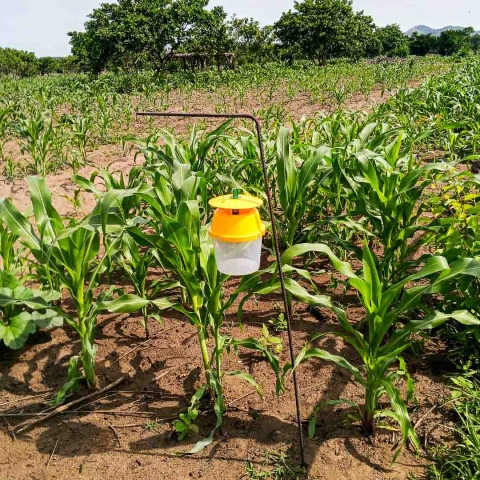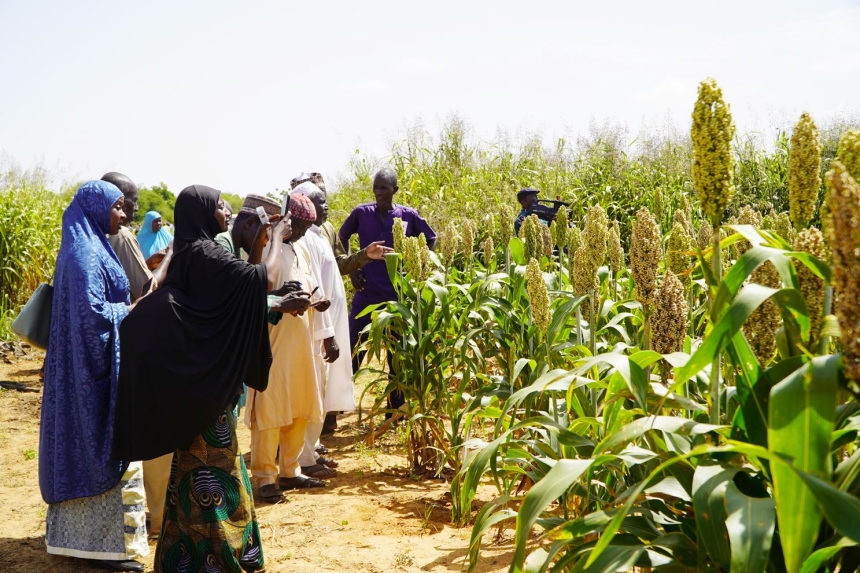
Identifying agricultural solutions capable of simultaneously increasing production, strengthening farmers’ resilience and limiting the environmental impact of agriculture has become a strategic priority for the region. In light of this, CORAF has, as part of the West African Food System Resilience Programme (PRSA/FSRP), scrutinised the most effective agricultural technologies in West and Central Africa.
Climate change is severely undermining agriculture in West and Central Africa, with droughts, erratic rainfall and land degradation threatening the food security of millions of farmers. It is against this backdrop that CORAF, as part of the synergy between the West African Food Systems Resilience Programme (PRSA/FSRP) and the World Bank-funded AICCRA project, has conducted an assessment of the agricultural technologies promoted in the FSRP participating countries. The results are compiled in a series of country briefs entitled “CSA Country Briefs”, covering Niger, Ghana, Senegal, Burkina Faso, Togo, Mali, Sierra Leone and Chad.
The aim of this approach is to draw on robust scientific evidence to provide decision-makers, agricultural advisory and extension services, farmers’ organisations, investors and technical partners with high-performance agricultural technologies to transform food systems in the face of climate change.
Climate-resilient varieties remain the first line of defence
One of the key lessons from this collaborative exercise with the countries is that climate-resilient varieties remain at the forefront of the transformation of agricultural production systems in the sub-region. Nagodé maize and Kogoni rice in Niger, CSIR-AGRA rice or Jasmine 85 in Ghana, etc., these short-cycle, drought-tolerant seeds yield higher harvests, despite the climate.
“CORAF, through these national agricultural research systems and specialist centres, continues to invest heavily in crop breeding as the first line of defence against climate change. The findings of the ‘Country Briefs’ clearly show that investing in crop breeding remains one of the fastest and most effective ways to strengthen agricultural resilience in the region,” explains Dr Moumini SAVADOGO, Executive Director of CORAF.
Each country is charting its own path to resilience with technical support from CORAF
These country studies also reveal that there is no ‘miracle’ technology that applies across the whole of West and Central Africa. Technological solutions depend on the agro-ecological, economic and social realities of each country.
In Senegal, the most promising innovations include improved varieties of rice, millet, groundnuts and fonio, combined with sustainable soil management techniques such as rapid composting, deep urea application or small-scale agricultural improvements for better water management at plot level, such as...... In Burkina Faso, technologies for restoring degraded land – such as the ‘zaï’ method, half-moon plots, assisted natural regeneration (ANR) and stone ridges – are among the most effective solutions for tackling declining soil fertility and erratic rainfall. In Sierra Leone, the most promising innovations combine light mechanisation, efficient irrigation and market gardening technologies adapted to new climatic conditions.
Climate-smart agriculture is not based on a standardised model but on solutions tailored to local realities
“These ‘Country Briefs’ show us that West and Central Africa are not short of solutions. The region already has a portfolio of scientifically validated agricultural technologies. Our responsibility now is to scale these up so that they can benefit millions of farmers,” explains Dr Niéyidouba LAMIEN, Programme Manager at CORAF and Coordinator of Component 2 of the FSRP programme.
Technologies must be promoted as integrated packages
One of the key findings of these country analyses is that no single technology, taken in isolation, can address the challenges of climate change on its own. The best results are observed when several complementary innovations are combined in the form of technology packages. The Country Briefs therefore propose country-specific technology packages not only to accelerate the uptake of these technologies but, above all, to strengthen the resilience of these countries’ agricultural systems.
In Ghana, for example, experts recommend combinations that pair CSIR-AGRA or Jasmine 85 rice varieties with biochar, minimum tillage and appropriate mechanisation. In Niger, the most effective packages combine improved varieties, animal traction, post-harvest equipment and the utilisation of agricultural residues.
In Chad, irrigation infrastructure, integrated crop-livestock farming systems, Climate-Smart Villages, agroforestry and Assisted Natural Regeneration are emerging as the most promising technologies for strengthening the resilience of local areas.
“No single technology is sufficient on its own. It is the combination of improved varieties, sustainable soil management, appropriate mechanisation and climate services that builds resilience. The FSRP invests specifically in these climate-smart packages, tailored as closely as possible to the realities of each country,” continues Dr Niéyidouba LAMIEN.
Resilience is now built through a combination of several technologies. Improved varieties remain essential, but they are now reinforced by complementary approaches: the real-time use of climate information, land restoration techniques, agroforestry, integrated crop-livestock systems, the use of biofertilisers and biopesticides, smart water management techniques, and the use of digital tools. This development is fuelling a new strategy for guiding agricultural investment based on triple-centric scientific evidence, focusing not only on yields but, above all, on strategies for adapting to climate change and the sustainability of food systems.
The essential scale-up
Beyond identifying and prioritising the most effective technologies, these country studies all reach the same conclusion and call for action: scaling up these technology packages to enable mass adoption. Indeed, the real challenge now lies in the widespread dissemination of these technologies to farmers through more effective agricultural advisory systems, improved access to credit, tailored incentive mechanisms, accessible climate services and stronger links between research, extension services and farmers’ organisations.
By making these Country Briefs openly available to all, CORAF aims to equip decision-makers, investors, agricultural advisory staff and farmers so that these innovations can benefit millions of farmers in West and Central Africa.
Find out more here:
Country Brief - Climate-smart characteristics of the FSRP agricultural technologies in Burkina Faso.
Country Brief - Climate-smart characteristics of the FSRP agricultural technologies in Mali
Country Brief - Climate-smart characteristics of the FSRP agricultural technologies in Niger
Country Brief - Climate-smart characteristics of the FSRP agricultural technologies in Senegal
Country Brief - Climate-smart characteristics of the FSRP agricultural technologies in Sierra Leonne
Country Brief - Climate-smart characteristics of the FSRP agricultural technologies in Tchad
Country Brief - Climate-smart characteristics of the FSRP agricultural technologies in Togo