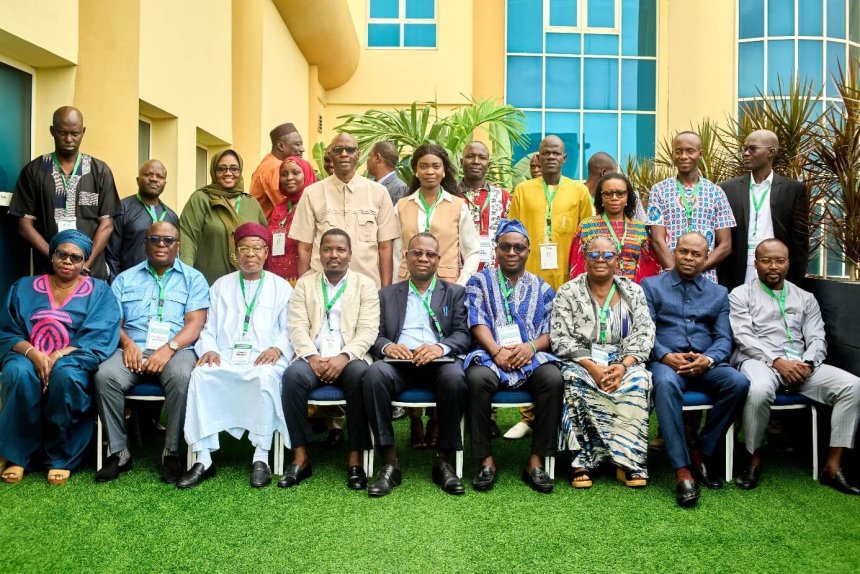
In the face of climate challenges, strategic crops such as rice must adapt to ensure the resilience of agricultural production systems. With this in mind, CORAF, in partnership with the Bioversity International Alliance and CIAT, through the AICCRA (Accelerating the Impact of CGIAR Climate Research in Africa) AfricaRice project, and the West African Food System Resilience Programme (FSRP), organised a regional workshop from 26 to 28 August 2024 in Cotonou/Benin to discuss innovations and technologies capable of strengthening the resilience of rice-growing systems in West and Central Africa.
Dr Elliot Dossou-Yovo, AICCRA Mali Coordinator, presented the various proven technologies available to the participants, in particular the Country Coordinators, rice specialists and agricultural advisors from the FSRP implementation countries, stressing the need to create effective mechanisms for their large-scale adoption. Several of the climate-smart technologies and innovations identified have demonstrated their potential to optimise production while taking climate constraints into account. Examples include RiceAdvice, Smart-Valleys, alternative wetting and drying (AWD), the integrated rice-fish system, Pay as you go and climate-resilient rice varieties. These innovations are crucial to improving the resilience of farming systems, boosting productivity and guaranteeing food and nutritional security for millions of people in the region.
"In the rice value chain, several technologies, innovations and research knowledge have been developed and deployed in the countries. These innovations need to be scaled up in order to reach and have a positive impact on the final beneficiaries, i.e. family farms", said Dr. Angelo DJIHINTO, representing INRAB at the opening of the workshop.
"General awareness of climate change has led to the development of a number of climate-smart approaches and technologies, which unfortunately remain unknown to the general public, particularly in the agricultural sector. Their widespread adoption is vital for the resilience of our food systems," emphasised Dr Komla Kyky Ganyo, CORAF's FSRP technical assistant.
For Dr Alcade Segnon, researcher at the Bioversity International and CIAT Alliance and West Africa scientific manager for the AICCRA project, "it is essential to disseminate these technologies on a large scale for the benefit of African producers".
Funded by the World Bank and implemented by the Bioversity International Alliance and CIAT, the AICCRA project aims to promote the adoption and use of climate-smart agricultural technologies and innovations, as well as climate information services. In West Africa, the aim is to ensure that these technologies and innovations can be taken to scale through multi-stakeholder partnerships. The World Bank-funded West Africa Food System Resilience Programme (WAFRSP), which is being implemented in 9 countries, is seen as an ideal channel for this large-scale dissemination of technologies in the rice value chain. This workshop aims to inform FSRP stakeholders about these available technologies and to define actions for their adoption in the region.
At the end of the presentations, the participants identified key activities, recommendations for PRSP implementing countries and the best strategies for disseminating these technologies to farmers, with particular emphasis on family farms, which account for a large proportion of rice production in the region.
"We were very interested in the Smart-Valley technology because it requires the mobilisation of the entire community, especially women. On our return to Mali, we will be raising awareness among the stakeholders so that we can implement this innovation in Mali", said Sory Ibrahim Konaté from the FSRP Mali team.
The workshop also produced a clear roadmap for the use and scaling-up of climate-smart technologies in the rice value chain. This roadmap includes concrete actions to strengthen the adoption of technologies in FSRP implementing countries.