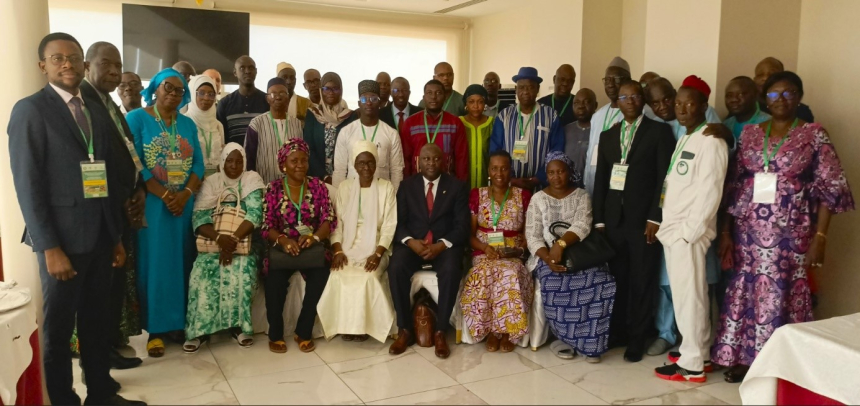
This consultation, organised by the Economic Community of West African States (ECOWAS) Commission, provided a framework for an institutional and organisational self-diagnosis of existing and emerging cross-border agri-food inter-professional structures in West Africa, incorporating gender issues and environmental and social safeguards.
Some forty representatives of inter-professional agri-food organisations took part in the conference, held from 31 October to 3 November 2023 in Dakar/Senegal, to discuss the promotion of inclusive regional trade in agri-food products generated by local businesses.
Over four days of discussions, the players and partners in the intra-regional agri-food market used the Strengths, Weaknesses, Opportunities and Threats (SWOT) and Political, Economic, Social, Technological, Ecological and Legal (PESTEL) tools to identify the current challenges facing inter-professional organisations, which are hampering their operation and impacting on the achievement of their objectives.
The Dakar regional meeting was part of the implementation of the West Africa Food System Resilience Programme (FSRP), financed by the World Bank and coordinated by ECOWAS, CILSS and CORAF, which is currently benefiting 7 countries (Burkina Faso, Chad, Ghana, Mali, Niger, Sierra Leone and Togo). The ECOWAS Agricultural Trade Programme (EAT) also took part.
In West Africa, agricultural production has increased significantly in recent years, but marketing is still weak.
The representative of the ECOWAS Directorate of Agriculture and Rural Development at the meeting, Dr Bio Soulé GOURA, stressed the importance of agricultural markets in the West African economy: "The market ensures and facilitates access to food by transferring goods, products and services between producers, distributors, manufacturers and consumers. It is therefore the primary guarantor of food and nutritional security for populations".
In fact, in the sub-region, the functioning of the market, in particular trade in foodstuffs, both at national and cross-border level, is important, with enormous potential, but has many imperfections that prevent it from playing its role as guarantor of coordination of the economy, and guarantor of the food and nutritional security of the population.
This is why the results of the Dakar meeting are eagerly awaited, as underlined by the Secretary General of Senegal's Ministry of Agriculture, Rural Equipment and Food Sovereignty, Malick N'DAO. Malick N'DAO, Secretary General of Senegal's Ministry of Agriculture, Rural Equipment and Food Sovereignty. "The results of this consultation will fill a gap and enable countries to strengthen intra-regional trade in our sub-region, especially as official statistics show that trade in agri-food products only represents around 20 to 25% of the value of intra-regional trade, which in turn only represents around 15% at most of the region's overall trade transactions.
The partner actors present drew up priority action plans to strengthen the achievements and correct their weaknesses through key activities to be carried out in the short, medium and long term. The PRSF at regional and country level will take into account a number of activities in its 2024 Work Plan and Budget (WBP) to help strengthen these key partners in order to boost intra-regional trade in West Africa.
The Dakar meeting is therefore a first step towards meeting the many challenges involved in creating a genuine intra-regional market for the benefit of players and partners in the agri-food sector.