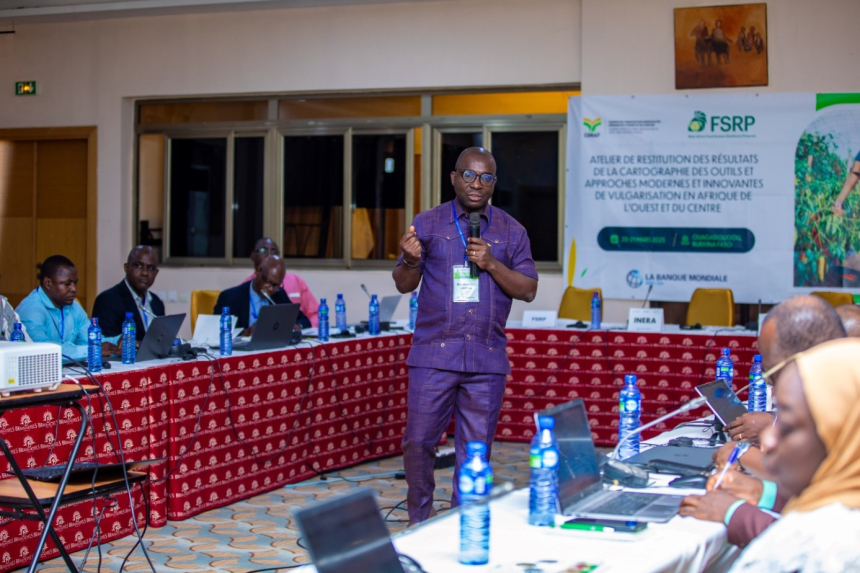
As part of the activities relating to the sustainability and adaptation of the productive base of the West Africa Food System Resilience Programme (FSRP), coordinated by the West and Central African Council for Agricultural Research and Development (CORAF), a workshop to present the results of a study was held on 20 and 21 March 2025 in Ouagadougou, Burkina Faso.
This event was an opportunity to share the results of a mapping exercise of modern and innovative agricultural extension tools and approaches in West and Central Africa, in collaboration with the Rural Advisory Services Network in West and Central Africa (RESCAR-AOC).
Agricultural extension services play a central role in disseminating innovations and good farming practices. However, these services are often ineffective, limited in their geographical coverage and poorly adapted to the specific needs of farmers. In the face of growing climatic and economic challenges, the adoption of new technologies and farming practices is crucial to strengthening the resilience of farms. This study has helped to fill these gaps by identifying and disseminating the best extension approaches.
For two days, heads of extension services from FSRP member countries, researchers and experts in agricultural innovation, representatives of NGOs and civil society organisations and private sector players involved in the provision of agricultural services discussed the directory of tried and tested agricultural advisory tools and approaches: a detailed mapping of initiatives that have demonstrated a significant impact in different agro-ecological contexts.
The work enabled successful cases to be identified and best practices to be shared, with a view to highlighting successful experiences and encouraging their replicability.
Together, the stakeholders and partners have drawn up a roadmap for the modernisation of extension services, which will now have to incorporate digital tools and participatory approaches for more effective and accessible extension.
By encouraging dialogue and pooling expertise, this meeting laid the foundations for structuring a new dynamic in farm advisory services, based on modern methods and adapted to the realities of producers.
The initiative supported by CORAF and RESCAR-AOC should lead to a significant transformation of agricultural extension services. The integration of digital technologies, the training of extension agents in new approaches and the increased involvement of the private sector are all levers for guaranteeing wider and fairer access to agricultural advisory services.