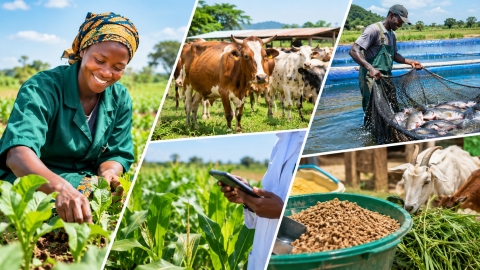
In Sierra Leone, women and young people play a crucial role in vegetable production, making a significant contribution to the country's food system. However, despite the growing demand for vegetables, in particular onions, which are a staple in local cuisine, women farmers often face considerable barriers to their potential. The Food System Resilience Programme (FSRP) has stepped in to bridge this gap, empowering women farmers to break the cycle of poverty through improved vegetable growing practices.
Supported by collaborations with the World Bank, the Government of Sierra Leone and the Global Agriculture and Food Security Programme, the FSRP provides vital resources such as seeds, fertilisers, compost manure, tools, greenhouses and irrigation infrastructure, as well as training. This support aims to boost the production and productivity of women farmers, who are often hampered by limited access to quality seeds, land, finance and adequate storage facilities.
 These difficulties have been compounded by climatic conditions that make market gardening costly and unpredictable. During the COVID-19 pandemic, the situation worsened considerably. With the price of onions rising from 17 to 40 dollars per 50 kg, the government suffered considerable losses, spending over 20 million dollars a year to import onions. This crisis highlighted the urgent need to invest in local agriculture in order to stabilise the food supply and protect consumers.
In response, the FSRP implemented its contingent emergency response component (component 4) from 2023 to 2024, providing free support to 15,580 women and youth farming households. This initiative facilitated land preparation, provided high-quality seeds, fertilisers, compost manure, extension services and established market access. More than 430 hectares of onions and 30 hectares of various vegetables (cabbage, lettuce, tomatoes, peppers, etc.) have been grown in four districts: Port Loko, Koinadugu, Western Rural and Moyamba. As a result, local onion prices have begun to stabilise, enabling farmers to earn an income and provide for their families.
Thaio Kamara, a farmer in the Koinadugu district, shared her experience: "COVID-19 has taught me a lot. Before the crisis, I didn't understand the importance of obtaining high-quality seeds and planting beyond my small plot. With the FSRP, I've made a big change in my life - I got more than 50 50 kg bags at my first harvest and I sold them to extend my farmland, I now have seeds, money and knowledge to develop my farming activity".
When the emergency phase ended in early 2025, the project changed the approach to its support, focusing on creating links between farmers and the private sector to support production. The project has partnered with PC & Son, a major onion importer, to involve FSRP farmers as outgrowers, ensuring a sustainable investment in the sector. In addition, a Memorandum of Understanding has been signed with PC & Sons to facilitate the training of PRSP beneficiaries and enable them to develop their onion farms for consumption and commercial markets.
Lungi, an onion production centre in the Port Loko district, is an excellent example of the impact of the PRSF. Thanks to the assistance provided to over 500 farmers, almost all the households are involved in market gardening, mainly to supply the capital, Freetown. Mary Mani, one of the beneficiaries, told us her story: "My husband is retired, and we have three children. I met the FSRP in 2023, when the country was recovering from the impact of COVID-19, the vegetable sector had dried up and onions had become a luxury product for most households. That year, the FSRP provided me with inputs (seed, fertiliser and compost manure) and extension services that considerably increased my productivity and household income. Previously, growing onions was difficult and I struggled to make a profit. This year, I harvested more than 200 bags of onions thanks to the FSRP, the Sierra Leone government and the World Bank. I now own a house and have the means to provide for the basic needs of my household thanks to onion growing".
With the emergency phase due to end in 2025, the PRSP's Global Agriculture and Food Security Programme (GAFSP) will take over, continuing to help farmers prepare land and provide fertilisers, seeds and greenhouses to more than 16,500 people in eight districts: Bonthe, Pujehun, Koinadugu, Kambia, Western Rural, Moyamba, Tonkolili and Port Loko.
In the future, the project sees market gardening as a year-round opportunity, fuelled by persistent demand from urban consumers. The women farmers are planning to invest in this sector, particularly through improved access to irrigation. To this end, the FSRP has partnered with UNOPS to develop solar wells and is also setting up 15 weather stations through the Sierra Leone Meteorological Agency to provide weather updates to farmers. In addition, partnerships with telecommunications providers are planned to provide early warning messages, which will further strengthen the resilience of these vital farmers.
The FSRP represents a transformative step towards gender equality and economic empowerment in Sierra Leone, enabling women farmers to realise their potential and contribute to a more stable and sustainable agricultural sector. Through collaborative efforts and targeted support, we can pave the way for a prosperous future where women flourish and the chains of poverty are broken for good.