Senegal's Food System Resilience Programme (FSRP) continues to move towards the operationalisation of the matching grant mechanism. Following the national information and awareness-raising tour organised in Senegal's thirteen (13) regions, the momentum is now well underway. Private promoters, producers, livestock farmers, young people and women, as well as technical services and local authorities, have mobilised strongly to seize the opportunities offered by the programme. To date, more than ten thousand (10,000) sub-project submission files have already been registered.
Beyond the figures, the tour revealed an unprecedented mobilisation of communities, technical services and local authorities. The FSRP Matching Grant is now establishing itself as a concrete and inclusive tool, promoting the participation of women, young people and private entrepreneurs.
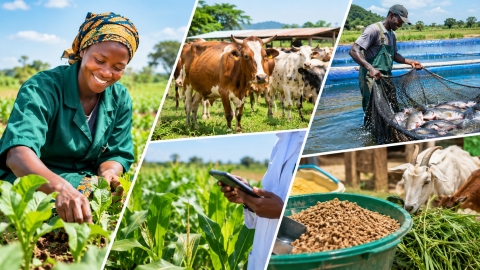
The FSRP Senegal's cost-sharing financing is an innovative mechanism that supports producers, livestock farmers, young entrepreneurs, SMEs and cooperatives through three (03) windows tailored to their needs.
The first window targets small sub-projects with a 70% grant (and up to 80% for women and young people) to facilitate access to inputs, water, infrastructure, energy and basic equipment.
The second supports SMEs and young people with innovative agricultural processing, production, storage or service projects, with a contribution of 50% of the investment.
Finally, the third window supports larger-scale projects with a 30% subsidy, promoting the modernisation and competitiveness of the agro-sylvo-pastoral sector.
A national dynamic set in motion after the FSRP information tour
The FSRP management unit, accompanied by its strategic partners, namely the Rural Sector Development Support Fund (FADSR) and the Livestock Fund (FONSTAB), met with key stakeholders in the 13 regions to provide information and widely publicise the mechanism, but also and above all to mobilise citizens around the windows, eligibility criteria and submission procedures.
To reach as many people as possible, the communication strategy combined information sessions, targeted meetings, appearances in the national media – television, radio, print and online press, programmes in local languages on community radio stations – and an active presence on social media. This multi-channel approach helped to strengthen support and clarify the conditions for accessing funding. The stakeholders met committed to acting as relays in their respective territories so that no one would be left out of the process. In addition, the PMU held a series of consultations with value chain stakeholders, including onion producers' and processors' associations and the poultry industry association, to gather information on their issues with a view to better addressing their constraints.
Tangible results: More than 10,000 applications already received
At the end of the tour, the conclusion is clear: local communities are mobilised, regional technical services are playing their role to the full, and a continuous flow of sub-project files testifies to the relevance of and support for the mechanism.
The initial results are encouraging. Decentralised technical services are regularly receiving sub-project files. Following the publication of calls for projects for windows 2 and 3, more than ten thousand (10,000) applications have already been received by the Departmental Services for Agriculture and Livestock. These structures provide an initial compliance filter before transmission to the National Committee, which will decide on the eligibility of the first beneficiaries.
This momentum demonstrates the stakeholders' ownership of the mechanism, but also the confidence placed in the FSRP as a lever for the revival and modernisation of the agro-sylvo-pastoral sector.
Beyond the figures, the tour revealed an unprecedented mobilisation of communities, technical services and local authorities. The FSRP Matching Grant is now establishing itself as a concrete and inclusive tool, promoting the participation of women, young people and private entrepreneurs.