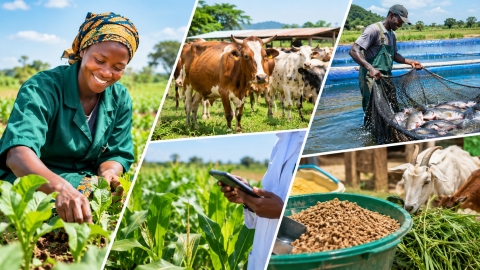
Senegal: Modern agricultural farms, development work officially launched in Taif, Mbayenne and Niakhène

Published on 14 March 2026

As part of the programme to develop 1,000 hectares of modern farms for community agricultural cooperatives, the FSRP-SN officially handed over the sites in February to the companies responsible for the development work in the municipalities of Taif (Diourbel region) and Mbayenne and Niakhène (Thiès region).

The handover of the sites to the contractors took place in the presence of administrative and local authorities, decentralised technical services, beneficiaries and representatives of the cooperatives, who contributed to the mobilisation and securing of land rights for the sites.

Divided into 50 farms of 20 hectares each, they are subdivided into 1-hectare plots, intended primarily for young people and women agripreneurs, with a view to promoting agricultural entrepreneurship and revitalising the rural economy.

The development works include the drilling of boreholes, the installation of modern irrigation systems (centre pivot, drip and sprinkler), the construction of water storage tanks, agricultural greenhouses, and multi-purpose buildings for the cooperatives. The sites will also be secured by fencing and equipped with infrastructure for livestock farming (poultry, sheep and goat rearing).

The pumping system will rely primarily on solar and thermal energy (with a backup generator), reducing operating costs and the carbon footprint.

In parallel, a support mechanism for development will be rolled out, providing agricultural advisers and training sessions to guide beneficiaries towards efficient and sustainable farming practices.

Led by the Ministry of Agriculture, Rural Infrastructure and Food Sovereignty, this initiative aims to modernise agricultural production, create jobs for young people and women, and strengthen Senegal’s food sovereignty.

A breath of fresh air for producers

At the handover of the sites, representatives of the cooperatives and producers expressed their enthusiasm and hope regarding these transformative investments, which are expected to bring about a lasting change in agricultural production conditions in these localities.

For many young people and women in rural areas, these modern farms represent a concrete opportunity to access land, modern equipment and sustainable incomes.

The implementation of this infrastructure will be overseen by ANIDA, in close collaboration with administrative and local authorities, decentralised technical services (DRDR, ANCAR, SDDR, DREEC, etc.) and producer organisations.

Through this initiative, the FSRP in Senegal is actively contributing to the modernisation of agriculture, strengthening the resilience of food systems and accelerating the achievement of food sovereignty in Senegal.

Senegal: Strong mobilisation of regional stakeholders following the FSRP's national tour on Matching Grant

Published on 7 September 2025

Senegal's Food System Resilience Programme (FSRP) continues to move towards the operationalisation of the matching grant mechanism. Following the national information and awareness-raising tour organised in Senegal's thirteen (13) regions, the momentum is now well underway. Private promoters, producers, livestock farmers, young people and women, as well as technical services and local authorities, have mobilised strongly to seize the opportunities offered by the programme. To date, more than ten thousand (10,000) sub-project submission files have already been registered.

Beyond the figures, the tour revealed an unprecedented mobilisation of communities, technical services and local authorities. The FSRP Matching Grant is now establishing itself as a concrete and inclusive tool, promoting the participation of women, young people and private entrepreneurs.

The FSRP Senegal's cost-sharing financing is an innovative mechanism that supports producers, livestock farmers, young entrepreneurs, SMEs and cooperatives through three (03) windows tailored to their needs.

The first window targets small sub-projects with a 70% grant (and up to 80% for women and young people) to facilitate access to inputs, water, infrastructure, energy and basic equipment.

The second supports SMEs and young people with innovative agricultural processing, production, storage or service projects, with a contribution of 50% of the investment.

Finally, the third window supports larger-scale projects with a 30% subsidy, promoting the modernisation and competitiveness of the agro-sylvo-pastoral sector.

A national dynamic set in motion after the FSRP information tour

The FSRP management unit, accompanied by its strategic partners, namely the Rural Sector Development Support Fund (FADSR) and the Livestock Fund (FONSTAB), met with key stakeholders in the 13 regions to provide information and widely publicise the mechanism, but also and above all to mobilise citizens around the windows, eligibility criteria and submission procedures. 

To reach as many people as possible, the communication strategy combined information sessions, targeted meetings, appearances in the national media – television, radio, print and online press, programmes in local languages on community radio stations – and an active presence on social media. This multi-channel approach helped to strengthen support and clarify the conditions for accessing funding. The stakeholders met committed to acting as relays in their respective territories so that no one would be left out of the process. In addition, the PMU held a series of consultations with value chain stakeholders, including onion producers' and processors' associations and the poultry industry association, to gather information on their issues with a view to better addressing their constraints.   

Tangible results: More than 10,000 applications already received

At the end of the tour, the conclusion is clear: local communities are mobilised, regional technical services are playing their role to the full, and a continuous flow of sub-project files testifies to the relevance of and support for the mechanism.

The initial results are encouraging. Decentralised technical services are regularly receiving sub-project files. Following the publication of calls for projects for windows 2 and 3, more than ten thousand (10,000) applications have already been received by the Departmental Services for Agriculture and Livestock. These structures provide an initial compliance filter before transmission to the National Committee, which will decide on the eligibility of the first beneficiaries.

This momentum demonstrates the stakeholders' ownership of the mechanism, but also the confidence placed in the FSRP as a lever for the revival and modernisation of the agro-sylvo-pastoral sector.

Beyond the figures, the tour revealed an unprecedented mobilisation of communities, technical services and local authorities. The FSRP Matching Grant is now establishing itself as a concrete and inclusive tool, promoting the participation of women, young people and private entrepreneurs.

Senegal/Boosting intra-regional trade: cross-border players equipped with the harmonised phytosanitary certificate to promote the free movement of agro-sylvo-pastoral products

Published on 3 June 2025

Faced with the persistent weakness of intra-regional trade in West Africa - which accounts for only around 15% of the value of total trade in the ECOWAS region - regional players are stepping up their efforts to remove the non-tariff barriers that impede the free flow of trade. Against this backdrop, an awareness-raising workshop on the Harmonised Phytosanitary Certificate (HPC) and other Community instruments was organised in Dakar by ECOWAS, with the support of the West African Food System Resilience Programme (FSRP) in Senegal.

The workshop, held from 20 to 23 May and attended by traders, phytosanitary inspectors, border authorities and institutional partners, aimed to popularise the use of the CPH, the cornerstone of the free movement of agricultural products within the EU. It is part of the regional dynamic promoted by the FSRP through its component dedicated to the integration of food markets.

"A number of obstacles stand in the way of intra-regional trade, including complex administrative procedures, redundant inspection requirements and inconsistent regulations. The harmonised phytosanitary certificate aims to simplify and secure this trade", emphasised Mouhamadou Lamine Dia, national coordinator of the FSRP-Senegal.

A strategic tool for regional integration

The harmonised phytosanitary certificate, drawn up in accordance with international standards, meets a dual challenge: protecting consumer health and facilitating the movement of agricultural products through the region's trade corridors. It is a response to the obstacles posed by the lack of mutual recognition of health documents between Member States.

"This certificate, coupled with a regional health inspection guide, will make it possible to unify practices between inspectors, ensure the quality of products and guarantee their free movement", explained Justin Bayili, consultant at the ECOWAS Commission.

In addition to this tool, the FSRP is also supporting the introduction of a regional agricultural trade scoreboard, designed to improve the monitoring of trade flows and guide strategic decisions. The aim is clear: to reduce costs, shorten border crossing times and boost the competitiveness of the agro-sylvo-pastoral sectors.

Stakeholder involvement: a prerequisite for success

The success of this initiative depends on the tools being taken on board by those primarily concerned: traders, transporters, inspectors and border authorities. For Mbaye Chimère Ndiaye, Secretary General of the Dakar Chamber of Commerce, "the harmonisation of health documents is a major competitive lever for economic operators". He called for a collective effort to make the CPH a real catalyst for regional trade.

The FSRP is thus pursuing its mission of strengthening the resilience of food systems through regional integration. By removing barriers to the movement of agricultural products, the programme is helping to increase market access, improve food security and stimulate inclusive economic growth in the ECOWAS region.

Senegal: towards a vast project to develop 4,700 ha of village irrigated areas with masonry canals in the river valley

Published on 3 May 2025

As part of the implementation of sub-component 2.2 of the FSRP "Strengthening regional food security through integrated landscape management (GIP)", the Food System Resilience Program, in partnership with the Société d'Aménagement et d'Exploitation des Terres du Delta du Fleuve Sénégal et des Vallées du Sénégal et de la Falémé (SAED), is undertaking a vast project to develop 4,700 hectares of village irrigated areas (PIV) with masonry canals in the Senegal River valley. 
Against a backdrop of climate change marked by recurrent flooding and often dilapidated irrigation infrastructure, this programme to develop 4,700 ha of PIV by the FSRP in Saint Louis and Matam aims to improve food security, through the increased development of rice growing and horticultural production thanks to sustainable and more efficient irrigation infrastructure.
The sustainability of these developments lies in the modernisation of irrigation and drainage systems. Until now, the PIVs were fed by earthen canals, which were often fragile and prone to flooding. The irrigation solution put forward by the FSRP is based on the construction of reinforced concrete masonry canals (invert, posts and stiffeners) for greater durability and efficiency.

Masonry channels, a solution for the durability of PIVs 
The choice of masonry canals as the irrigation solution stems from the major problem of the need to maintain the structures in the valley's village irrigation schemes. The FSRP Sénégal has opted for an irrigation system that is both economical and sustainable.
These channels are made up of masonry blocks (walls) and structural reinforcement elements in reinforced concrete, such as: the base slab (raft); the top wall ties; the intermediate columns and the stiffeners installed at defined intervals. Not to mention the expansion joints to prevent the risk of the structure cracking in the event of differential settlement along the route of the canals. 
At the PIV level, this solution enables beneficiaries to reduce irrigation time and water losses through infiltration, and to increase the flow rate to guarantee water requirements, thereby combating the water stress that can lead to low yields. 
From an economic point of view, with masonry canals, upkeep and maintenance costs are lower due to the consistency of the initial investment, making it easier for beneficiaries to maintain the works. This innovation, which has a lifespan of at least fifteen (15) years, will also reduce pumping costs. 
In addition to improving the irrigation networks, the FSRP plans to make the areas safer from flooding by reinforcing the dykes and installing appropriate protection. The renewal and modernisation of hydraulic equipment is also at the heart of the project, with the installation of new motor-driven pumps (GMP).
With these 4,700 hectares, the feasibility study for which is currently underway, the Senegal River Valley is poised to become a model of integrated water resource management, serving food security and rural development.

Senegal/FSRP: an official launch raising hopes for food sovereignty

Published on 3 May 2025

Chaired by the Minister of Agriculture, Food Sovereignty and Livestock, Dr Mabouba Diagne, the launch ceremony of the Food System Resilience Programme (FSRP) in Diamniadio was marked by a clear, action-oriented vision for the transformation of agriculture. For Senegal, integrating phase 3 of the FSRP is an opportunity to build a more solid and sustainable agricultural future.
In a West African context often weakened by climatic hazards and economic tensions, a glimmer of hope shone through with the official launch of the Food System Resilience Programme (FSRP) in Diamniadio. In his speech at the launch, the Minister Agriculture diagnosed the ills undermining Senegal's agricultural sector, such as dependence on food imports, youth unemployment and the effects of climate change. The FSRP thus represents a structured and regional response to modernise Senegalese agriculture and strengthen the resilience of food systems.
The programme aims to increase preparedness for food insecurity and improve the resilience of food systems in Senegal, while contributing to the preparation and management of agricultural and food crises, strengthening the resilience of agro-sylvo-pastoral production systems and facilitating trade in agricultural goods and inputs within and across national borders in West Africa. 
To achieve this, the resilience programme takes a multi-dimensional approach, embracing all aspects of the agricultural value chain. This includes stimulating research and innovation, facilitating access to finance for producers, promoting agro-ecological practices, strengthening rural infrastructure, and fostering the integration of agricultural markets.
The Minister also emphasised the importance of the "attentiveness and flexibility" shown by the World Bank and IFAD over the past 12 months, enabling the project to be aligned with the new orientations of the President of the Republic and to better meet the needs of stakeholders in the agricultural and livestock sector. 
The World Bank's representative, Aïfa Fatimata Ndoye Niane, began by emphasising the "immense potential" for transforming this collective undertaking. "The FSRP is not just a project, it is a shared vision for a resilient West Africa", she declared with conviction. This vision, supported by ECOWAS, CORAF and CILSS, aims to strengthen food security in the face of recurring crises.
The hope raised by the FSRP in Senegal is also fuelled by its recent restructuring, aimed at precise alignment with national priorities, in particular "Vision Sénégal 2050", focused on sovereignty and prosperity. "We have integrated the financing of agricultural cooperatives, because they are at the heart of the modernisation of the sector". 
Community agricultural cooperatives at the heart of the strategy
The success of the transformation of agriculture lies in the development of community-based agricultural cooperatives. These cooperatives will be the basic units for pooling means of production, improving access to finance, facilitating training, formalisation, processing and marketing of agricultural products, while creating massive employment.
The FSRP plans to equip these farms with modern infrastructure such as boreholes, high-performance irrigation systems and generators, as well as connecting them to the national electricity grid. The aim is to turn these cooperatives into "agri-innovation hubs" for modernising agriculture and livestock farming.
By also targeting transhumance corridors, the programme aims to develop community agricultural cooperatives focused on livestock farming, thereby contributing to red meat self-sufficiency and local product processing, in order to curb the rural exodus. 
To make this vision a reality, Senegal is committed to developing 1,000 hectares of modern, inclusive agricultural farms. "I am committing my entire department to making these 1,000 hectares a showcase for inclusive and sustainable modern agriculture", said Mabouba Diagne, who reiterated his gratitude to financial and technical partners, underlining their attentiveness, responsiveness and strategic support. 
Speaking on behalf of the national coordination, Dr Mohamadou Lamine Dia highlighted the challenges and levers for successful implementation: "What we are launching today is not just a programme; it's a collective drive to transform the agricultural sector. 
The FSRP will only succeed if every player, at every level, takes part in this mission in a responsible and coordinated manner". He stressed the importance of participatory, transparent and locally-based governance, while praising the flexibility shown by the partners in adapting the programme to national priorities, in line with Vision Senegal 2050.

Senegal: the FSRP, an essential lever for the resilience of the livestock sector

Published on 22 February 2025

The 9ᵉ edition of the National Livestock Day, held in Kaolack (Central Zone) in February 2025, highlighted the challenges and opportunities of the sector in Senegal. The event, which brought together various stakeholders from the rural world, particularly livestock farmers, provided an opportunity to take stock of the livestock sector and propose sustainable solutions. Among the structuring initiatives, the Food System Resilience Program (FSRP) is positioned as an essential lever for transforming livestock farming in Senegal in a sustainable manner and strengthening the resilience of the food system.

Livestock farming plays a key role in Senegal's economy, contributing to both food security and job creation in rural areas. The discussions and recommendations arising from the 9ᵉ Journée de l'Élevage highlighted the need for a strong commitment to the sustainable development of the sector. Indeed, several major challenges were raised by stakeholders in the sector, including livestock theft, inadequate pastoral infrastructure, the scarcity of fodder and water resources, the need to improve health cover, the low genetic potential of animals and limited access to finance for livestock farmers. The FSRP provides a response to these challenges by improving access to infrastructure, animal health, livestock feed, production and processing and marketing capacities through community-based agricultural cooperatives (CACs) and the funding of sub-projects through the Matching Grant (MG) and Integrated Landscape Management (GIP) sub-projects, etc.

Strategic investments in livestock farming in Senegal

The FSRP is a regional programme funded to the tune of US$230 million by the World Bank and IFAD. Through its actions, it aims to strengthen the resilience of the food system by supporting livestock farmers, improving animal health and modernising infrastructure.  Ultimately, the FSRP's actions in Senegal should directly affect 600,000 beneficiaries, including 240,000 women, and will result in the financing of 1,144 sub-projects in the livestock sub-sector, the construction of 20 veterinary posts, 2 border inspection posts (PIF), and the construction of 100 vaccination parks to ensure effective control and combating of priority animal diseases. There are also plans to build 5 fattening platforms for cattle and pigs.

To help bring the livestock sector up to standard, the FSRP Senegal plans to rehabilitate the Centre d'Application des Techniques d'Élevage (CATE) and set up an incubation centre for animal products equipped to encourage innovation and processing. Support is also planned for the national veterinary research laboratory (LNERV), the vaccine production unit and the Dakar veterinary school.

In order to strengthen the modernisation of the sub-sector, 4 Centres d'Impulsion pour la Modernisation de l'Élevage (CIMEL) will be rehabilitated and equipped. The programme also includes the upgrading of national laboratories and the acquisition of 2 Border Inspection Posts (BIPs), which will be built at Kidira (border with Mali) and Karang (border with Gambia) to strengthen livestock health controls.

Livestock CACs’ to improve productivity

The National Livestock Day highlighted the importance of structuring animal value chains to ensure better value for livestock products, the provision of appropriate infrastructure, access to water, and the promotion of technological innovation and good practice.

Together with its partners, the FSRP is implementing a major programme to address these challenges through the establishment of fifty (50) modern agricultural farms, dedicated to Community Agricultural Cooperatives (CACs) for farming and livestock production. Worth USD 22.5 million, the modern farms for the CACs will be spread over a total area of one thousand (1,000) hectares and should, among other things, promote fodder farming, access to water, cattle, sheep, goat, pig and poultry rearing, processing of livestock products, etc.

Livestock co-operatives will also benefit from training in modern livestock techniques, genetic improvement of livestock and efficient use of water resources. These initiatives aim to increase productivity and reduce the vulnerability of livestock systems to climate shocks.

The FSRP also includes support for the organisation and structuring of livestock sectors in order to improve producers‘and breeders’ access to local and regional markets, in addition to sustainable land management initiatives, in particular the fight against desertification and the preservation of pastoral rangelands and ‘nature-based solutions’ (NBS) practices in GIPs. By integrating these practices, the FSRP contributes to better adaptation of the livestock sector to climate challenges.

Convergence of objectives between the FSRP and the Senegal 2050 vision

By integrating targeted actions and strategic investments, FSRP is actively contributing to the modernisation and resilience of the livestock sector in Senegal. Thanks to these efforts, the programme is not only helping to secure livestock farmers' incomes, but also to improve the country's food sovereignty and combat unemployment among young people and women.

The lessons learned from the National Livestock Day confirm the convergence of objectives between the FSRP and the Senegal 2050 vision. They also reflect the relevance of the FSRP's actions in modernising the livestock sector in Senegal. Through its targeted interventions, the programme is helping to secure livestock farmers' livelihoods and guarantee sustainable and competitive livestock production. Its role remains crucial in ensuring a resilient and inclusive food system in Senegal.

Senegal: financing for 50 modern 20-hectare farms dedicated to Community Agricultural Cooperatives (CAC)

Published on 15 February 2025

As part of the Senegalese government's strategic approach to food sovereignty, the West African Food System Resilience Programme (PRSA-FSRP SN) is providing $22.5 million to set up 1,000 hectares of 50 modern 20-hectare farms dedicated to community-based agricultural cooperatives (CACs).

Senegal is one step closer to achieving food sovereignty thanks to the contribution of the FSRP -SN, which will finance fifty (50) modern agricultural farms.  These farms will be dedicated to Community Agricultural Cooperatives (CACs) and spread over a total area of one thousand (1,000) hectares in different regions of Senegal.

The establishment of the CACs is an initiative backed by the Food Sovereignty Strategy (SSA) initiated by the Ministry of Agriculture, Food Sovereignty and Livestock (MASAE). It contributes to the implementation of the vision of the new authorities expressed in the 2050 reference framework for "a Sovereign, Fair and Prosperous Senegal" through a systemic approach and endogenous efforts. The CACs aim to stimulate rural development and create sustainable jobs by putting into operation agricultural farms equipped with modern infrastructure.

A community agricultural cooperative is a collective organisation formed by farmers and stockbreeders from the same community area, with the aim of pooling their resources to improve their practices and promote local economic development.

Several farm variants covering areas of 20 ha, extendable to 200 ha, and located in communes with proven potential have been studied. For each farm, the surface area will be divided into plots ranging from 1 to 5 hectares, which will be allocated to the beneficiaries.

Ultimately, the aim is to help Senegal achieve food sovereignty. Reducing Senegal's dependence on food is a major challenge linked to the introduction of the CACs, given that 1070 billion CFA francs are spent each year by Senegal on food imports, according to Dr Mabouba Diagne, Minister of Agriculture, Food Sovereignty and Livestock (MASAE), citing figures from the national statistics and demography agency (ANSD). A country that imports so much food exports jobs. Food sovereignty means limiting imports and a 'new approach' to agricultural development...".

The FSRP SN, to drive CACs through implementing agencies!

This new approach to modernising agricultural and pastoral farming systems is intended to be an example of a successful partnership between the FSRP SN, the supervisory authority, technical services, financial partners and local authorities. Following the World Bank supervision mission in November 2024, and in accordance with the guidelines of the Government of Senegal, it was decided to restructure the FSRP in order to promote the creation of CACs in conjunction with the Agence Nationale d'Insertion et de Développement Agricole (ANIDA) and the Direction des Bassins de Retention et des Lacs Artificiels (DBRLA).

The aim of this partnership is to create thirty (30) farms of twenty (20) ha each by ANIDA (600ha) and twenty (20) farms of twenty (20) ha each by DBRLA (400ha). The activities to be financed will involve the construction of agricultural, livestock or integrated farms, equipped with boreholes with irrigation systems (pivot, drip, sprinkler) using solar energy and a back-up generator for pumping, incorporating recovery basins to secure the water supply. The farms will also be equipped with modern storage warehouses, greenhouses and other infrastructure.

A multi-stakeholder technical committee set up by the Ministry of Agriculture, Food Sovereignty and Livestock is working on the modelling of CACs and is proposing to include mechanisation aspects. In addition, the FSRP SN's implementing agencies have recommended the establishment of working capital and agricultural advisory services to enable the monitoring and planning of agricultural and livestock production activities.

ANIDA and DBRLA are playing a key role in identifying sites, designing modern agricultural and livestock perimeters and providing technical support to beneficiary cooperatives, in conjunction with the supervisory authority, the technical committee and the FSRP SN. The site identification process is currently underway, in close collaboration with the mayors of the communes concerned.

For the delivery of the CACs, the FSRP and its two implementing agencies intend to draw on the experience of the AGEXs and the lessons learned from irrigation projects. The first steps taken by the Technical Committee show that the foundations are solid for turning this ambition into reality. By supporting this project, the FSRP SN is confirming its role as a catalyst in Senegal's agricultural revival.

Senegal: A meeting in Dakar focuses on the basis for closer collaboration with the PRSP’s implementation structures

Published on 5 October 2024

An important milestone has just been reached in the implementation of the West Africa Food System Resilience Program (FSRP) in Senegal. A few months after it became operational, the FSRP Management Unit mobilized the implementation structures and various key partners around a workshop from 24 to 25 September in Dakar to work on the agreements and memorandums of understanding that are to provide a framework for the implementation of the activities planned to strengthen the resilience of the food system in the face of climate and economic challenges in Senegal.

This meeting represents a crucial stage in the process of implementing the project in Senegal. It provided an opportunity to share essential information on the origins and objectives of the FSRP, which is designed to ‘Increase preparedness for food insecurity and improve the resilience of food systems in participating countries.

Dr Mouhamadou DIA, National Coordinator of FSRP Senegal, explained the structure and implementation of the project to the FSRP’s implementing structures (SMOs) in Senegal, before emphazising the expected results and impacts, namely the reduction in the number of people suffering from food insecurity and the strengthening of the resilience of food systems.

The FSRP, financed by the World Bank and IFAD, aims to strengthen food security through the modernisation of agricultural practices and the sustainable management of natural resources. To this end, agreements and memorandums of understanding need to be drawn up with the implementing bodies to put in place a structured working framework that will enable efforts to be effectively coordinated with a view to building a more resilient food system in Senegal.

These structures include public and private institutions such as the Agence Nationale d’Aviation Civile et de la Météorologie (ANACIM), the Secrétariat Exécutif du Conseil National de Sécurité Alimentaire (SE-CNSA), the Centre de Suivi Ecologique (CSE), the Direction de l’Horticulture (DHORT), the Direction de l’Agriculture (DA), the Direction de la Protection des Végétaux (DPV), the Institut National de Pédologie (INP) and others.

The programme will also involve academic and research institutions such as the École Nationale Supérieure d’Agriculture (ENSA), and support funds for small and medium-sized agricultural businesses, such as the Fonds National de Recherche sur l’Agriculture et l’Agroalimentaire (FNRAA) and the Fonds d’Appui à la Stabulation (FONSTAB).

An agreement with FONSTAB provides for the funding of 1,268 small-scale sub-projects, including 708 for young people and women, 576 medium-scale sub-projects and 9 large-scale sub-projects, as part of the implementation of activities under sub-component 3.3.

These agreements and protocols, which have been discussed, will formalise and strengthen the collaboration between the FSRP and the SMOs and ensure the effective implementation of actions on the ground. This is therefore an inclusive approach that will ensure the coherence and effectiveness of the actions to be carried out under the FSRP to guarantee food security and the resilience of Senegal’s agricultural system.

FSRP/Phase 3: Senegal joins the programme with a financial support of $200 million

Published on 5 February 2024

As part of the implementation of the multi-phase programmatic approach of the West Africa Food System Resilience Program (FSRP), the World Bank approved on 18 January 2024 a financing of 200 million dollars in support of the third phase of the program (FSRP-3) for Senegal.

This financial support will enable Senegal to join the 7 countries of phase 1 (Burkina Faso, Mali, Niger and Togo) and phase 2 (Ghana, Sierra Leone and Chad).

Implementation of the FSRP in Senegal will make it possible to strengthen the level of preparedness in the face of food insecurity and improve the resilience of food systems in the country of Teranga. FSRP-3 offers a unique opportunity to remedy the main factors of food insecurity in Senegal and establish the resilience of its food systems. It will make it possible to tackle the factors holding back sustainable production, productivity and competitiveness, while promoting adaptation to and mitigation of climate change.

With more than 600,000 direct beneficiaries – 40% of whom are women – FSRP-3 will help to set up digital advisory services to improve the efficiency of agriculture and the prevention and management of food crises. Beneficiaries include farmers and livestock breeders, small-scale producers and processors, and agricultural micro-entrepreneurs. Financial service providers and public and private institutions will also benefit from the programme.

FSRP in Senegal will help to strengthen capacities for adaptation to climate change and agricultural research systems. The programme will also strengthen the policy environment relating to landscape governance and integrated management to improve food production, the provision of ecosystem services, the protection of biodiversity and the livelihoods of local populations. Support will be provided for the regional food market and trade integration, which will facilitate trade of agricultural products and inputs, both within and across national borders in West Africa.

As in the other FSRP participating countries, the implementation of the programme in Senegal is an opportunity to remove barriers to food trade, invest to improve regional trade and allow the free movement of capital across borders with a view to building the resilience of regional food systems.

Officially launched on 15 June 2022, FSRP with the entry of Senegal thus increases its area of intervention in 8 countries and the number of direct beneficiaries to more than 5 million vulnerable people. This programme, coordinated at regional level by ECOWAS, also involves CILSS and CORAF, and aims to increase preparedness against food insecurity and improve the resilience of food systems in participating countries. It provides a platform for partnerships with many other institutions.

Subscribe to Senegal