Togo shares the results of the regional and national reports on the first phase of the SCORECARD

Published on 11 October 2026

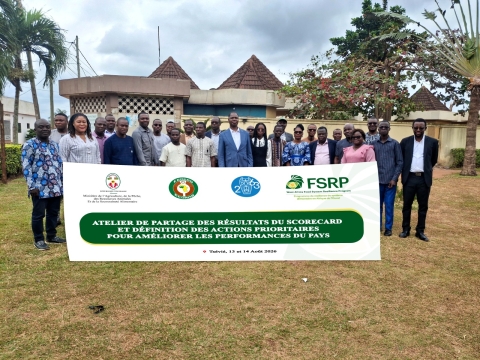
In Togo, the outcomes of the first phase of the ECOWAS Trade and Agricultural Markets Scorecard (SCORECARD) were discussed during a results-sharing workshop with various national stakeholders on 13 and 14 August 2026 in Tsévié (located 35 km north of Lomé).

Chaired by Mr ESSIOMLE Komi, Director of Planning, Agricultural Statistics and Monitoring and Evaluation, and Coordinator of the SCORECARD process in Togo, the meeting brought together around fifty participants from the various organisations involved in implementing the process, with the participation of ECOWAS. The participants also defined a strategy for implementing the recommendations aimed at improving, in future rounds, those indicators that have not yet reached the expected levels.

Implemented as part of Component 3 of the West Africa Food System Resilience Programme (FSRP), SCORECARD is a tool for monitoring countries’ commitments and performance in the areas of trade and agricultural markets. It provides comparable data, identifies progress made and highlights areas requiring further effort.

Over the course of two days, representatives from public institutions, professional organisations, the private sector, inter-professional bodies, civil society, employers’ organisations, the technical implementation committee, and the national and regional coordinating bodies of the FSRP and the Regional Programme for the Integration of Agricultural Markets (PRIMA) contributed to the discussions in working groups and plenary sessions. This approach made it possible to identify, in collaboration with the relevant bodies, the actions required to improve the indicators. It helps to clarify the responsibilities of the various institutions, the priority actions, the deadlines and the monitoring mechanisms.

Through this framework for discussion and knowledge-sharing, the SCORECARD is gradually becoming a tool for decision-making and collective accountability, enabling better monitoring of progress made from one edition to the next.

Following this sharing of the results from the regional and national reports, Togo now has a basis on which to better prepare for future editions of the SCORECARD.

Regular monitoring of the recommendations arising from this sharing will make it possible to measure the progress made and to identify actions that still require adjustments.

The first phase of the SCORECARD has thus enabled an important milestone to be reached: providing stakeholders with validated data on the country’s performance.

Through the coordinated implementation of the recommendations, Togo aims to improve its performance on indicators where targets have not been met, build on existing best practices and create the conditions for continuous improvement in trade and the agricultural market.

As a reminder, the SCORECARD is being implemented in five countries, including Ghana, Niger, Sierra Leone, Chad and Togo, with technical support from Akademiya2063.
Togo: 500 pheromone traps deployed by the FSRP to step up monitoring and control of the autumn armyworm in maize fields

Published on 7 September 2026

Preparing for pest control is a major challenge for food security in Togo. Maize, the country’s main food crop, is particularly vulnerable to the autumn armyworm, a pest that severely compromises yields.

Aware of this situation, the Ministry of Agriculture, through the Directorate of Agricultural Production and its Plant Protection Division, with support from the Food System Resilience Programme (FSRP-Togo), is strengthening its national monitoring system in order to take action before infestations cause significant losses in the fields.

Accordingly, FSRP-Togo has acquired 500 pheromone traps to be gradually deployed in the main maize-producing areas across the country’s six agricultural regions. This equipment is a recognised tool for phytosanitary surveillance. By attracting male moths of the autumn armyworm, it enables:

Early detection of the pest’s presence;

Monitor changes in its populations; and

Initiate control measures at the time when they are most effective.


This approach prioritises early action over late interventions, which are often more costly, less effective and more damaging to crops.

180 agricultural advisers at the heart of the monitoring system

The success of a monitoring system depends above all on the men and women who run it. That is why FSRP-Togo has invested in capacity-building for 180 agricultural advisers, comprising Technical Advisers in Farm Management (CTGEA) and Specialised Technicians (TS), spread across the whole country.

Following the training, each of the 180 agricultural advisers received a pheromone trap as part of the first phase of the system’s roll-out. They then proceeded to install the traps in the maize fields of farmers in their respective areas of operation. In addition to installing the traps, they monitor and maintain the devices, collect data on changes in autumn armyworm populations, and raise awareness amongst farmers to ensure that the most appropriate integrated pest management measures are implemented in a timely manner.

As well as providing equipment, this initiative aims to:

Reduce production losses,

Limit the routine use of plant protection products,

Promote integrated pest management that is more environmentally friendly; and

Sustainably improve the resilience of farms in the face of health threats.

FSRP exchange visit: Chad draws inspiration from Togo’s agricultural digital innovations

Published on 7 September 2026

On Friday 28 August 2026, a delegation of four experts from FSRP-Chad undertook a technical visit to the FSRP-Togo National Coordination Office in Lomé, as part of an exchange of experiences focusing on digital solutions for agriculture and climate risk management.

During this mission, the Chadian experts learnt how three flagship platforms operate: SIHAM (Hydro-Agrometeorological Information System), TG-ALERTE+ and e-Agri Conseil. These tools enable farmers, technical services and decision-makers to access meteorological, agricultural and early-warning information in order to anticipate risks and improve decision-making.

Discussions with the Institute for Consultancy and Technical Support (ICAT), the National Meteorological Agency (ANAMET), the National Civil Protection Agency (ANPC), the IFDC and the FSRP-Togo National Coordination Unit have enabled the delegation to gain a better understanding of the conditions under which these innovations are implemented, the institutional and technical challenges encountered, and the key factors behind their success.

At the end of the visit, the Chadian delegation left with practical insights to strengthen its own digital infrastructure, particularly in terms of integrating hydro-agri-meteorological data, issuing early warnings and providing digital agricultural advisory services. This South-South cooperation initiative illustrates the FSRP’s ambition to promote the sharing of best practices and the replication of innovations for the benefit of resilient food systems in West and Central Africa.

Togo: modern equipment provided to nearly 200 women rice processors to boost their empowerment

Published on 30 March 2026

Faced with ever-increasing demand for rice, Togo is accelerating the modernisation of its rice sector, which is still hampered by shortcomings in local processing. Having long had to contend with rudimentary equipment and arduous working conditions, women processors are now embarking on a decisive turning point thanks to the introduction of appropriate technologies.

Nearly 200 women, organised into five cooperatives across the Central, Kara and Savanes regions, have recently received modern rice parboiling kits as part of the West African Food System Resilience Programme (FSRP). This equipment includes soaking tanks with capacities ranging from 800 kg to one tonne, 120-kg parboiling machines fitted with stainless steel sieves and fuelled by improved stoves, as well as drying tarpaulins. This material support is complemented by technical and entrepreneurial training designed to strengthen management capacities and improve the profitability of the activities.

The introduction of this equipment not only increases production volumes but also significantly reduces post-harvest losses and improves the quality of parboiled rice. Working conditions for women processors are also improved, with safer and less physically demanding processes.

The rice processed in this way, being more nutritious and commanding a higher market price, offers new economic opportunities, helping to increase incomes and empower beneficiaries.

The official handover of the equipment, held on 25 March 2026 in Tchamba, forms part of a national drive to modernise agriculture and promote female entrepreneurship in rural areas. This initiative highlights the strategic role of local rice processing in reducing dependence on imports and strengthening food security.

Beyond the provision of equipment, the approach adopted is based on comprehensive support, including close technical monitoring, to ensure that cooperatives sustainably adopt the technologies. On the ground, this initiative is seen as a key driver for boosting the local economy, improving people’s living conditions and strengthening the resilience of food systems.

Through this initiative, Togo is reaffirming its commitment to making the rice sector a driver of inclusive development, by placing women at the heart of agricultural transformation.

Togo: agro-hydro-meteorological data to improve agricultural productivity

Published on 14 March 2026

For a long time, farmers lived at the mercy of an unpredictable sky, and the weather was almost a mystery. Should they sow now… or wait for the rain?

In the villages, this uncertainty sometimes led to losses and forced farmers to take out loans to get through the season.

In Gadjagan, in the Agou prefecture, AGBAKLA Véronique was all too familiar with this reality. “Before, we used to farm without taking weather data into account. Often we would sow and it wouldn’t rain. We farmed in uncertainty (…)

Today, farmers are learning to plan ahead. Thanks to digital technology, agro-hydro-climatic information is no longer distant or uncertain: it is accessible, understandable and useful in everyday life. This innovation, introduced by the West African Food System Resilience Programme (FSRP TOGO) and its partners, enables farmers to make the right choices at the right time, thereby increasing the chances of success for their farming seasons.

“Since we’ve been receiving weather information, we now know when to sow. We also know weeks in advance whether it’s going to rain or not. This improves our yields.”

The relay committees set up within the Planned Agricultural Development Zones (ZAAPs) play a key role. These on-the-ground actors pass on the rainfall forecasts produced by the Togolese National Meteorological Agency (ANAMET) – disseminated via digital solutions – to their fellow farmers in local languages. In Gadjagan, the relay committee meets once a month and shares the weather information received with the 178 producer members of the ZAAP. Following the example of the Gadjagan ZAAP, 39 weather sub-committees have been set up to relay climate information across Togo’s six agricultural regions. Every message and every alert enables them to plan sowing more effectively, organise the growing season and protect their crops.

It all starts with weather forecasts produced by the Togolese National Meteorological Agency (ANAMET). But to be useful, this information must reach farmers at the right time. Thanks to the SIHAM platform, an innovative digital solution that improves the dissemination of rainfall forecasts, messages are sent via text and voice calls in French and local languages directly to farmers organised within the ZAAPs.

Behind this project initiative lies a dynamic public-private partnership, led by the FSRP, ANAMET, the IFDC, telecommunications providers (Moov, Yas Togo) and other partner organisations (ICAT, CTOP), which combine expertise and technology to make the weather a true ally for farmers.

Furthermore, the refurbishment and equipping of weather stations have modernised climate data collection. FSRP Togo has facilitated the acquisition of spare parts, enabling the upgrading of automatic weather stations and thereby strengthening its global network. With new interconnection and transmission equipment, information flows more efficiently and is analysed more seamlessly. To make the most of these innovations, the FSRP supported the training of ANAMET staff in agrometeorology, climate change and sustainable development at Agrhymet

Today, these enhanced skills enable them to transform this data into reliable forecasts, directly useful to farmers in the field.

“Before, the success rate of our forecasts was around 40%. Thanks to the training, we have helped improve our bulletins to an 85% success rate,” says a beneficiary of the climate change training

Through this initiative, 123,598 farmers, 41.28% of whom are women, now have access to agro-hydrometeorological information.

Togo: 200 agricultural producers and seed growers attend open days at ITRA's technology and innovation satellite parks in Sarakawa and Dapaong

Published on 15 January 2026

As part of the implementation of the Food System Resilience Programme in West Africa (FSRP), the Togolese Institute for Agricultural Research (ITRA) organised its first open days and guided tours of technology and innovation satellite parks on 18-19 December 2025 in Dapaong and on 16 December 2025 in Sarakawa.

Following the success of the first Agricultural Technology and Innovation Park (PTIA) established in Davié in 2023 with the support of CORAF, the national coordination of FSRP-Togo assisted ITRA in setting up satellite technology and innovation parks in Sarakawa (Kara region) and Dapaong (Savanes region). These satellite parks, also known as local technoparks, were created to bring innovations from research closer to producers in remote areas and encourage their adoption. They serve as platforms for demonstration, learning, training and dissemination of agricultural technologies.

The organisation of these first open days and guided tours gave nearly 200 visitors (agricultural producers, seed producers and other stakeholders in the sector) the opportunity to discover and evaluate several improved crop varieties. These include soybeans (CRASS-1910P1, ITRA-SJ171), sorghum (Soubatimi and Pépé Kalé varieties), rain-fed rice (WAB0019634, WAB0019715), legumes, particularly cowpeas (WANG KAE), peanuts (IS1, L-GHA ITRA-SH2, ITRA-RAF and SH470P), and a variety of sweet potato varieties (Apomuden 1 and 2, Amouzoukopé, Djété Jaune). These technologies have been appreciated for their earliness, yield and potential for adaptation to local agroecological conditions.

Since 2022, several major achievements have been made possible thanks to the support of the national coordination of the FSRP Togo, including:

  • the establishment of two (02) satellite parks in the Kara and Savanes regions;
  • the conduct of field trials over two (02) agricultural seasons (2023 and 2024) in the six (06) agricultural regions of Togo, focusing on rice, maize, sorghum and legumes (groundnuts, cowpeas, soybeans);
  • the organisation of Periodic Technology Review Workshops (APRT) in the six agricultural regions;
  • the strengthening of technology transfer through ITRA's System Research Support Mechanism (DARS).

Thanks to these interventions, the following results have been recorded to date:

  • More than 900 producers have participated directly in field trials, promoting the adoption of technologies and good agricultural practices;
  • 244 leading producers and around 150 agricultural advisers have been trained in the use of the FeSeRWAM interactive digital platform, enabling better support for producers in variety selection and fertiliser management;
  • Nearly 200 agricultural producers and seed growers actively participated in open days and guided tours of the technology and innovation parks in Sarakawa and Dapaong;

The gradual adoption of these different technologies has enabled producers to achieve substantial improvements in their yields.

  • Producers who have adopted improved sorghum varieties (Soubatimi) report a significant increase in yields of up to 5 t/ha, compared to around 1 t/ha for local varieties.
  • Similarly, groundnut producers using the IS1 variety have seen their yields increase to 2 t/ha, compared to 0.5 t/ha previously.

These yield improvements contribute to higher incomes for producers, leading to significant positive changes in their living conditions.

Togo: 60 motor cultivators handed over to agricultural cooperatives to boost productivity with the support of the FSRP

Published on 26 December 2025

Dapaong, 12 December 2025: The Chief of Staff of the Ministry of Agriculture, Fisheries, Animal Resources and Food Sovereignty (MAPRASA) officially handed over 60 motor cultivators to agricultural cooperatives in the Savanes region on behalf of the Minister.

The 60 motor cultivators were acquired as part of the implementation of the Food System Resilience Programme in West Africa (FSRP-Togo). This equipment was acquired for the benefit of 5,025 producers (including 2,881 women) operating in the ZAAPs in the Savanes, Kara and Centrale regions. The aim of this support is to improve sustainable access to agricultural mechanisation services, increase productivity and strengthen food security in the targeted areas.

During the symbolic handover of the equipment, the Minister's representative reiterated the President of the Council's vision of making Togolese agriculture a productive, high value-added sector that creates wealth and drives the country's economic growth. He urged the beneficiaries to use the motor cultivators responsibly and rationally in order to ensure their sustainability, stimulate local economic development and contribute effectively to the fight against poverty.

The heavy and light motor cultivators come with essential accessories such as shredders, trailers, carts, mowers, harrows, stone removers, cage wheels and spare parts. Their acquisition meets the needs expressed by producers and is part of a cost-sharing management approach, as highlighted by the FSRP's deputy operational coordinator, , in his speech: "These motor cultivators will be managed on a cost-sharing basis, meaning that beneficiaries will contribute 50% of the purchase price of the equipment. This will ensure that they are used properly, that they are durable and that it will be possible to purchase more in the future for producers who are also in need."

The choice of motor cultivators is the result of an in-depth analysis of soil characteristics, with the aim of preserving soil structure and contributing to the gradual restoration of degraded land through sustainable agricultural practices. This equipment is also designed to be accessible to women and young people, who are key players in agricultural development.

Agricultural advisers specialising in farm management (CTGEA) and the beneficiaries themselves have been trained at the National Agricultural Training Institute in Tové (INFA de Tové) on the use and management of the equipment. A monitoring and support system is in place to ensure the optimal and sustainable use of the equipment. "The motor cultivators we are handing over today are not just tools, but real levers for transforming agriculture," emphasised the FSRP Coordinator, inviting producers to make judicious use of them.

Speaking on behalf of the Governor of the Savanes region, the Secretary General of the governorate, Kegbero Latifou Seigneur, praised the leadership of the President of the Council, His Excellency Faure E. GNASSINGBE, whose vision and commitment to peace and security enable the population to carry out their agricultural activities in favourable conditions. He encouraged the beneficiaries to use the equipment in a spirit of collective responsibility so that each farming community could reap the full benefits.

In addition to providing 60 motor cultivators, the FSRP has achieved major accomplishments that reflect the scope of its interventions in the field. These include:

  • the distribution of input kits consisting of certified seeds and fertilisers to 81,558 farmers in the ZAAPs, including 36,953 women, representing 45.3% of beneficiaries.
  • The provision of market gardening kits (certified market garden seeds, biofertilisers and tools) to 7,267 producers, including 3,572 women (49.15%);
  • The financing of 413 sub-projects led by young people and women as part of the PURS, reflecting the FSRP's commitment to rural employment and economic empowerment;
  • Support for the construction of 1,600 livestock shelters and the provision of breeding stock for the small ruminant and poultry sectors;
  • The ongoing development of four ZAAPs in the Savanes region, with the construction of superstructures and storage facilities.

These achievements have had a tangible, measurable and significant impact on the living conditions and economic performance of the beneficiaries. For example, 79.1% of beneficiary producers in the Savanes region report an improvement in their agricultural yields; 60.25% of beneficiary women report an increase in their income, compared to 23.36% of men. There has also been an increase in income of +83.6% in the Savanes region and +85.9% in the Kéran prefecture;

Beyond these figures, the FSRP's actions have promoted the sustainable reintegration of many producers who had previously abandoned their farms due to lack of resources, thereby contributing to strengthening agricultural resilience and reviving local economies.

Togo : 42 priority standards approved to boost the country's agri-food sector

Published on 10 December 2025

From 25 to 28 November 2025, the Togolese Standardisation Agency (ATN) organised in Lomé, with the support of the Food System Resilience Programme in West Africa (FSRP-Togo), the validation of 42 national standards in priority sectors such as cereals, tubers and legumes, meat and poultry, horticulture and derived products.

Despite the internalisation of international and regional standards (ISO, IEC, ECOSTAND, CODEX, etc.), Togo did not yet have its own national standards for these priority sectors. This absence was a major obstacle to the competitiveness of products, the improvement of their quality and their access to markets. It was precisely to remove this obstacle and promote the free movement of products at regional and international levels that FSRP-Togo provided support for the development of national standards adapted to both the realities of the country and the requirements of regional and global trade.

Launched in 2024, the development process resulted in 42 draft standards, which were reviewed in a rigorous, inclusive and concerted manner with a view to their validation. Over four days, experts and stakeholders identified the standards to be made mandatory and defined the next steps in a project considered transformative for Togo's food and economic sovereignty.

The meeting was opened by the authorities responsible for promoting investment, who emphasised the importance of an economic framework based on quality, safety and competitiveness. Discussions then highlighted the strategic role of quality standards in improving product safety, business performance, cost reduction and trade dynamism. The objective is clear: to make the 42 standards currently being developed a sustainable tool for enhancing agri-food value chains and strengthening the "Made in Togo" label.

This initiative is part of Component 3 of the Food System Resilience Programme in West Africa (FSRP), dedicated to market integration, regional food trade and the development of agricultural trade. Thanks to the support of the Programme, Togo is now establishing its first national regulatory framework for agri-food, in line with regional policies and standards.

With this unprecedented set of standards, the country is taking a major step towards more competitive and secure production that can conquer regional and international markets. Standardisation is thus becoming a structuring lever for the competitiveness and resilience of Togo's strategic agricultural sectors.

Togo : biological control of the fall armyworm is bearing fruit with the support of the FSRP

Published on 5 November 2025

Faced with agricultural losses caused by the fall armyworm, Togo is making a strategic shift by focusing on biological control.

In May 2025, the West Africa Food System Resilience Programme (FSRP) supported a mass release of parasitoids in several Planned Agricultural Development Zones (ZAAP), particularly in the East Plateaux and Kara regions.

This approach is based on the laboratory breeding of two particularly effective species of parasitoids (12,000 individuals of Cotesia marginiventris and 3,800 individuals of Chelonus insularis), which are introduced directly into maize fields to naturally neutralise the fall armyworm.

In order to maximise the effectiveness of this method, producers were made aware of the importance of not applying chemical treatments for two weeks after release. This allowed the parasitoids to establish themselves permanently in the treated areas.

Five months later, the initial results are promising.

Feedback from producers confirms a positive impact on maize yields. "This year, there have been far fewer attacks. The caterpillars haven't caused as much trouble as in previous years," says a producer from the Bouladè ZAAP in Assoli.

The trend is similar in the Atifoutou ZAAP. Attacks by the fall armyworm have been significantly lower this year, leading to improved crop quality and reduced use of chemicals.

This improvement in the field confirms the effectiveness of the biological approach adopted. To date, seven sites have already been successfully covered. The short-term objective is to extend the method to the entire territory, while continuing the mass rearing of parasitoids in Togolese laboratories.

For the FSRP, this initiative marks a major step forward in the fight against a scourge that has been ravaging Togo since 2016. It represents a tangible source of hope for maize producers across the country.

About the release of parasitoids

The release was carried out by slightly opening the cage containing the parasitoids to allow them to gradually escape. It is essential that the maize plants are between two and four weeks old after sowing at the time of the operation. This precaution has a significant effect on the parasitism rate of armyworms, particularly those in the L1 larval stage.

Once the cage is open, the agents move through the maize field, cage in hand, to facilitate the dispersal of the insects.

Togo/access to agro-hydrometeorological data: a new weather station installed with the support of the FSRP

Published on 24 October 2025

Faced with the challenges of climate change, access to accurate, real-time agro-hydrometeorological data has become an essential lever for securing agricultural campaigns and strengthening the resilience of producers. In order to guarantee the timely availability of agro-hydrometeorological data essential to actors in agricultural value chains, while promoting the development of integrated services via innovative digital platforms, the FSRP is strengthening the capacity of national structures to provide reliable information services. The project is therefore investing heavily in supporting the Togo National Meteorological Agency (ANAMET), providing it with state-of-the-art equipment and strengthening its operational capacities.

Among the most significant advances, the installation of a satellite image receiving antenna opens up new prospects in terms of the accuracy and reliability of climate forecasts. ANAMET now has access to high-quality satellite data from more dynamic and powerful forecasting models, enabling it to anticipate future climatic conditions.

In addition, new agro-meteorological stations have been acquired and are ready to be deployed in the field. These stations will enable localised, real-time monitoring of agro-climatic parameters, a major asset for farmers, particularly in areas with high agricultural potential.

The relaunch of the production and dissemination of rainfall and climate information via the hydro-agrometeorological information system (SIHAM) is a decisive innovation that facilitates real-time access to localised agro-meteorological forecasts. This system, set up by the FSRP, allows forecasts to be sent directly to agricultural producers, either by SMS or voice call, in planned agricultural development zones (ZAAP) and beyond. The result is better anticipation, reduced losses and optimised agricultural campaigns.

Beyond the equipment, the rehabilitation of weather parks and administrative buildings in various centres across the country, as well as the rehabilitation of the Directorate-General of Meteorology, provide a sustainable foundation for ensuring an efficient, modern public service that is more attuned to the needs on the ground.

Every year, as the rainy season approaches, ANAMET, in collaboration with technical structures, develops strategic agro-hydro-climatic forecasts. Thanks to the support of the FSRP, these forecasts are now more accurate, faster, more reliable and better disseminated, enabling farmers, decision-makers and socio-economic actors to plan their activities with greater confidence and efficiency.

This FSRP intervention illustrates how targeted investments in technology, infrastructure and information dissemination can transform warning and forecasting systems, while empowering producers to make timely decisions elsewhere.

Subscribe to Togo