- About
- Stakeholders
- Resources
- Opportunities
- News
- Complaints
Under the theme "Facilitating access to agricultural technologies and innovations for integrated soil management", the 5th edition of the Agricultural Innovations and Technologies Market (MITA) officially opened in Bamako, Mali, on Monday 20 October 2025.
This edition of MITA 2025 highlighted the challenges and solutions for restoring soil fertility and strengthening the resilience of agricultural systems in the face of climate change. MITA 2025 mobilised strong political commitment to support research and accelerate the scaling up of agricultural technologies and improve the climate adaptation capacities of FSRP beneficiary countries and beyond.
Organised by CORAF, with support from the World Bank through the Food System Resilience Programme (PRSA/FSRP) and the AICCRA programme, MITA 2025 brought together more than 300 technology providers and initiative leaders, agricultural entrepreneurs, producer organisations, women entrepreneurs and public decision-makers.
Over five days, participants discussed innovative solutions for integrated soil management, fertility conservation and the dissemination of climate-smart agricultural technologies.
Thursday 23 October 2025 was dedicated to Mali and featured a visit by MITA participants to the technology park of the Institute of Rural Economics (IER) in Sotuba. Participants had the opportunity to discover Malian agricultural innovations by visiting several stands and demonstration plots. This immersion continued in the animal park, where visitors were able to appreciate high-quality livestock specimens such as Boer goats and Wasase chickens. The visit also highlighted advances in Mali's national research on food security and nutrition, with presentations on fortified millet, optimised livestock feed and a variety of processed products, illustrating the diversity and potential of local solutions developed to support the agro-sylvo-pastoral sector.
The first Abdoulaye Touré Innovation Award at the 5th edition of the Agricultural Innovation and Technology Market, in the category "agricultural innovation for adequate and sustainable financing and trade", went to Burkina Faso. The lucky winner was Dr Abel TANKOANO from the Institute for Research in Applied Sciences and Technologies, for his work on the use of cashew apples in human food.
With climate change and declining yields undermining rice production in several regions of West Africa, CORAF is banking on a bold solution: the dissemination of hybrid irrigated rice varieties combined with the practice of the System of Rice Intensification (SRI). Commissioned by CORAF, the consortium formed by IER (Mali), INERA (Burkina Faso) and ISRA (Senegal) is implementing this regional initiative with support from the World Bank, as part of the Food Systems Resilience Programme (FSRP). It aims to address the dual challenge of food insecurity and declining agricultural yields in the countries where the project is being implemented.
Local solutions to intensify rice production
The project is being implemented in three key areas: the Niono area in Mali, the Senegal River Delta area in Senegal and the Farako-Bâ area in Burkina Faso. It combines demonstrations in farming communities, the production of hybrid rice seeds and technical training, with the aim of transforming rice production in West Africa.
"Intensive rice cultivation systems (SRI), combined with hybrid irrigated rice varieties, appear to be a solution for strengthening the resilience of agricultural systems in Senegal, Mali and Burkina Faso. We want to boost yields and are currently distributing two hybrid rice varieties – ISRI 9 and Mayun 1 – combining spaced transplanting, compost and controlled irrigation," explains Dr Omar NDAO FAYE, Director of the Agricultural Research Centre in Saint-Louis, Senegal.
Conducting demonstrations in farming communities
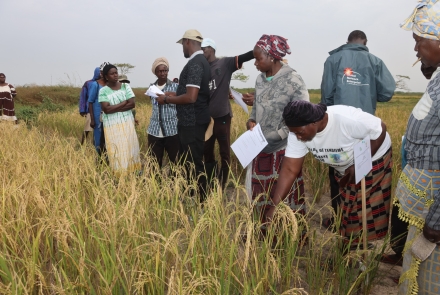
In Senegal, teams from CORAF, ISRA, researchers and producers met from 14 to 17 July 2025 in Fanaye and Savoigne in northern Senegal to follow up on this innovative approach. The initial results on the demonstration plots are encouraging: significantly higher tillering compared to usual practices, improved plant vigour, reduced use of seeds and chemical inputs, and increased resistance to water stress.
"Tillering was greater in plots under SRI combined with hybrid varieties. This technique has led to savings on seed and fertiliser purchases. In Savoigne, soil salinity is a limiting factor that must be taken into account when implementing SRI practices. Salt-tolerant and/or lodging-resistant varieties will therefore be added to the SRI technology package," explains Dr Omar NDAO FAYE.
"We are counting on ISRA and related services to build capacity so that farmers can master and effectively implement this agricultural practice," insists Mamadou Niang, a rice farmer in Savoigne.
Seed production and large-scale adoption
Beyond the agronomic results, this project is part of a systemic transformation process. Seed production is another important pillar of this initiative. Local seed companies are involved in this initiative to multiply hybrid seed varieties in accordance with harmonised regional seed regulations. The ultimate goal is to guarantee access to high-quality seeds adapted to local agroclimatic conditions.
"This initiative to disseminate hybrid rice varieties irrigated using the System of Rice Intensification (SRI) in Senegal, Burkina Faso and Mali is a lever for adaptation to climate change, but also a source of hope for young people in rural areas," says Dr Fatou DIENG GUEYE, Monitoring and Evaluation Specialist at CORAF.
The intensive rice cultivation system is based on simple but effective practices: using fewer seeds, spacing plants further apart, enriching the soil with compost, resulting in more vigorous plants, more tillers and higher yields with fewer resources. The combined use of SRI practices and hybrid rice varieties should improve yields to between 8 and 10 tonnes per hectare, compared to yields of 4 to 6 tonnes per hectare using conventional methods. This initiative is part of a broader effort by CORAF, through the FSRP, to make high-performance varieties available to producers and increase agricultural yields in Burkina Faso, Mali and Senegal. It is essential to strengthen the capacities of local producers and seed companies and to structure the hybrid rice seed sector in West Africa in a sustainable manner for the large-scale dissemination and adoption of these innovations.
From 20 to 22 May, the West and Central African Council for Agricultural Research and Development and the Food and Agriculture Organisation of the United Nations co-organised a regional training workshop in Accra, Ghana, as part of the Food System Resilience Programme (FSRP). The event brought together key players in agricultural extension from eight West African countries to discuss a central but often underestimated issue: integrating gender into rural advisory services. This is an essential lever for building more inclusive, equitable and resilient food systems in the face of climatic and socio-economic challenges. The FSRP is a flagship regional investment programme that aims to strengthen the resilience of the West African food system through a strategic regional approach. CORAF is leading Component 2 on the sustainability and adaptability of the productive base of the food system, with a focus on agro-ecological practices and sustainable land and watershed management. Gender-focused interventions are integrated into this framework to help bridge persistent gender gaps that hamper food security and rural development. Since 2023, FAO has been working with CORAF to provide technical support, including methodologies, tools and capacity building training on gender mainstreaming. This current training on gender-sensitive rural advisory services is the latest in a series of collaborations between CORAF and the FAO under the FSRP.
Women make up around 50 per cent of farmers in West and Central Africa and 60 per cent of those working in the non-agricultural sectors of agri-food systems, but few women farmers than men are reached by rural advisory services designed to support farmers. Most agricultural extension systems continue to cater primarily for men due to a number of systemic issues. Extension service providers do not consider women as clients of rural advisory services, and farmers in their own right, seeing them instead as farm helpers. The services they offer do not take into account the challenges that rural women often face, including the burden of unpaid care and domestic work, limited mobility, low levels of literacy and restrictive social norms.
The training, delivered by Bethel Terefe Gebremedhin, Senior Gender Expert at the FAO Regional Office for Africa in Ghana, focused on identifying structural barriers to women's access to agricultural advisory services and exploring strategies to overcome them. Using tools such as seasonal calendars and daily activity profiles, participants from Benin, Mali, Niger, Togo, Ghana, Chad, Nigeria and Senegal analysed the situation in their countries. A common trend emerged: extension services often target men as household heads and landowners, excluding women from training despite the fact that a significant number of agricultural production activities are carried out by women. The exercises also showed that women worked longer hours on unpaid productive care activities with limited time for rest and leisure than men. The exercise showed participants the lack of time available to women, the importance of tackling the burden of unpaid care work by introducing time- and labour-saving technologies and the need to encourage the redistribution of care work within the household. Above all, it has shown the need to organise extension advisory services that consider the responsibilities of women's unpaid care work.
The workshop focused on the design of gender-sensitive advisory services throughout the agricultural value chain, from inputs to production, processing and marketing. Participants compared traditional value chain analysis with gender-sensitive approaches that take into account women's access to credit, market information, training and decision-making power.
Participants developed action plans to strengthen gender mainstreaming in agricultural extension services in their respective countries and created indicators to monitor progress.
Faced with the climate emergency that is disrupting agricultural systems in West Africa and the Sahel, boosting the resilience of agricultural sectors is no longer an option, but a strategic necessity. Prolonged drought, flooding, seasonal irregularities, soil degradation, food insecurity... these are just some of the challenges that call for concrete responses, based on proven technologies that are adapted to the realities of producers.
CORAF, in collaboration with the International Bioversity Alliance and the International Centre for Tropical Agriculture (CIAT), organised a regional training workshop on the assessment and prioritisation of climate-smart agricultural technologies from 12 to 16 May 2025 in Lomé, Togo. This initiative was part of the Food Systems Resilience Programme and the AICCRA project, with the support of the World Bank.
For five days, experts from the FSRP/PRSA national implementation units and national research institutes in the eight beneficiary countries (Burkina Faso, Chad, Ghana, Mali, Niger, Senegal and Sierra Leone) enhanced their skills in using a robust methodology (multi-criteria analyses) to assess the climate intelligence of existing agricultural T&I before rolling them out to farmers.
Specifically, the work enabled participants to find out whether the technologies currently being deployed in the project's areas of intervention meet the three pillars of climate-smart agriculture, namely productivity, adaptation and carbon mitigation.
The ambition of CORAF and its partners through this regional workshop was to facilitate the appropriate use of technologies and innovations for scaling up climate-smart agriculture (CSA).
The training of experts from national PRSP implementation units and researchers from national research institutes on T&I assessment has further confirmed CORAF's position as a key player in the development and scaling-up of climate-smart agricultural innovations and technologies.
From 24 to 26 April 2025, Niamey hosted the annual regional planning meeting for the research activities and projects of the Regional Centre for Livestock Specialisation (CRS-EL). This strategic meeting was part of efforts to strengthen the centres of excellence and specialisation of the West and Central African Council for Agricultural Research and Development (CORAF), with the support of the West Africa Food System Resilience Programme (PRSA/FSRP), funded by the World Bank.
CORAF, as the regional scientific coordination body, plays a central role in the operationalisation of the CRS-EL. Since the Center was set up in 2018, CORAF has provided ongoing technical and institutional support, fostering the emergence of a research network made up of eleven national centres in ten countries. Today, this regional structure enables expertise to be pooled and innovative solutions to be co-constructed to meet the many challenges facing the livestock sector in West Africa.
The meeting in Niamey enabled participants - government representatives, researchers, teacher-researchers, producer organisations and technical partners - to define the research priorities for the period 2025-2026. The aim was to design scientific interventions adapted to local realities, while meeting the expectations of producers and stakeholders in the livestock-meat-dairy value chain.
With livestock farming occupying a strategic position in the West African economy, the debates focused on the major research themes to be prioritised: genetic improvement, animal health, livestock feed, product processing, adding value to hides and skins, among others.
Professor Yayé Aissatou, Chair of CORAF's Scientific Committee, welcomed the progress made in structuring the CRS-EL. She emphasised the importance of strengthening the alignment between research activities and the needs of the field, stressing the need to involve end-users in the innovation process. In her view, CORAF's support through the PRSA/FSRP is crucial to ensuring regional coherence and the sustainability of interventions.
This meeting is part of a series of regional planning workshops organised under the FSRP, following those held in Mali and Chad in 2024. It will be followed by another session in Senegal in September 2025, demonstrating the regional momentum in research and development for resilient food systems.
All in all, this CRS-EL annual meeting is a major step towards consolidating the programme's achievements and promoting resilient, productive and sustainable livestock farming, in the interests of food security, job creation and economic development in West Africa.
As part of the activities relating to the sustainability and adaptation of the productive base of the West Africa Food System Resilience Programme (FSRP), coordinated by the West and Central African Council for Agricultural Research and Development (CORAF), a workshop to present the results of a study was held on 20 and 21 March 2025 in Ouagadougou, Burkina Faso.
This event was an opportunity to share the results of a mapping exercise of modern and innovative agricultural extension tools and approaches in West and Central Africa, in collaboration with the Rural Advisory Services Network in West and Central Africa (RESCAR-AOC).
Agricultural extension services play a central role in disseminating innovations and good farming practices. However, these services are often ineffective, limited in their geographical coverage and poorly adapted to the specific needs of farmers. In the face of growing climatic and economic challenges, the adoption of new technologies and farming practices is crucial to strengthening the resilience of farms. This study has helped to fill these gaps by identifying and disseminating the best extension approaches.
For two days, heads of extension services from FSRP member countries, researchers and experts in agricultural innovation, representatives of NGOs and civil society organisations and private sector players involved in the provision of agricultural services discussed the directory of tried and tested agricultural advisory tools and approaches: a detailed mapping of initiatives that have demonstrated a significant impact in different agro-ecological contexts.
The work enabled successful cases to be identified and best practices to be shared, with a view to highlighting successful experiences and encouraging their replicability.
Together, the stakeholders and partners have drawn up a roadmap for the modernisation of extension services, which will now have to incorporate digital tools and participatory approaches for more effective and accessible extension.
By encouraging dialogue and pooling expertise, this meeting laid the foundations for structuring a new dynamic in farm advisory services, based on modern methods and adapted to the realities of producers.
The initiative supported by CORAF and RESCAR-AOC should lead to a significant transformation of agricultural extension services. The integration of digital technologies, the training of extension agents in new approaches and the increased involvement of the private sector are all levers for guaranteeing wider and fairer access to agricultural advisory services.
On the initiative of the West and Central African Council for Agricultural Research and Development (CORAF), some thirty young researchers from the National Agricultural Research Systems (NARS) in West Africa were trained in meta-analysis in Lomé/Togo. This regional meeting, held from 29 October to 02 November 2024, brought together researchers and teachers from countries benefiting from the Food System Resilience Programme (FSRP) and doctoral students sponsored by the said Programme, from some fifteen West African countries.
Participants were trained in the fundamental concepts of agricultural data management and analysis, with a view to mastering the tools and techniques that will enable them to carry out metadata analyses.
Thanks to this training, participants have an exportable database that they can use to write scientific articles and capitalise on the results for CORAF and their respective NARS.
This training course in Lomé/Togo initiated by CORAF is a response to the needs expressed by its members in terms of capacity building on emerging themes and practices in the agricultural sector.
Experts agree that meta-analysis of data has become an essential part of scientific research, particularly in the field of agriculture. It represents a quantitative assessment of knowledge on a given subject, making it an essential skill to acquire, over and above the traditional skills of literature review.
Indeed, the application of metadata analysis in the field of agriculture could facilitate the identification of data gaps and formulate new and robust research questions to be addressed to achieve food security. By combining the results of individual or national studies, meta-analysis produces summaries and conclusions that can be used to explain regional mechanisms or phenomena.
The Davié agricultural technology park in Togo, run by the Institut Togolais de Recherche Agronomique (ITRA), opened its doors to Togo's agricultural producers and livestock breeders on Wednesday 11 September 2024. This open day, organised in partnership with CORAF as part of the FSRP and iREACH projects, enabled participants to discover the latest technological advances developed to improve agricultural and livestock production systems.
Agricultural technology parks, set up in 9 West and Central African countries by CORAF, are dynamic platforms that bring agricultural innovations closer to producers. At Davié, a number of technologies were highlighted, including short-cycle climate-smart seeds, technologies for aquaculture, rabbit, pig and poultry farming, agronomic practices and agri-food processing solutions.
This technology park plays a key role in bringing researchers and farmers together, bridging the gap between theory and practice. Research results, tested on different varieties and soil conditions, are presented to farmers in a practical environment where they can evaluate and adopt these technologies for their own farms.
In addition to this open day, regular visits are planned for potential users of the technologies and innovations on display. ITRA, with the support of CORAF, is working in partnership with the region's universities and agricultural schools to help improve the training of tomorrow's agricultural players, while at the same time boosting the widespread adoption of agricultural technologies.
It should be noted that the Davié agricultural technology park initiative began in 2023 with technical and financial support from the FSRP and iREACH projects coordinated by CORAF.
Several other agricultural technology parks are being set up in Togo to bring producers closer to the technologies and innovations available, so that they can incorporate them into their production systems. Thanks to the agricultural technology parks, Togolese producers have concrete tools at their disposal to improve productivity and respond to current climatic and economic challenges.
In the face of climate challenges, strategic crops such as rice must adapt to ensure the resilience of agricultural production systems. With this in mind, CORAF, in partnership with the Bioversity International Alliance and CIAT, through the AICCRA (Accelerating the Impact of CGIAR Climate Research in Africa) AfricaRice project, and the West African Food System Resilience Programme (FSRP), organised a regional workshop from 26 to 28 August 2024 in Cotonou/Benin to discuss innovations and technologies capable of strengthening the resilience of rice-growing systems in West and Central Africa.
Dr Elliot Dossou-Yovo, AICCRA Mali Coordinator, presented the various proven technologies available to the participants, in particular the Country Coordinators, rice specialists and agricultural advisors from the FSRP implementation countries, stressing the need to create effective mechanisms for their large-scale adoption. Several of the climate-smart technologies and innovations identified have demonstrated their potential to optimise production while taking climate constraints into account. Examples include RiceAdvice, Smart-Valleys, alternative wetting and drying (AWD), the integrated rice-fish system, Pay as you go and climate-resilient rice varieties. These innovations are crucial to improving the resilience of farming systems, boosting productivity and guaranteeing food and nutritional security for millions of people in the region.
"In the rice value chain, several technologies, innovations and research knowledge have been developed and deployed in the countries. These innovations need to be scaled up in order to reach and have a positive impact on the final beneficiaries, i.e. family farms", said Dr. Angelo DJIHINTO, representing INRAB at the opening of the workshop.
"General awareness of climate change has led to the development of a number of climate-smart approaches and technologies, which unfortunately remain unknown to the general public, particularly in the agricultural sector. Their widespread adoption is vital for the resilience of our food systems," emphasised Dr Komla Kyky Ganyo, CORAF's FSRP technical assistant.
For Dr Alcade Segnon, researcher at the Bioversity International and CIAT Alliance and West Africa scientific manager for the AICCRA project, "it is essential to disseminate these technologies on a large scale for the benefit of African producers".
Funded by the World Bank and implemented by the Bioversity International Alliance and CIAT, the AICCRA project aims to promote the adoption and use of climate-smart agricultural technologies and innovations, as well as climate information services. In West Africa, the aim is to ensure that these technologies and innovations can be taken to scale through multi-stakeholder partnerships. The World Bank-funded West Africa Food System Resilience Programme (WAFRSP), which is being implemented in 9 countries, is seen as an ideal channel for this large-scale dissemination of technologies in the rice value chain. This workshop aims to inform FSRP stakeholders about these available technologies and to define actions for their adoption in the region.
At the end of the presentations, the participants identified key activities, recommendations for PRSP implementing countries and the best strategies for disseminating these technologies to farmers, with particular emphasis on family farms, which account for a large proportion of rice production in the region.
"We were very interested in the Smart-Valley technology because it requires the mobilisation of the entire community, especially women. On our return to Mali, we will be raising awareness among the stakeholders so that we can implement this innovation in Mali", said Sory Ibrahim Konaté from the FSRP Mali team.
The workshop also produced a clear roadmap for the use and scaling-up of climate-smart technologies in the rice value chain. This roadmap includes concrete actions to strengthen the adoption of technologies in FSRP implementing countries.