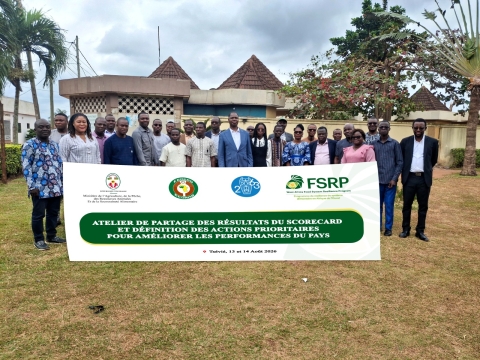
Climate-smart agriculture in West Africa: countries equipped to cope with the effects of climate change

Published on 3 November 2024

As part of the implementation of the West African food system resilience programme (PRSA), the West and Central African Council for Agricultural Research and Development (CORAF) has invited experts and decision-makers on environmental issues to a regional training workshop on assessing the climate-smart characteristics of agricultural innovations and technologies, from 26 to 28 July 2023 in Abidjan, Côte d'Ivoire.

This meeting for CORAF, which coordinates the activities of component 2 of the PRSA on "the sustainability and adaptability of the productive base of the food system", with financial support from the World Bank, was aimed at building the capacity of players in national agricultural research systems and Alliances for Climate-Smart Agriculture (AIC) to develop AIC projects using tools and methods for assessing AIC characteristics, practices and technologies.

According to the researchers, the AIC concept is based on 3 pillars: productivity, resilience and mitigation of the effects of climate change.

On this basis and on the basis of field experience, the participants, made up of researchers, farmers and agricultural entrepreneurs, saw their knowledge improved on (i) the basic concepts and phenomenon of climate change, (ii) climate-smart agriculture for more resilient agricultural systems, (iii) methods and tools for assessing the climate-smart characteristics of agricultural technologies and practices.

At the end of the three-day course, participants will be able to develop projects that take AIC into account and identify technologies and practices that integrate AIC.

Market for Agricultural Innovation and Technology (MITA): 3rd edition held in Ouagadougou

Published on 2 November 2024

The third edition of the Market for Agricultural Innovations and Technologies (MITA), held from 12 to 15 September 2023 in Ouagadougou, was an important event for highlighting the innovations and technological advances coming out of research and public and private inventors in West and Central Africa.

Participants discussed the following theme: "Facilitating access to gender- and nutrition-sensitive agricultural technologies and innovations". This regional meeting organised by CORAF was an opportunity to promote gender- and nutrition-sensitive innovations that meet the needs of the various links (production, post-harvest, processing, mechanisation, etc.) in the agricultural value chains. MITA also provided a forum for strengthening access to and dissemination of agricultural technologies in West and Central Africa.

In four days of exchanges punctuated by an exhibition of the main results of research and innovations, the third edition of MITA was above all a framework for the exchange of technological information and innovation for the benefit of the public and agricultural professionals, through B to B sessions and workshops. Researchers, students, producers and private sector players took advantage of MITA to showcase proven innovations and technologies that have the potential to transform agriculture and contribute to greater food security.

MITA 2023 brought together a wide range of participants, including ministries of agriculture, regional bodies, research institutes and universities, private sector players, non-governmental organisations, farming associations, potential investors and others.

Numerous cutting-edge agricultural technologies were presented, in-depth discussions took place and excellence was rewarded at the gala evening for agricultural innovators. The results achieved during these 4 days of exchanges underline the strong commitment of decision-makers to support agricultural research and the scaling-up of climate-smart and gender- and nutrition-sensitive technologies as part of the implementation of the Farming System Resilience Programme (FSRP).

MITA is a platform designed by CORAF to disseminate the technologies and innovations developed by agricultural research in West and Central Africa. As an exhibition and discovery platform, the MITA digital platform presents more than 400 technologies classified by value chain and by country. It facilitates interaction between technology developers and end-users, with a view to increasing the rate of adoption of proven technologies and innovations. In this way, MITA contributes to food and nutrition security in West and Central Africa. 

Immersion in the National Specialization Centers: CORAF contributes to the next generation of scientists

Published on 6 October 2024

At the age of 25, Marie-Claire KONÉ, a young woman of Malian origin, embodies hope and ambition in the field of agricultural research. A third-year research student at the Faculty of Agronomy and Animal Medicine, Marie-Claire not only excels in her studies: she is also the major of her class, a recognition that testifies to her dedication and talent.

Young graduates from vocational schools often face obstacles such as a lack of practical learning environments, professional experience and networks. To overcome these challenges and strengthen the skills of young researchers at universities and public research institutions in West and Central Africa, CORAF has set up an immersion program at national centers of specialization in West Africa.

Marie-Claire had the opportunity to take part in this immersion program in Senegal, organized by the Conseil Ouest et Centre Africain pour la Recherche et le Développement Agricoles (CORAF) as part of the Food System Resilience Program in West Africa (‘FRSP’). This experience took place at the headquarters of the Regional Center of Excellence (CRE) on dry cereals and associated crops (CERAAS), a center renowned for its contributions to improving agricultural production in a context of climate change. Over the course of a month, Marie-Claire explored four state-of-the-art platforms at CERAAS: the genotyping platform, the biochemistry research and training platform, the phenotyping platform and the bioinformatics facility. Each week in these high-tech environments was a revelation for her. Supervised by experts, she discovered new and fascinating fields, in particular genotyping, which redirected her professional ambitions.

“This immersion trip was a real revelation for me. I’d never had the opportunity to work in a research laboratory of this scale, and it changed my view of science and my own abilities,” Marie-Claire confides enthusiastically. “CORAF’s support has been invaluable. They have opened doors that I didn’t think I could get through, especially as a woman in a field still largely dominated by men,” said Marie-Claire KONÉ.

Like Marie-Claire, ten other students and young scientists (50% of them women) have benefited from this immersion program in the specialization centers. Talla LO from Senegal and Hassane YAYE ABDOU from Niger spent their respective stays at the aquaculture specialization center in Nigeria. CISSE Awa Marie Coll and Talla KANE, both from Senegal, were hosted at the CRE-Fruit et légumes in Burkina Faso. Marie-Claire is particularly grateful for this opportunity as, until now, similar opportunities at her university were mainly reserved for men. Her selection by CORAF was a great surprise and a source of pride. “I hope my story will inspire other young Malian women to pursue careers in agricultural research, a crucial field for Africa’s future,” she insisted.

With ambitious dreams for the future, Marie-Claire aspires to a PhD and hopes one day to become her country’s Minister of Agriculture. Her journey is proof that, with hard work and the right opportunities, anything is possible. “I encourage all young girls to go into agricultural research. Our continent needs our ideas, our determination and our passion to solve tomorrow’s challenges,” she concludes with determination.

With ambitious dreams for the future, Marie-Claire aspires to obtain a doctorate and wishes to one day become her country’s Minister of Agriculture. His journey is proof that, with hard work and the right opportunities, anything is possible. “ I encourage all young girls to embark on agricultural research. Our continent needs our ideas, our determination and our passion to solve the challenges of tomorrow,” she concludes with determination.

For Prof Niéyidouba LAMIEN, Program Manager at CORAF, “CORAF’s initiative to organize immersion trips for research students is crucial. It helps to mentor and inspire young people to pursue a career in research, ensuring a succession to the aging generation of researchers in West Africa.”

Through this initiative, supported by the World Bank-funded West Africa Food Systems Resilience Program (FSRP), CORAF seeks to strengthen the skills of young researchers across the region, offering them practical experience and high-level training.

Subscribe to CORAF