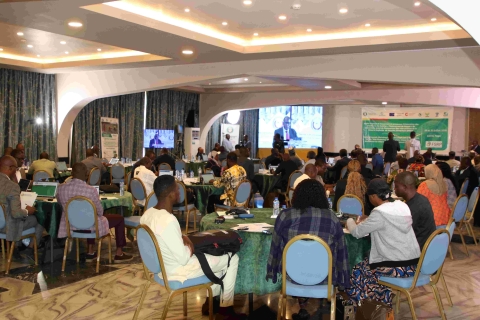
From July to early October, a technical monitoring-evaluation team made up of regional coordinators from CILSS, CORAF, ECOWAS and the World Bank carried out monitoring-evaluation support missions in six countries of the West African Food System Resilience Programme (FSRP). The mission, which covered Mali, Niger, Burkina Faso, Togo, Ghana and Sierra Leone, aimed to improve the FSRP's performance management by harmonising the measurement methods and data sources for the indicators in the programme's results framework.
The main objective was to arrive at a reliable monitoring and evaluation system that would enable the PRSP's performance to be managed in the best possible way. These meetings were of particular benefit to the countries in the first phase of the programme's implementation, now at the half-way stage. They provided an opportunity for national stakeholders to harmonise their understanding of the results framework indicators and to revise the data collection forms used by all the countries.
The discussions took place in a hybrid format, combining face-to-face and online working sessions. They brought together experts from ECOWAS, CORAF, CILSS, the World Bank and the monitoring and evaluation teams of the countries concerned, in addition to the technical partner services involved in implementing the FSRP.
One of the crucial stages of this mission was to carry out a complete review of the indicators in the regional results framework. This included an examination of the results calculated, the calculation formulas applied, the data collected and the collection tools used in each country. This technical work enabled the harmonisation that was essential to guarantee the reliability and comparability of data between the different countries where the programme operates.
The indicators deemed to have priority were examined in detail. These include: (i) ODP2 (Number of programme beneficiaries); (ii) ODP3 (Number of food system actors with access to hydrological and agrometeorological advisory services); (iii) ODP4 (Area of land under sustainable landscape management practices); (iv) ODP5 (Number of producers adopting agricultural technologies and services adapted to climate change); and (v) IRI1 (Percentage of satisfied users with access to climate and agricultural advisory services).
These indicators are at the heart of the evaluation of the progress made by the programme and provide an overview of the initial impact of the interventions on beneficiaries.
At the end of this support mission, the Regional Coordination of the PRSF will have an overview of national data, enabling a more detailed assessment of the overall performance of the programme. This rigorous monitoring is essential to assess the effectiveness of the PRSF's interventions and to ensure greater resilience of food systems in West Africa.