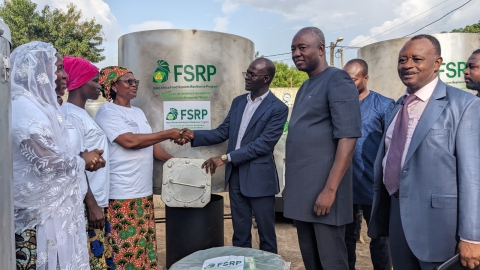
Two years ago, riverine farming communities across Sierra Leone lost an estimated 15% of their rice production due to flooding, resulting in reduced yields, lost incomes, and heightened food insecurity for smallholder farmers. At the time, the Early Warning System (EWS) within the Ministry of Agriculture and Food Security (MAFS) was not fully functional, limiting farmers’ ability to prepare for climate-related shocks.
As part of its mandate to strengthen Sierra Leone’s food systems, the Food System Resilience Program (FSRP) revived and reinforced the national Early Warning System to better protect farmers from climate risks. Working closely with key partners including the Sierra Leone Meteorological Agency (SLMeT), the National Water Resources Management Agency (NWRMA), and the National Disaster Management Agency (NDMA) to deliver critical infrastructure, produce bulletin and build technical capacity to improve the availability and use of timely, reliable climate information.
The project procured and installed 15 weather stations for SLMeT, constructed hydrological stations for NWRMA across the country, provided modern data-collection gadgets, and strengthened the capacity of technicians and extension workers to collect, analyze, and disseminate early warning data. These investments are now translating into practical benefits for farming communities.
For Mabinty Conteh, a smallholder farmer in Robere Village, Port Loko District, access to accurate weather forecasts and cropping calendars was transformative. “Before, I planted by guesswork,” she explained. “Now I know when the rains will start and how long they will last.” By adjusting her planting dates and crop choices, Mabinty increased her yields and reduced production losses.
Similarly, Isata Sesay, who lost her entire farm to flooding in 2023, found renewed hope through FSRP support. Having lost her seeds, savings, and income, she was unable to farm the following season. In 2024-25, FSRP supported her with inputs to cultivate one hectare of rice. During harvest, Isata shared, “The flood reduced me to nothing, and my family could hardly afford meals. Thanks to FSRP, I am farming again and standing as an independent woman.”
In late 2025, during a joint field visit to one of the riverine communities, an NWRMA beneficiary, Jounah Kamara, testified to the impact of the capacity-building support. “FSRP has equipped me with the knowledge and tools needed to provide farmers with accurate information, recognizing that water plays a critical role in food production. Before FSRP, I had limited skills and equipment to monitor water levels and share timely data. Now, I am confident that our work is directly protecting lives and livelihoods.”
During the 2025 World Food Day celebration, the Minister of Agriculture and Food Security, Dr. Henry Musa Kpaka, proudly recognized FSRP’s contribution to strengthening the Early Warning System as critical infrastructure supporting the Feed Salone initiative. “By turning climate data into practical advice for farmers,” he stated, “we are reducing losses, increasing productivity, and safeguarding national food security.”
Through this strengthened Early Warning System, FSRP is building flood-resilient communities and ensuring that climate shocks no longer wipe out farmers’ hard-earned gains.