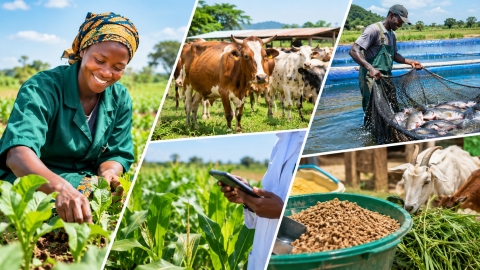
For many years, smallholder farmers in rural communities struggled to increase their yields despite their hard work and experience. Limited access to practical research and modern technologies forced them to rely on traditional farming practices that no longer produced optimal results. Through the Food System Resilience Program (FSRP), this challenge is now being addressed by bringing adaptive solutions, from the field-based research funded by the project.
Under FSRP’s Adaptive Research support, six researchers at the Sierra Leone Agricultural Research Institute (SLARI) were awarded grants to work closely with farmers, testing improved production practices on real farm plots rather than in distant laboratories. Farmers actively participated in selecting crop varieties, testing soil and plant health management techniques, and refining planting calendars based on local climate conditions. This hands-on approach allowed them to witness results firsthand and compare new methods with their traditional practices.
To ensure immediate impact on smallholders, FSRP worked with the researchers to fine-tune their research focus. Priority areas included reducing aflatoxin contamination, improving plant health, maximizing fertilizer efficiency, and promoting climate-smart farming practices. The goal was simple: increase productivity while lowering production costs.
For Mohamed Kamara, a farmer whose produce was rejected two years ago due to high aflatoxin levels, the new knowledge has restored hope. “My crops were once rejected, and I lost income,” he said. “Now I understand how to prevent aflatoxin. This means better prices, more food for my family, and a secure future.”
Being that cassava is the country second staple with a potential to convert the waste into energy, Ibrahim Boa, a cassava producer, described the research as transformative. He gained skills to convert cassava waste into energy, reducing waste and creating an alternative power source for processing. “What we used to throw away can now help us save money and improve production,” he shared.
At the end of the 2025 harvest season, FSRP visited Five of the participating communities and observed clear improvements. Around 10,000 farmers adopted so far, spending less on production and yields increased by 1.5%. Most importantly, farmers trusted the innovations because they were developed on their own fields and aligned with their indigenous knowledge.
FSRP’s approach demonstrates that scaling up production does not always require complex or expensive interventions. By supporting adaptive research and promoting community ownership of research findings, FSRP is delivering practical, immediate, and sustainable results for smallholder farmers across Sierra Leone.