The livestock farming of small ruminants, including sheep and goats, is an essential source of animal protein in Togo. The sector provides a significant proportion of the meat consumed in urban and rural areas, while constituting a major source of income for rural households. It also makes a significant contribution to strengthening the national economy.
However, this activity, practised using traditional methods, faces major challenges, notably a high mortality rate linked to various diseases and insecurity in the Savanes region, the country’s main livestock farming area.
To address these constraints, the West Africa Resilience Programme (FSRP) in Togo has included an initiative to support small-scale livestock farmers as part of its Emergency Resilience Programme (PURS). This involves providing them with quality breeding stock for both small ruminants and poultry.
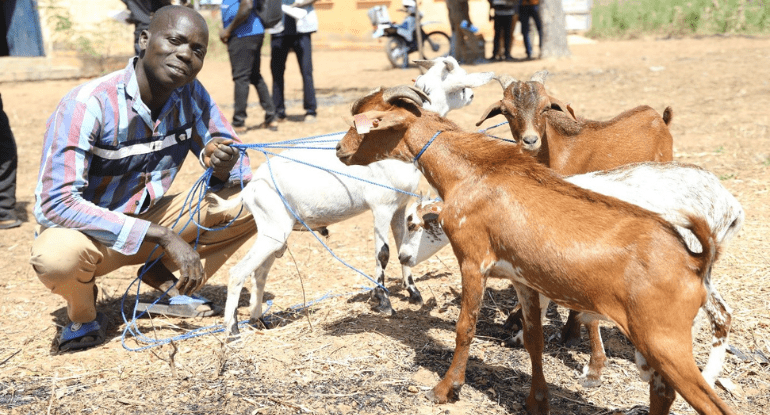
The initial phase of the programme involved identifying production centres and farms capable of supplying the necessary breeding stock. At the end of this stage, the FSRP-Togo acquired sheep and goat broodstock, which were distributed to the targeted farmers, in collaboration with the Institute for Technical Advice (ICAT).
In the Savannah Region, 176 farmers were selected to receive a breeding nucleus of one male and three females each. Of these, 121 were sheep farmers and 55 were goat farmers. A total of 704 breeding stock were distributed, including 121 rams, 363 ewes, 55 bucks and 165 goats.
To guarantee the health and reproductive performance of the breeding stock, brucellosis tests were carried out before they were distributed to the beneficiaries. Mr Tchalon, a biologist at the Institute of Agricultural Research (ITRA), stresses the importance of these analyses: ‘We carry out brucellosis tests on the breeding animals before they are given to the beneficiaries. This zoonosis, which can be transmitted to humans, can unbalance the reproductive system of animals and lead to abortions. These tests enable us to ensure that they are in good health and can reproduce.
Testimonials from beneficiaries highlight the impact of this initiative. Kanfiyéne, a farmer in Naki-Est, shares his experience: ‘I used to rear around ten sheep, which earned me a bit of money, but I suffered major losses. Thanks to the FSRP, I received four sires, including a male. That gave me new hope.
For his part, Daniel, a breeder in Tchamonga, also expressed his satisfaction: ‘I breed for passion, but I lacked the means to develop my business. With these robust sires, I’m convinced that my herd will grow and perform better.
In addition, Daniel had already benefited from an improved traditional sheepfold built with the support of the FSRP, thus improving breeding conditions.
In the seven prefectures of the Savanah Region, 176 farmers have benefited from this initiative, with a total of 704 sheep and goat breeders, including 484 sheep and 220 goats. This intervention is not only helping to strengthen the resilience of livestock farmers, but also to improve food and economic security in the region.
The FSRP-Togo plans to continue and extend its actions in favour of sustainable, high-performance livestock farming, thereby contributing to rural development and the national economy.