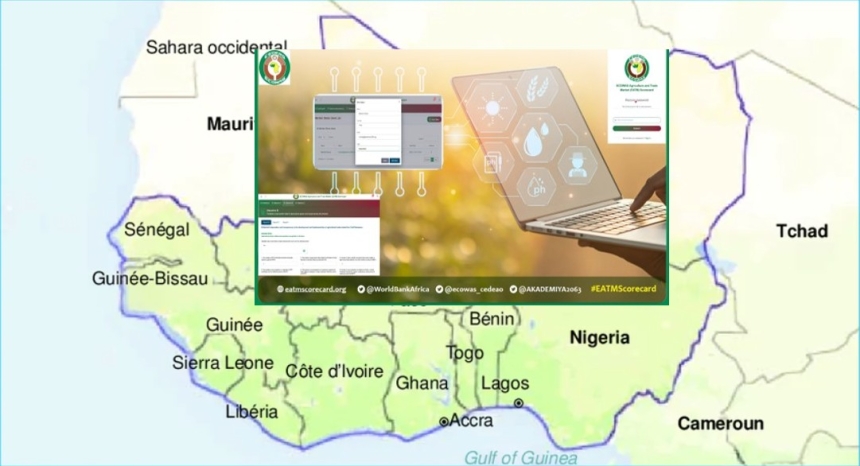
Developed by the ECOWAS Commission, the Agricultural Trade and Markets Scorecard (SCORECARD) is a mechanism for monitoring the implementation of Community protocols relating to the free movement of agricultural, forestry, livestock and fisheries products within the Community. It also aims to identify barriers to intra-regional trade and to provide decision-makers with reliable information to guide policies and interventions in support of agricultural market integration in West Africa.
As part of the implementation of the West African Food System Resilience Programme (FSRP), funded by the World Bank and coordinated at regional level by the Regional Agency for Agriculture and Food (RAAF), with technical support from AKADEMIYA2063, the SCORECARD was rolled out through an initial pilot phase in four countries in the region, namely Ghana, Niger, Sierra Leone and Togo as well as in Chad.
Considering the results achieved, the extension of the mechanism to all Member States was recommended at the 68th Ordinary Session of the ECOWAS Conference of Heads of State and Government, held on 14 December 2025 in Abuja, Nigeria.
Consequently, Benin, Cape Verde, Côte d’Ivoire, The Gambia, Guinea, Guinea-Bissau, Liberia, Nigeria and Senegal are the countries that will implement the SCORECARD in the coming months.
Following online working sessions with stakeholders in these countries, supported by the ECOWAS Commission’s Directorate of Trade, and prior to the roll-out of the tool, missions will visit the countries to engage the relevant national institutions, present the methodology for data collection and analysis, clarify the ECOWAS Commission’s expectations, and define the institutional arrangements necessary for the implementation of the mechanism.
From 2 November 2026, the aim will be to raise awareness amongst national authorities and key stakeholders of the importance of the SCORECARD as a tool for monitoring regional policies relating to agricultural trade and market integration; to identify and validate the national institutions expected to contribute to data collection, coordination and the implementation of the mechanism; and to facilitate the establishment of national teams, in particular through the appointment of focal points responsible for monitoring the process.
Beyond the geographical expansion of the SCORECARD, the approach adopted by the ECOWAS Commission aims to strengthen ownership of the initiative by Member States and Community institutions. In this regard, the involvement of national administrations, technical bodies and stakeholders active in agricultural trade is a key factor in ensuring the availability, reliability and consistency of data.
Ultimately, the SCORECARD should provide a harmonised regional framework to better assess progress made in implementing Community legislation, document barriers to the movement of agricultural products and inform decisions aimed at improving market functioning.
Through this initiative, ECOWAS thus reaffirms its commitment to promoting a more integrated, transparent and competitive agricultural trade area, contributing to the smooth flow of intra-regional trade, the promotion of local produce and the strengthening of the resilience of food systems in West Africa.