Niger: 2,691 women benefit from agricultural processing kits

Published on 4 December 2024

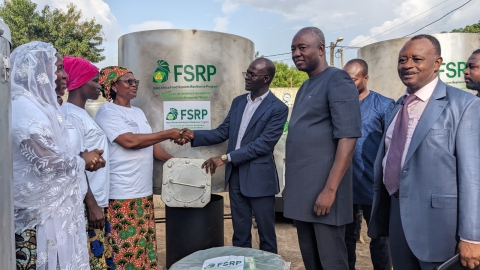
As part of its efforts to empower women farmers in the Tahoua and Zinder regions, the West Africa Food System Resilience Programme (FSRP) Niger has distributed agricultural processing kits to 2,691 women. This initiative aims to improve the living conditions of women processors in rural areas.

In the Tahoua region, 1,804 women processors each received a kit comprising a 50kg bag of soya, 5 litres of oil and a gas stove. In Zinder, 887 women received kits consisting of a 50 kg bag of groundnuts, a rotary groundnut roaster, ten small plastic buckets and a basin.

This support comes at just the right time to help women in rural areas, who often face economic difficulties after the harvest, when the men leave for exodus. During this period, women struggle to meet the basic needs of their families. Thanks to these FSRP donations, they will be able to improve their financial independence and strengthen their resilience. The women expressed their satisfaction with the donations from PRSA Niger, and thanked the authorities for helping to improve their living conditions.

It should be emphasised that FSRP-Niger, through its expected results, contributes directly to the objectives of the Programme de Résilience pour la Sauvegarde de la Patrie (PRSP), an initiative set up by the Niger authorities to support development and food security.

Niger: stakeholders and partners trained on gender-based violence

Published on 3 December 2024

From 24 to 25 June 2024, the coordination team of the West Africa Food System Resilience Programme (PRSA)/Niger organised a training workshop on gender-based violence for members of the complaints management committees of the 5 intervention communes in the Tillabéry region. The training was run jointly by a specialist in gender-based violence (GBV) and a specialist in social development from PRSA/Niger. It targeted 23 people, including 8 women, and included 10 EAS/HS focal points identified to receive complaints about EAS/HS. At the end of the training, a register was shared with all the EAS/HS focal points for recording sensitive complaints.

As part of the implementation of PRSA activities across the four (4) intervention regions (Diffa, Tahoua, Tillaberi, Zinder), an action plan for the mitigation of EAS/HS risks has been drawn up. The plan includes the training of complaints management committee members and the identification of EAS/HS focal points within the Global Complaints Management Mechanism. The role of PRSA Niger's GPM members is to receive EAS/HS-sensitive complaints, register EAS/HS complaints, provide initial psychosocial support, refer victims to holistic care services (health, psychosocial, legal) and conduct investigations into complaints received.

In accordance with the World Bank's Good Practice Note on Preventing and Responding to Sexual Exploitation and Abuse (SEA) and Sexual Harassment (SH). In investment operations involving civil engineering works, such as the PRSA-NE, activities can have repercussions that can have harmful impacts on the environment and populations. To deal with these impacts, especially social ones, the programme offers communities in its intervention zone a framework for lodging any complaints they may have about the implementation of activities. PRSA has therefore set up a Complaints Management Mechanism (MGP) that includes the dimension of gender-based violence, sexual abuse and exploitation and sexual harassment (GBV/EAS/HS).

Diffa: The FSRP supports the strengthening of the fish marketing counter

Published on 3 December 2024

Fishing is one of the main economic activities in the Diffa region, with revenues of nearly 70 billion according to the latest statistics from the Ministry of Livestock. It is therefore an activity that makes a major contribution to ensuring food security and combating poverty in the Diffa region, while also helping to create jobs for young people.

However, the fishing industry faces enormous difficulties, which can be summed up as the problem of organising producers, marketing throughout the chain, collection and conservation techniques and infrastructure.

As part of the implementation of the activities of the Programme de Résilience pour la Sauvegarde de la Patrie (Resilience Programme for the Safeguard of the Homeland), the Government of Niger has targeted the fish sector as a key activity to be promoted to support the people of the Diffa region. It was against this backdrop that the West African Food System Resilience Programme in Niger (PRSA_Niger) was asked to strengthen the fish marketing counter in Diffa.

Based on the constraints currently identified at the fish market, the PRSA will focus its activities on rehabilitating the fish marketing centre by: (i) finalising the civil engineering work on the main building, (ii) building the fish market's own water station, (iii) connecting the fish market to the Nigelec network (the Niger electricity company) and, finally, (iv) providing the fish market with refrigerated lorries to facilitate distribution to other regions.

All in all, more than 3,000 beneficiaries will benefit from this support to improve their income from fish marketing in Diffa.

Niger: the FSRP supports the rehabilitation of 2 satellite data reception stations and trains data management specialists

Published on 3 December 2024

In order to improve the production, access and use of information derived from satellite data in Niger, two (2) satellite data reception stations installed in 2015 at the Ministry of Agriculture and Livestock have been rehabilitated with the support of the West African Food System Resilience Programme.

This support, which covers technical equipment and capacity-building for users, will enable these stations to become operational. This equipment provides important real-time information on temperatures, rainfall, vegetation (pastures, crops), the level of water in ponds and bush fires, all of which is used for forecasting and decision-making in the agro-pastoral sector.

This support will enable stakeholders and partners in Niger's agricultural system to better manage information and facilitate planning and decision-making, while contributing to the regional effort to address environment, climate, food security and related issues by improving access to and exploitation of relevant earth observation applications in Africa.

Following the acquisition and installation of the additional equipment, twenty-six (26) technicians, made up of administrators from the Monitoring for Environment and Security in Africa (MESA) stations and thematic specialists, were trained.

The learners were equipped with techniques for managing a MESA-type station, including the station's organisation chart, the operation of the machines and the systems installed, the reception of satellite data and its quality, the processing and archiving of the data received, the handling of current problems and the use of the data received.

With the knowledge they have acquired, the learners are now able to produce ten-monthly bulletins for use by agropastoralists and agricultural producers, while keeping decision-makers informed.

Niger: the FSRP equips three laboratories with equipment

Published on 3 December 2024

The Central Livestock Laboratory (LOBOCEL) of the Ministry of Agriculture and Livestock; the Laboratoire d'Insémination Artificielle (LIA) of the Faculty of Agronomy at the Abdou Moumouni University in Niamey and the Laboratoire d'Alimentation Animale (LANA) of the Institut National de la Recherche Agronomique (INRAN) under the supervision of the Ministry of Agriculture and Livestock and the Ministry of Higher Education have just been equipped with modern equipment to facilitate the work of researchers.

This material support, at a total cost of two hundred and eighty-two million six hundred and eighty-seven thousand four hundred and seventy-five (282,687,475) CFA francs, will enable these laboratories to work towards the development of livestock production in Niger, as they are Implementing Agencies (IAs) and partner structures of the Regional Centre specialising in Livestock (CRS-EL), which is now destined to become a Regional Centre of Excellence in Livestock for the West African sub-region at ECOWAS level under the impetus of the Food System Resilience Strengthening Programme (FSSRP) in West Africa.

In the long term, the equipment intended for the Central Livestock Laboratory (LABOCEL) will make it possible, through an agreement with the Ministry responsible, to cover the national annual needs for animal health vaccines, estimated at some 36,500,000 doses, including 25 million doses for small ruminants, 10 million doses for cattle and 1.5 million doses for camels, which used to be imported. To help meet the sub-region's needs, those in charge intend to do their utmost to obtain approval for the vaccines from international institutions in the field.

As far as the Artificial Insemination Laboratory (LIA) in the Faculty of Agronomy is concerned, the acquisition of this equipment will improve the training of skills in the field of Artificial Insemination and will be a reference in the ECOWAS region.

Subscribe to