Togo: more than 2,0609 people trained in the processing of foodstuffs with high nutritional value

Published on 1 January 2025

With a view to helping households improve their resilience in the face of food insecurity and malnutrition, women leaders and women from organised groups (RENAFAT, cooperatives and others) have benefited from training in the processing of foodstuffs with high nutritional value, including soya, orange-fleshed sweet potatoes (PDCO) and the preparation of moringa sauces and other vegetables. The aim of the training is to promote nutrition education and good food practice, and to popularise basic concepts of nutrition and food hygiene.

The training took place in the country's three northern regions (Savanes, Kara and Central) and consisted firstly of training the trainers, then training the women leaders from 19 districts, divided into 21 sessions, and finally relaying the training to the contact groups.

In the prefecture of Kpendjal, for example, the sixty or so women trained expressed their joy and gratitude to the FSRP, which had enabled them to benefit from this training through the nutrition division of the Ministry of Health. "We really thank the FSRP project, because thanks to it we have learned how to make doughnuts, milk, cheese and many other products not only for our own consumption but also for sale. This enables us to help our husbands with the family expenses and gives us financial independence", they emphasised.

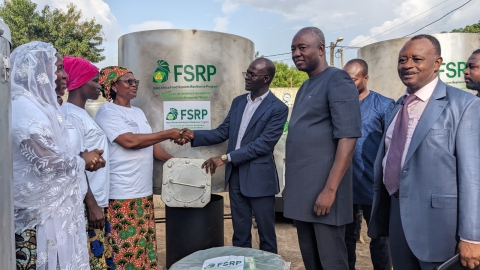
To facilitate the training, the FSRP provided the women with cooking kits consisting of aluminium pots and pans, SMOAC-type stoves, wooden spatulas, aluminium cups and ladles, ordinary stainless steel table spoons, plastic buckets and dishes, and 555-type plates and dishes. This multi-faceted support from the FSRP was greatly appreciated by the beneficiaries, who broke into a dance and expressed their great satisfaction in the following terms: "What the FSRP project has done for us is something we never dreamed of. Projects have been coming to visit us for a long time, but they haven't offered us this equipment, which meant that we had difficulty carrying out the training sessions. We used to lend utensils here and there, but with this equipment from the FSRP, we're really fulfilled.

Through this multifaceted support, the FSRP is helping to reduce poverty among women in rural areas and to lay the foundations for effectively combating food and nutritional insecurity in Togo.

By the end of the training, more than 20,609 women will have been strengthened to date.

Togo: the country demonstrates its commitment to the fight against bio-aggressors

Published on 1 January 2025

Pests and diseases are a major constraint on agricultural development. In line with National Specialisation Centres (NSC) approach promoted by CORAF, Togo, through the Institut Togolais de Recherche Agronomique (ITRA), is positioning itself as an NSC to tackle the challenge of pests and diseases that are hampering food security in sub-Saharan Africa.

ITRA and experts from the region met in Lomé from 09 to 11 August 2023 to discuss issues relating to pests and diseases affecting crops and livestock. These  specialists, including plant pathologists, entomologists, nematologists, weed scientists, as well as veterinarians from Togo and other ECOWAS member countries and Chad, bear witness to the regional commitment to a collective response to these crucial challenges.

A regional approach to combating pests and diseases

The establishment of the NSC on pests and diseases in Togo reflects the region's determination to tackle major agricultural issues from a common perspective. This step forward represents a significant contribution to food security and agricultural development in sub-Saharan Africa and beyond. Similarly, the establishment of this Centre in Togo has the support of the national authorities and is part of the Programme on Food System Resilience in West Africa (PRSA/FSRP), funded by the World Bank.

In addition, the National Specialisation Centre (NSC) concept is perfectly aligned with the regional commitment to integration, particularly in the ECOWAS region. This approach aims to pool research efforts to meet common agricultural challenges and exploit the comparative advantages of each country in a specific value chain.

Synergy for mutual research

Togo joins other countries in the region that have already set up NHAs in areas such as maize, coarse grains, livestock, fruit and vegetables, roots and tubers, rice, plantain, aquaculture and mangrove rice. This initiative reflects the growing importance of agricultural research and development in meeting regional food and environmental challenges.

By capitalising on the experiences of previous NSCs, Togo is well positioned to advance pest management and contribute to regional food security. The successful launch of the CNS bioagresseurs demonstrates Togo's willingness to address agricultural challenges in a proactive and innovative way, with the support of CORAF and ECOWAS and other regional partners. This example illustrates how agricultural research and development can play a crucial role in achieving sustainable and resilient agriculture, while strengthening regional cooperation and partnerships.

Togo: the Government commits to respecting environmental and social standards in the implementation of the FSRP

Published on 15 December 2024

The Togolese government has received additional funding from the Global Agriculture and Food Security Programme (GAFSP) to implement the West African Food Systems Resilience Programme (FSRP), the aim of which is to increase preparedness for food insecurity and improve the resilience of food systems in Togo.

In accordance with the environmental and social standards (NES) applicable to projects financed by the World Bank, an Environmental and Social Commitment Plan (PEES) has been drawn up. The development of this plan, which is a prescribed instrument for assessing and managing environmental and social risks and impacts, demonstrates the government's commitment to complying with environmental and social standards. It sets out the measures and actions for effectively managing the environmental and social risks associated with the project's activities, and specifies the resources, levels of responsibility and deadlines for implementation.

The PEES document thus drawn up is part of the day-to-day management of the FSRP and can be consulted at the FSRP/Togo national coordination office ( https://agriculture.gouv.tg/documentation/ ).

Togo: agricultural tools and inputs acquired for 1,727 market gardeners, including 719 women

Published on 15 December 2024

In support of the implementation of the Emergency Programme to Strengthen Resilience in the Savannah Region (PURS), the West African Food System Resilience Programme (FSRP) in Togo distributed agricultural inputs and tools to 1,727 market garden producers, including 719 women from the Savannah Region and the Kéran Prefecture, on 24 August 2023 in Dapaong.

Aimed at improving the productivity of the targeted farms, these inputs and tools, estimated at more than 613 million FCFA, are made up of certified tomato, chilli and onion seeds for each producer; market gardening tools (spraying machines, wheelbarrows, watering cans, rakes, shovels, hoes, cutters, etc.), fertilisers and biopesticides.

As a beneficiary, Mrs Minlékibé does not hide her joy: "I am particularly moved because the FSRP project that I heard about, I had never imagined being a beneficiary. But today I am one. I would like to thank all the partners for the support they have given us, and I would like to express my gratitude to the Head of State for allowing these tools to reach us.

Regional and central directors, coordinators, and local and administrative authorities from the region present at the official distribution ceremony for the agricultural inputs and tools encouraged the beneficiaries to make good use of them in order to improve their production and therefore their income. 

Togo: 180 groups of women and young people made aware of seed regulations and inclusive employment in the sub-sector

Published on 12 December 2024

From 27 to 28 July 2023, a regional awareness-raising tour brought together women's and youth groups in Atakpamé and Kara on seed regulations and inclusive employment in Togo's seed sub-sector.

Organised as part of the implementation of the Programme for the Resilience of the Food System in West Africa (PRSA-Togo), this activity enabled new people enter the agricultural seeds and seedlings value chain in order increase supply of quality seeds and seedlings in the country. For two days, officials from the Agricultural Seeds and Seedlings Department informed 180 youth and women's groups about the various aspects of seed regulations in the ECOWAS zone, as well as job in Togo's seed sector. This awareness-raising event was well attended, with active participation from all stakeholders.

In both Atakpamé and Kara, participants shared their experiences as seed producers and the impact of the support they have received from the Ministry of Agriculture through its various development projects. Wolou Assamati, a seed producer based in Atakpamé, gave an example: "My name is Assamati Wolou and I'm a seed producer. I've been producing seeds since 2009. At the beginning, we planted areas of 2 hectares, sometimes 1 or even 0.5. But in 2013, the DSP and the PADAT and PPAAO projects trained us. Things changed from then on. At the moment, I have more than 15 hectares of maize and 20 hectares of soya. With the DSP, we certify the seeds and have also set up sales outlets in the villages to organise the marketing of our seeds. (...) We also work with inspectors who visit our fields 2 or 3 times before harvest.

In Kara, the proceedings were chaired by the Regional Director of Agriculture for the said region and provided an opportunity discuss the criteria for accessing the PRSA's financial instruments through its windows and the contribution of the seed sector support fund set up since 2014 by the Government. Discussions also focused on the major innovations undertaken within the Ministry of Agriculture to boost the sector, in particular the agricultural transformation agency and the new department of entrepreneurship and agricultural financing.

It should be noted that this awareness-raising tour comes as a prelude to CORAF's technical support, which consists of training seed producers on seed value chains and the creation of an inclusive business model in order to contribute effectively to the scaling-up and promotion of quality seeds.

Togo/Agricultural season 2023-2024: multi-faceted support for more than 29,000 farmers thanks to the PRSA

Published on 12 December 2024

More than 29,000 beneficiaries in the Savannah region and the Kéran prefecture have benefited from multi-faceted support in the form of certified rice and soya seeds, market gardening tools, biopesticides and fertilisers as part of the implementation of the West African Food System Resilience Programme (PRSA) to significantly increase agricultural productivity, boost producers' incomes and ultimately ensure sustainable food and nutritional security in Togo.

This intervention by PRSA-Togo is in line with the many actions that the project is implementing as part of the Emergency Programme for the Savannah Region (PURS), designed to strengthen the resilience of the populations of this northern zone of Togo. After receiving the kits, the beneficiaries expressed their satisfaction. This is the case of LANKOME Tilate, a satisfied beneficiary from Tampialime in the prefecture of Tandjouaré.

"My name is LANKOME Tilate and I come from the village of Tampialime in the prefecture of Tandjouaré. Our cooperative has been identified to benefit from the improved rice and soya seeds that the FSRP project has acquired for us. I sit on our cooperative's management committee as treasurer. Our organisation is a ZAAP* cooperative. Before, we used to use the old crops as seeds, but this time, with the certified seeds that the FSRP has bought for us, we are very happy. We're not going to use the old seeds any more. We're going to use these seeds in the firm belief that their yield will be better. This will enable us to meet the needs of our husbands and children, so that we can have a peaceful family environment. We can therefore say that this support heralds a better tomorrow for us women farmers. We would like to thank the Togolese government, specifically the Minister of Agriculture and the FSRP project, for this support, which will have a positive impact on our harvest and benefit the whole family," she says, happy and optimistic.

Togo: the Participatory Integrated Climate Services Agriculture approach is being rolled out at farm level

Published on 12 December 2024

One of the sectors most affected by the effects of climate change agriculture. In rural areas, climate change directly affects producers and exposes households to food insecurity. The basic natural resources of production systems are sensitive and deteriorating.

In order increase the resilience of production systems to the effects of climate change, the Food System Resilience Programme in West Africa (FSRP Togo) is supporting the training of facilitators for the implementation of the Participatory and Integrated Climate Services Agriculture (PICSA) approach in rural and farming communities.

The aim of this training is to help build farmers' resilience to climate variability and change, with a view to improving agricultural productivity.

The training took place in two phases. The first (theoretical) phase involved training facilitators from the Institut Togolais de Rechers Aagricoles (ITRA), the Institut de Conseil et d'Appui Technique (ICAT), the Agence Nationale de la Météorologie (ANAMET) and CONACILSS. The second phase (practical) took place in the field at Farendè in the canton of Lama-tessi, Binah prefecture, and involved more than 90 local producers.

The field work involved drawing up a resource allocation map, a seasonal calendar, calculating the probabilities of agro-climatic characteristics based on historical data, and risk management. It was an interactive and participatory session that enabled the facilitators and farmers to become more familiar with the PICSA approach, with a view to improving resilience to the effects of climate change in Togo.

The FSRP supports the training of 3,000 farmers in the ZAAPs of southern Togo in agro-ecological practices and sustainable land management.

Published on 12 December 2024

In the specific context of climate change, characterised by drought, irregular rainfall, the proliferation of plant pests and the development of harmful bacteria leading to the impoverishment of arable land, the adoption of agro-ecological practices is the best strategy for achieving food and nutritional security, combating poverty and creating jobs in rural areas through the sustainable use of developed areas.

To this end, the West African Food System Resilience Programme (FSRP) is supporting the Togolese Coordination of Farmers' and Agricultural Producers' Organisations (CTOP) to train 3,000 farmers operating the ZAAPs in southern Togo through its agro-ecological farm school scheme.

This first training course, which covers the Maritime, Eastern Plateau and Western Plateau regions, aims to strengthen the sustainability of the production systems practised in the ZAAPs and the resilience of the beneficiary households. A total of 3,000 farmers will be trained in several stages, the first of which consists of training 300 relay farmers identified in 60 ZAAPs, who will in turn be responsible for relaying and training farmers in their respective ZAAPs in the agro-ecological practices learned during the training.

The launch ceremony for this series of training courses was marked by the handing over of kits consisting of boots, waistcoats and learner's manuals donated by the project to the participants.

About ZAAPs

The Zones d'Aménagement Agricole Planifiées (ZAAP) are production blocks of at least 100 ha of monoculture on which producers are concentrated for supervised production. They ensure large-scale production and a regular supply of raw materials for processing units.

To date, the development of the sites has enabled the ZAAP strategy to be outlined, based on principles derived from the government's "Togo 2025 strategic vision".

Sustainable land management: adoption of organic manure to restore land

Published on 4 December 2024

In the north of Togo, farmland is becoming increasingly nutrient-poor due to erosion (on hillsides and mountainsides), climate change and the excessive use of pesticides and mineral fertiliser by farmers.

To reverse this trend, the Ministry of Agriculture, Village Hydraulics and Rural Development, as part of the implementation of the FSRP, has trained 4,103 beneficiaries in sustainable land management (SLM) practices in 60 Planned Agricultural Development Zones (ZAAP), to help them adopt these practices and thus contribute to restoring degraded land.

In the Kadjalla ZAAP in the Niamtougou prefecture, Atou Jean was one of the beneficiaries of this training, which enabled him to learn techniques for preparing compost, BOKASHI organic fertiliser, apichi and mulching, which he applies to his plots while reducing the use of mineral fertiliser.

Image
Plot receiving only mineral fertiliser
Image

On a 1 ha maize plot, he applied 100 kg of organic fertiliser two weeks before sowing. A few days later, he added 75 kg of mineral fertiliser (50 kg of NPK and 25 kg of urea). On the other area, he applied only mineral fertiliser (300 kg of NPK and 150 kg of urea) without adding any organic fertiliser.

The maize plants that had received the organic fertiliser and a little mineral fertiliser were vigorous and growing well, whereas those on which he had only applied mineral fertiliser were yellow and had difficulty developing.

He is the attraction in the village of Outi, and has no hesitation in explaining his secret. Atou Jean is happy to know that he is contributing to the restoration of the land in his village, and invites his fellow farmers to follow him down this promising path: “I’m asking all the farmers in the region to adopt bokashi, which is a reality and really helps to restore the land. The use of fertiliser is increasingly impoverishing our land and is dangerous for ourselves. Although boKashi is a bit tricky to prepare, it costs nothing compared to fertiliser, which is increasingly expensive.

The adoption of organic manure in northern Togo is an essential farming practice for restoring soil fertility. Organic manure, which includes compost, crop residues and animal waste, is an environmentally friendly alternative to chemical fertilisers. Organic matter improves soil structure, increasing its capacity to retain water and supply nutrients to plants.

By improving soil cohesion, organic fertiliser reduces nutrient leaching and captures the mineral salts needed by plants. Unlike chemical fertilisers, which offer a short-term solution, organic fertiliser enriches the soil on a long-term basis, promoting stable agricultural productivity over the long term. It uses local resources and reduces dependence on expensive inputs, which is particularly beneficial for low-income farmers.

Subscribe to