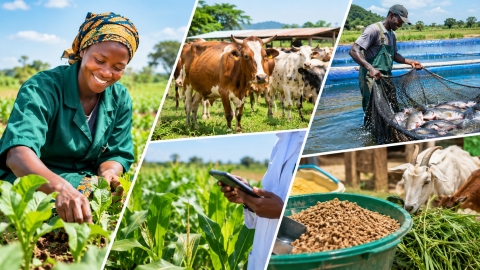
Ghana: the FSRP promotes 15 technological innovations with a view to their adoption by 240,000 beneficiaries

Published on 5 January 2025

The West Africa Food System Resilience Programme (FSRP Ghana) brought together a team of scientists, practitioners, extension workers, value chain actors, institutional representatives and other stakeholders from the 20th to the 21st to identify, examine and select locally developed, tested and proven innovations and technologies for climate-smart agricultural practices in Ghana.

They also examined locally applicable technologies developed by the PRSP's regional research partners - the West and Central African Council for Agricultural Research and Development (CORAF) and the CGIAR - a consortium of international agricultural research institutions. The exercise is in line with the implementation of a key PRSP objective to promote at least 15 climate-smart, nutrition-sensitive, youth-friendly and gender-responsive technological innovations for adoption by 240,000 beneficiaries in selected PRSP value chains.

Based on their experiences and interactions with local and foreign stakeholders, the experts shared their knowledge of the innovative agricultural technologies they have studied, developed, tried and tested. These exchanges were followed by debates and deliberations on the implications, challenges and opportunities of the technologies presented. The experts also dissected advances in genetic engineering - including plant and animal breeding; sustainable plant and animal production systems; advances in animal health; sustainable agroecology and agroforestry engineering technologies - including mechanisation and irrigation, among a range of topics.

The team has already developed the first draft of a set of technologies (a bouquet of technologies in the FSRP value chains - rice, maize, soya, poultry and tomatoes), from soil preparation to waste management.

The national coordinator of the FSRP-Ghana, Osei Owusu Agyeman, urged the think tank to take into account the cost-benefit analysis of the adoption and use of these new technologies. In his view, this would enable potential beneficiaries and consumers to better evaluate and compare existing technologies, taking into account the themes on which the FSRP-Ghana's activities are anchored: "We should at all times be thinking about how to attract private sector interest in everything we do," he added.

To ensure better visibility and understanding of innovative agricultural technologies among stakeholders, the FSRP will promote increased awareness and interest in the adoption of new agricultural technologies among its priority commodities. To this end, a catalogue of appropriate technologies to be disseminated by the FSRP and MOFA will be developed, training protocols will be updated, on-farm demonstrations will be set up, and demonstration manuals and videos will be produced to train farmers in the application of these innovations.

The team is also responsible for identifying opportunities for the development of future innovations and for devising ways of scaling up these technologies in the agricultural sector.

Ghana: the FSRP evaluates four (04) markets with a view to their renovation

Published on 3 January 2025

A team of specialists in agricultural trade issues visited four markets in the northern, central and southern districts of Ghana to assess their viability as centres for cross-border trade in agricultural products in the West African sub-region.

This activity, part of the implementation of the West African Food System Resilience Programme (FSRP), provided an opportunity for discussions with market women, district assembly authorities and the directors of agriculture in the districts where the markets are located. The markets assessed by the team are the Fumbisi market in the North region, the Abofour and Agogo markets in the Ashanti region and the Denu market in the Volta region.

For each market, the assessment covered market infrastructure, market management, viability of regional trade and marketing, safety and disaster management systems, food handling, food safety and quality controls, and welfare provisions.

The FSRP aims to support key value chain activities through the implementation of relevant interventions to improve food insecurity preparedness and strengthen the resilience of agri-food systems in West Africa. In Ghana, the project's priority value chains are rice, maize, soya and poultry (with a focus on broiler production). One of the PRSF's main interventions, called Component 3, focuses on promoting regional trade as part of measures to ensure food security and resilience in member countries. Farmers and traders in the sub-region engage in substantial cross-border trade in agricultural products, but this activity faces a number of challenges that impede the free flow of trade. The aim of this activity is therefore to facilitate trade and the movement of agricultural products between Ghana and its neighbouring countries in these main market centres.

The team also examined the state of safety and disaster management in each market. This included recurring and potential disasters, presence or proximity of fire stations or hydrants, emergency coordination protocols or arrangements, prevalence of crime, internal security arrangements, presence or proximity of police stations, police posts or barriers.

In line with standard FSRP requirements, the team assessed the attention paid by each market to the well-being of its users in terms of health care, welfare and hygiene. The presence of health posts, infirmaries or first aid facilities was studied, as was the existence of crèches or nurseries on the market premises, the proximity of primary schools and the necessary provisions to discourage the prevalence or potential for child labour practices.

The four (04) markets were selected for evaluation after extensive consultations with regional and district directors of agriculture, as centres for promoting trade in the FSRP's value chain products - rice, maize and soybeans. The FSRP will carry out rehabilitation and upgrading work to better position them as centres for the expansion of agricultural trade in the region.

The results of the evaluation exercise will be presented to the PRSP Project Implementation Unit, the Ministry of Food and Agriculture and the World Bank for further consideration. 

The Ghana Standards Authority, with the support of the FSRP, is conducting a review of product standards in the rice, maize, soya, cowpea and poultry value chains.

Published on 3 January 2025

The West Africa Food System Resilience Project (FSRP), in collaboration with the Ghana Standards Authority, has carried out a first phase review of product standards for FSRP value chain products: rice, maize, soya, cowpea and poultry.

The aim of the review was to establish an industry-wide consensus on acceptable food standards as a means of building resilience.

Participants were drawn from various national regulatory organisations, including the Ghana Standards Authority (GSA), the Food and Drugs Authority (FDA) and the Environmental Protection Agency (EPA), as well as key departments of the Ministry of Food and Agriculture (MOFA). Other experts came from the Ministry of Trade and Industry (MOTI), the Ghana Commodity Exchange (GCX), and a number of private players in the value chain for the aggregation and processing of selected commodities.

The analyses and reviews targeted rice, maize, soya and poultry, focusing on general and specific requirements, in accordance with definitions, hygiene, contaminants, microbiological limits, physical and sanitary characteristics, pesticide residues, mycotoxins, grading, compliance criteria, sampling, testing, packaging, labelling and storage, among others.

The FSRP, under the aegis of the Ministry of Food and Agriculture (MOFA), is financed by the World Bank and coordinated by ECOWAS, with the aim of mobilising national and sub-regional forces to sustainably reduce food insecurity in West Africa. Component 3 of the project focuses on facilitating the integration of markets and trade, consolidating food reserve systems and developing strategic value chains.

Allswell Emmanuel, agricultural economist at the FSRP's national coordination office, explained that the project would provide technical assistance to assess the state of the current product certification regime in the selected value chains, and develop an action plan to improve it, including improving standards for rice, maize, soya and poultry. The experts were therefore tasked with reviewing existing standards to ensure that they are adapted to current and emerging trends (both locally and internationally) and to identify any gaps. They also critically examined the process of updating existing standards, in order to keep abreast of new trends (both locally and internationally), and to develop awareness and training programmes on the updated standards and how to comply with them.

The FSRP's national coordinator, Mr Osei Owusu Agyeman, stressed the need to widely disseminate the results of the product standards review to value chain players and the general public, in order to ensure mass awareness, appreciation and mutual respect.

For the Ghana Standards Authority, among other benefits, compliance with standards makes it possible to improve risk management, reduce production and transaction costs and enhance the competitiveness of businesses.

The participants recommended that the FSRP consider acquiring certain standards documents from the GSA for the beneficiaries of its projects, in order to encourage the adoption of and compliance with the standards.

The products examined are currently undergoing technical control protocols at the GSA with a view to possible modifications, before being approved for industrial adoption.

Ghana/Development of the poultry industry: discussions initiated with players in the sector

Published on 2 January 2025

As part of the implementation of the West African Food System Resilience Programme (FSRP) in Ghana, discussions have begun with poultry industry players and manufacturers with a view to setting up a poultry intensification programme in the country. The aim of the programme is to produce at least 2 million broiler chickens by the end of 2024, as part of the Ministry of Food and Agriculture's (MoFA) strategy to revive the broiler industry and increase the rate of adoption of modern and improved poultry production, processing and marketing techniques.

Discussions with stakeholders focused on key issues in the value chain, including feed quality and supply, vaccinations, strict compliance with biosecurity requirements, weight and general health checks on chickens, quantities to be supplied per cycle, processing and packaging, meeting delivery deadlines, pricing and marketing of processed and frozen Ghanaian broilers.

The President of the Poultry Farmers Association, Victor Oppong Agyei, expressed his gratitude to the government and the World Bank for setting up the poultry intensification programme, and pledged that members would comply with the terms and conditions of the programme in order to move Ghana's poultry industry forward.

Officials from the Department of Animal Production and the Directorate of Veterinary Services of the Ministry of Food and Agriculture (MoFA) reminded the industry that the quality of their poultry, packaging, strict professionalism and perfection in the conduct of the poultry business are key to ensuring profitable markets. Mr Osei Owusu Agyeman, PRSP Coordinator in Ghana, highlighted the three guiding principles of the PRSP, namely "sustainability, ownership and public-private partnership" before challenging the beneficiaries to strive to ensure that Ghana's poultry industry thrives and expands beyond the programme. 

Ghana: official launch of the FSRP

Published on 2 January 2025

"Joining forces to manage food system risks in West Africa" was the theme around which stakeholders and partners officially launched the West African Food System Resilience Programme (FSRP) for Ghana on 7 December 2023 in Kumasi.

In the presence of administrative, political and customary authorities, as well as the World Bank and ECOWAS, the launch ceremony focused on introducing the FSRP to Ghana, mobilising stakeholder support for its implementation and promoting business opportunities under the FSRP.

ECOWAS, which was invited to the ceremony, congratulated Ghana on its participation in this flagship programme, which it sees, as the programme's coordinating institution, as a unique tool that will strengthen regional integration by facilitating regional trade in food products, as well as exchanges of technologies and innovations and the mobility of researchers and players between countries, which will contribute considerably to the implementation of ECOWAP, the regional agricultural policy, and thus accelerate the transformation of the agricultural sector in the sub-region.

The representative of the Regional Coordinator of the FSRP, Dr Gaoussou Diarra, reiterated ECOWAS's willingness to provide institutional and technical support to all stakeholders and partners to ensure the success of the programme.

At the end of the day, the 300 participants noted the government's commitment to joining forces with sister West African nations and the World Bank to promote the best interests of Ghana's farmers. With the presentations of the main activities of the FSRP Ghana, the public is better informed of the magnitude of the work to be done and its expected impact on the lives and livelihoods of the targeted beneficiaries. The operational principles of sustainability, ownership and public-private partnership of the PRSF have been clearly defined.

The beneficiary communities also noted the commitment of the political, administrative and customary authorities to the success of the FSRP in Ghana.

Ghana: the World Bank's Country Director visits PRSP intervention sites

Published on 2 January 2025

The Country Director of the World Bank, Mr Pierre Laporte, paid a working visit on 21 and 22 October 2023 to certain communities in the East, Greater Accra and Volta regions, which will benefit from the West Africa Food System Resilience Programme (FSRP). He was accompanied by Ms Ashwini Rekha Sebastian, World Bank Team Leader for the FSRP-Ghana, Mr Osei Owusu Agyeman, FSRP National Coordinator, and technical experts from the project. These reconnaissance visits were intended to enable Mr Laporte to observe the final preparations for the launch of the project and to interact with the intended beneficiaries.

The FSRP is intended for farmers and value chain players in the lower Volta basin, the white/red Volta basin and the middle belt, as well as in northern Ghana. The field trip took him to the right and left banks of the Kpong Dam: the Kpong Irrigation Scheme at Asutsuare in Greater Accra and Akuse in the Eastern Region, and the Kpong Left Bank Irrigation Scheme (KLBIS) at Torgorme in the North Tongu District of the Volta Region, where Mr Laporte interacted with engineers, farmers and agricultural value chain actors. Project engineers took him on a tour of agricultural sites where permeability works have been carried out under the Ghana Commercial Agriculture Project (GCAP) and are due to be completed under the FSRP. He also visited a number of farms and spoke to key players about the nature of the food production value chain in the region, who shared their concerns with him, including their dependence on the sun to dry harvested rice, the destructive effect of heavy goods vehicles on their feeder roads and the low income from the sale of their produce.

The head of the World Bank task force said that the project would take into account the installation of rice mills with dryers in the region, and would target private sector players to facilitate the drying, storage and warehousing stages of the value chain.

The FSRP project coordinator, Mr Owusu Agyeman, assured them that the FSRP would be of immense benefit to those who want to take agribusiness to the next level. He added that one of the main objectives of the West Africa Food System Resilience Programme (FSRP) is to ensure that conflicts, climate change and other unpredictable factors do not disrupt the destiny and nutritional livelihood of farmers, families and communities. He advised farmers and key players in the agricultural sector to register their details with the FSRP and PFJ 2.0 database, in order to obtain timely information on the opportunities available to farmers and how to access or benefit from them.

Ghana: Government allocates $40 million to 26,000 farmers affected by the overflow of the Akosombo dam under the PRSF

Published on 2 January 2025

Nearly 26,000 farmers have been forced to evacuate their homes in eastern Ghana at the request of the authorities, due to flooding caused by several days of heavy rain.

Farmers saw their fields completely destroyed and schools closed after the Akosombo and Kpong hydroelectric dams burst their banks.

The worst affected areas are Sogakofe, Sege and Mepe in the Volta region. These submerged towns, home to fishermen and farmers, have been left without water and electricity. The inhabitants have had to be moved to places of refuge.

Paul Martey explains that the rising water "has had disastrous consequences" for his family. "For over a week, we've been unable to do anything about the water," he laments.

Ghana's Minister of Food and Agriculture, Bryan Acheampong, has ordered $40 million in World Bank funding for farmers in the Volta region who lost their farmland when the Akosombo dam overflowed.

According to Mr Acheampong, these funds will help to restore the livelihoods of the worst affected farmers.

Speaking at the launch of the "Youth In Agriculture" initiative as part of the Youth Employment Agency's employment module, Mr Acheampong said that farmers would be well looked after.

"To our friends, brothers and families in the Volta and eastern part of the Akosombo Dam trajectory, we have all witnessed the devastation resulting from the necessary action that the Volta River Authority had to take to save the Akosombo Dam. As a result, many farmers have been affected and many have seen their crops completely wiped out".

"I have ordered that, because of this emergency, $40 million of the World Bank-funded African Food Systems Resilience Programme be restructured to restore farmers whose farms have been wiped out as a result of the necessary action taken by the Volta River Authority to save us all.

Subscribe to Ghana