Every year, researchers, entrepreneurs, producer organisations and young innovators develop solutions capable of improving productivity, strengthening climate resilience and creating economic opportunities in rural areas. However, many of these innovations struggle to make the leap from the laboratory, workshop or prototype stage to actual adoption by producers and markets.
It is precisely to address this challenge that the Abdoulaye Touré Agricultural Innovation Prize (PIA-AT) was established by CORAF, with support from the West Africa Food Systems Resilience Programme (FSRP) funded by the World Bank.
Far more than just an award, this prize now serves as a genuine mechanism for accelerating agricultural innovation, enabling solution providers to test, improve, disseminate and scale up their technologies for the benefit of farmers, agri-entrepreneurs and consumers. “For technologies developed in laboratories and start-ups to reach producers on the ground, we need to strengthen the links between research, extension services, public policy and the private sector,” says Dr Kalifa TRAORÉ, Chair of CORAF’s Board of Directors.
From research to adoption: the unique added value of the PIA-Abdoulaye Touré
One of the award’s key strengths lies in its ability to bridge the gap that often separates innovation from its large-scale implementation. Thanks to support from the FSRP and the World Bank, CORAF offers winners not only recognition, but also the means to improve their innovations, demonstrate their effectiveness in the field and promote their adoption. “CORAF recommends that the 23 countries of West and Central Africa that make up the organisation integrate technology transfer and agricultural innovation into their policies. This will involve making the transfer of innovations a priority in national and regional agricultural policies. Funding mechanisms need to be accelerated in order to create and operationalise regional funds dedicated to agricultural innovation,” explains Dr Kalifa TRAORÉ.
The results observed among the winners of the second edition clearly illustrate this dynamic.
Accelerating mechanisation tailored to smallholder farmers
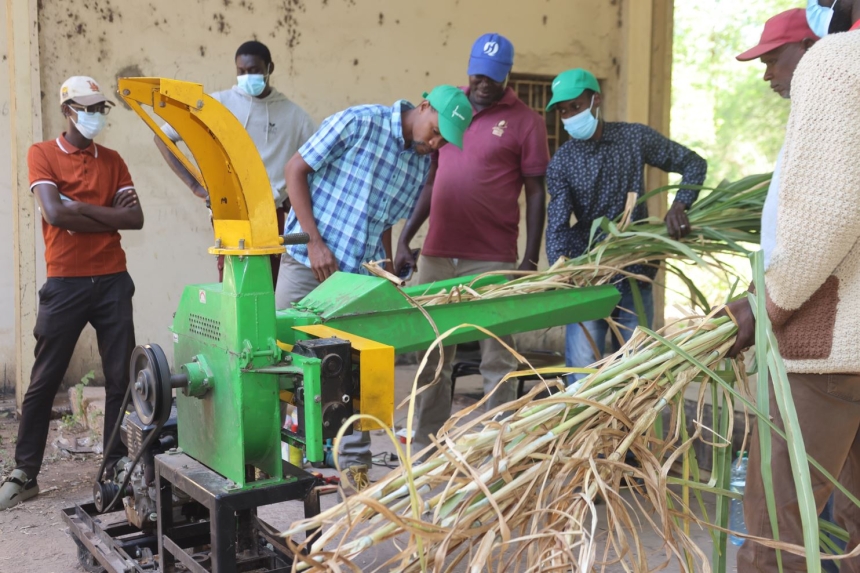
In Togo, Mr M’bantana Guéma, first-prize winner in Category 1, used his grant to refine mechanised solutions for the cultivation and harvesting of ‘egusi’ (seed squash).
Thanks to the funding received, he was able to:
• Train 47 rural stakeholders, including representatives of agricultural cooperatives and women’s organisations;
• Improve the skills of six young people from rural areas in the use of mechanised equipment;
• Set up a two-hectare pilot plot to test its prototype harvester-shredder;
• Provide mechanised services to a cooperative comprising 172 producers, including 27 women.
Most importantly, the prize enabled her to begin manufacturing prototypes of a harvester-shredder and a new husker.
Manufacture of a husking and grinding machine
Strengthening biological innovations for resilient agriculture
The second winner in Category 1, Ms Mariamma Faye, used her funding to improve the production process for Silicoderma, a biostimulant and biocide based on beneficial micro-organisms.
The support received from CORAF enabled her to:
• optimise the growth of the Trichoderma fungus;
• improve the biological processes that promote the production of the desired molecules;
• enhance recovery and purification techniques;
• acquire equipment suitable for larger-scale production.
These improvements have made the technology more robust, more reliable and more easily transferable to a commercialisation phase.
Digital technology serving producers and consumers
Agricultural innovation is not limited to production technologies. It also concerns the organisation of markets and the connection between producers and consumers.
It was with this in mind that Ms Hélène Ndiaye, from the RESAPAC network and winner of Category 3, used her funding to gain a better understanding of her customers’ expectations through an in-depth market survey.
The results highlighted strong consumer confidence in the agroecological products sold by RESAPAC. They also revealed the need to develop a more modern business model, combining:
• Physical markets;
• Pre-order systems;
• Delivery services;
• Simplified digital tools for purchasing.
This approach paves the way for better integration of digital technology into agricultural value chains and enables producers to capture greater added value whilst meeting new consumer expectations.
A strategic FSRP instrument implemented by CORAF
Through the Abdoulaye Touré Agricultural Innovation Award, CORAF demonstrates that investing in innovation does not simply mean funding research. It also involves creating the necessary conditions for innovations to reach farms, businesses and markets.
The prize thus helps to:
• Accelerate the adoption of agricultural technologies;
• Shorten the time between invention and market launch;
• Strengthen agricultural entrepreneurship;
• Create jobs for young people and women;
• Promote the modernisation of food systems;
• Encourage the exchange of experiences between countries in the region.
Investing in innovation to build the food systems of tomorrow
The 106 applications received for this third edition offer hope for the future of agriculture in West and Central Africa. Behind each one lie solutions capable of improving productivity, strengthening climate resilience, reducing post-harvest losses and creating new economic opportunities.