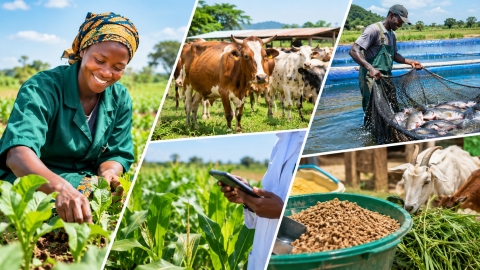
FSRP input kits to improve agricultural productivity and strengthen the resilience of producers in the Kéran prefecture in Togo

Published on 3 March 2025

In most regions of Togo, where 90% of the economy is based on agricultural and pastoral activities, farmers face major challenges. These include declining soil fertility, limited access to water and finance, the impacts of climate change and, above all, restricted access to seeds and fertilisers, the costs of which remain high.

In order to strengthen the resilience of vulnerable farmers, who often only practise subsistence farming, the West African Food System Resilience Programme (FSRP) in Togo is implementing initiatives aimed at improving the productive capacities of beneficiary farmers. One of the programme's flagship initiatives is the distribution of input kits consisting of improved seeds and fertilisers.

The 2023 agricultural season in the Kéran prefecture (Kara region) has been a turning point for local producers, thanks to the provision of certified seeds and fertilisers. A total of 1,562 farmers, 45% of them women, benefited from this 50% repayable input credit to improve their yields.

Thanks to the distribution of rice and soya seeds and fertilisers, farmers in the Kéran region have been able to plant a total of 400 hectares spread across the region's 9 cantons. This initiative has not only boosted local production, but has also supported the empowerment of women farmers, who make up a large proportion of the beneficiaries. Sambiani Biyina, a soya farmer, explains: "In 2023, I received 20 kg of soya, which enabled me to plant 0.25 ha. At the end of the season, I harvested 450 kg, which I turned into soya cheese for a profit of 200,000 CFA francs. This money enabled me to take care of some family expenses, help my husband build our house, and increase the area to be planted during the 2024 season (0.5ha).

Support for seeds and fertilisers has enabled Kéran farmers to significantly improve their yields. Rice and soya seeds, adapted to local climatic conditions, were chosen for their resistance and production potential. The use of fertilisers has also helped to maximise soil fertility and increase harvests.

Bonalé Kodjo, a rice farmer in Nambou, canton of Pessidé, is married to two women and has four children. He also has 3 nephews to support. "With the support of the FSRP, I received 10 kg of rice seed, 50 kg of NPK and 25 kg of urea. I grow maize, but given the number of family members and the high demand for rice for consumption, I planted 0.25 ha and harvested 600 kg of rice, which I made available to the family. 
The 120,000 CFA francs I used to spend on rice each year are now used for other things.

This year, with the 25 kg seed I've put together, I'm going to plant 0.75 ha for consumption and sale next year. The project has really helped me out of my vulnerability.

This initiative has had a positive impact not only on agricultural production, but also on the community as a whole. Increased harvests have led to better availability of food on local markets, reducing dependence on imports and strengthening the region's food resilience.

The fact that 45% of beneficiaries are women highlights the importance of including women in the agricultural sector. This support enables them to play a key role in food production and contribute to the food and nutritional security of their families and communities.

The efforts made in the Kéran prefecture illustrate the importance of targeted support to improve agricultural productivity and strengthen resilience in the face of climatic challenges. By providing essential resources such as seeds and fertilisers, this initiative is helping to build a sustainable agricultural future for the region. These essential inputs enable farmers to grow more resistant and productive varieties, thereby contributing to greater food security and poverty reduction in rural areas, while creating jobs for young people, like Potey Jérémie, a 33-year-old holder of the Baccalaureate who has returned to the village in 2019 to take up farming: 

"In 2023, I received 10 kg of rice seed from the FSRP, which I sowed on 0.25 ha. I harvested over 500 kg. I sold some of it, which enabled me to start raising guinea fowl. Thanks to the sale of the rice, I was able to finish building my house. I now live in my own home and no longer rent. The PRSF's support has not only given me a job, but also enabled me to live like a civil servant. I would like to thank the World Bank, ECOWAS and the Ministry of Agriculture for their support.

While continuing to provide advisory support to the beneficiaries of 2023, the distribution of seeds and fertilisers continued this year, with 1,197 beneficiaries, 58% of them women, receiving rice, soya, cowpea and maize seeds in the Kéran prefecture. 

Togo : 84,014 farmers adopt innovative practices and climate-resilient agricultural technologies

Published on 26 February 2025

With the aim of promoting the mass adoption of innovative agricultural practices and technologies that are resilient to climate change, the Food System Resilience Programme in West Africa, Togo project (FSRP-Togo) has initiated, since 2022, a series of training courses on good agroecological practices and the dissemination of climate-smart technologies for the benefit of targeted producers.

Thanks to the support of its partner organisations, in particular the Coordination togolaise des organisations paysannes et de producteurs agricoles (CTOP), the Institut de conseil et d'appui techniques (ICAT) and the Conseil interprofessionnel de la filière riz au Togo (CIFR), The FSRP Togo has facilitated practical training in a number of agroecological techniques, including compost making, seed coating, improved fallow, crop association and rotation, and the simple lowland management technique known as ‘smart valley’.

Three years after this support was provided, a survey of farmers carried out as part of the mid-term evaluation revealed perceptible socio-economic changes. On average, 87.65% of beneficiaries have seen their yields increase by 60% and their incomes by around 76%.

This is the case for Kouzotou Baomondom and her colleagues, who swear by the technique of summary management of low-lying rice fields:

‘This year, with smart valleys, we had to set up baskets, plant nurseries and transplant in rows.  We saw that with the little rainfall that arrived, the traps were able to collect water, and the water was used. The fertiliser we used was retained. The run-off water couldn't wash away. The rice really used this fertiliser to grow. This system saved me a lot more money, by using less seed. With the old conventional method, we gained 2.5 tonnes per hectare, but with the smart valleys approach we gained over 5 tonnes per hectare.

FSRP Togo's support has also enabled many farmers who had abandoned their fields for lack of financial resources to get back on their feet, thanks to the project's support.

These various training and support programmes have reached 84,014 farmers, 35% of whom are women, who are practising the techniques they have learned on more than 248 Planned Agricultural Development Areas (ZAAP) and other undeveloped agricultural plots.

Togo: distribution of market gardening tool kits launched for 5,500 producers

Published on 10 February 2025

On 19 December 2024, in Akparè in the Ogou prefecture, the Governor of the Plateaux region, General Dadja MAGANAWE, on behalf of the Minister of Agriculture, Village Hydraulics and Rural Development, symbolically handed over market gardening tool kits to market garden producers.

     This symbolic handover marks the start of the distribution of input kits and small agricultural equipment acquired by the FSRP for the benefit of 5,500 market garden producers (including 2,475 women) identified in the country's six agricultural regions. Each producer will receive a kit comprising seeds (onion, tomato and chilli), a sprayer, 2 watering cans, a hoe, a wheelbarrow, biopesticide, biofertiliser, a shovel, a rake, a hoe and a daba. There are also plans to provide motor-driven pumps for the dynamic solidarity groups, to enable them to obtain a better supply of water to meet the needs of their crops.

This action by the FSRP Togo is part of the additional financing of the GAFSP and aims to strengthen the resilience of vulnerable agricultural populations by improving their productivity through the use of quality tools and inputs. In his opening remarks, the FSRP Togo's delegate operational coordinator said: "This support from the FSRP is a strong commitment from the highest authorities to support and strengthen the agricultural sector as a whole, and by extension, to help improve the living conditions of the population. This is therefore the ideal time to encourage you to make good use of this support, which should enable you to be self-sufficient from now on".

The authorities present in turn urged the beneficiaries to make good use of their kits. The handover was followed by a visit to a market garden production site in Nangbéto.

Togo: 200 soya processors trained to comply with food hygiene standards and diversify the range of processed products on offer

Published on 10 February 2025

In Togo, agri-food processing is a sector that creates wealth and provides jobs for the population. Soya processing is dominated by small-scale and semi-industrial units, with large-scale units now gradually being installed throughout the country.

However, consumption of local processed products is lower than that of imported products, partly because of the hygienic conditions under which they are produced.

To remedy these weaknesses, the Food System Resilience Programme in West Africa (FSRP TOGO) is supporting the training of 200 soya processors in compliance with food hygiene standards, diversification of the range of processed products and packaging presentation. The aim of the training is to teach women about hygiene, quality, hazard control, packaging and good food processing practices, so that they can offer the public a diverse range of good-quality processed products.

Organised in conjunction with the Conseil Interprofessionnel de la Filière Soja au Togo (CIFS-Togo), this training targeted the family of processors organised within the Association Togolaise des Transformateurs de Soja (ATTS), and provided an opportunity to address issues of standards, hygiene, quality and packaging in order to correct shortcomings and offer the public products manufactured under good hygienic conditions.

As far as the FSRP's objectives are concerned, this training contributes to the adoption of nutrition-sensitive technologies by women processors and, in the short and medium term, helps to increase the proportion of nutrition-sensitive technologies and contributes to the implementation of the Togo 2025 roadmap, which itself aims to promote local processing through its third objective, that of strengthening agri-food processing industries and encouraging high value-added agriculture.

The training took place simultaneously from 30 September to 02 October 2024 in Tsévié, Atakpamé and Kara, and from 03 to 05 October 2024 in Sokodé and Dapaong.

Togo: Setting up agro-hydro-meteorological information groups on the ZAAPs of excellence

Published on 10 February 2025

As part of its West African Food System Resilience Programme (FSRP), Togo is continuing its efforts to optimise the dissemination of agro-climatic information to agricultural producers. One of the programme's innovative strategies is based on the creation of groups of relay producers responsible for transmitting this information in local languages to farmers within the Zones d'Aménagement Agricole Planifiées (ZAAP) d'excellence.

This initiative, implemented in collaboration with the Institut de Conseil et d'Appui Technique (ICAT) and the Agence Nationale de la Météorologie (ANAMET), is designed to alleviate the constraints on access to information faced by producers, particularly in a context of increasingly pronounced climate change. Through these information relays, producers in the ZAAPs receive key meteorological data, enabling them to adapt their farming practices and thus limit losses linked to climatic hazards.

In Ountivou, in the Ogou region, and in Atifoutou, in the Moyen Mono, the feedback from producers on this initiative is generally positive. The President of ZAAP Katoré 2 said: "Weather information is vital for us producers. With the climate change we are currently experiencing, this information will help us to organise our farming activities better and limit any losses due to the effects of climate change.

This innovative approach by the FSRP has led to the creation of more than 40 sub-committees within the ZAAP management committees at national level, responsible for relaying agro-hydro-meteorological information. Thanks to these joint efforts, Togolese farmers are better equipped to face climatic challenges, thereby ensuring greater resilience in their farming activities.

Togo: Focal points trained in data collection and processing techniques for the ECOWAS agricultural trade and market scoreboard

Published on 9 February 2025

As part of the implementation of component 3 of the FSRP entitled "integration of regional food markets and trade", an ECOWAS agricultural trade and market scorecard (EATM-Scorecard) has been developed.

The Scorecard is an analysis tool that aims to better document intra-regional trade in agri-food products, identify gaps in agri-food trade policies and strengthen the implementation of regional policies by countries.

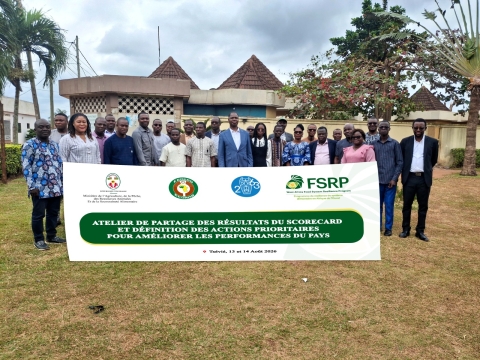
To make the Scorecard operational and regularly produce the information needed to monitor performance in the national implementation of regional policies and regulations, training for the focal points of the structures involved in implementing SCORECARD in Togo was organised from 21 to 25 May 2024 at the Woezon Hotel in Kpalimé.

The aim of the training was to enhance the skills of these focal points in data collection, processing, analysis and reporting methodology. It is organised in a hybrid format, with around thirty participants taking part in face-to-face and online sessions.

Chaired by the Policy, Planning and Monitoring and Evaluation Directorate of the Ministry of Agriculture, the proceedings were opened by Mr Tawo O. Kodjovi, who welcomed participants on behalf of his director, before outlining the objectives and expected results of the five-day event. This was followed by a presentation by Mr NATOR Koffi Edoh, Head of Component 3 of the FSRP, on the SCORECARD programme, its implementation process and methodology.

Mr TCHADOUWA Abasse, who is responsible for component 3 at ECOWAS level, and Mr SUNDAY Odjo, Deputy Director of Operations for Akademyia 2063, took part in the training course.

It should be remembered that this training in Togo follows on from the training of trainers organised by the ARAA/ECOWAS from 19 to 22 February 2024 in Abuja, aimed primarily at teams from the FSRP countries (Burkina Faso, Ghana, Mali, Niger, Sierra Leone, Chad and Togo). Akademyia 2063 provided technical support for the organisation of this workshop.

Donation of certified seeds and fertilisers: FSRP-Togo brings relief to vulnerable farmers

Published on 9 February 2025

This is significant support from the West African Food System Resilience Programme, Projet-Togo (PRSA/FSRP-Togo) to producers in the Maritime region.

On Thursday 1 August 2024 in the Moyen-Mono Vo, Yoto and Lacs prefectures, certified maize and rice seeds were distributed to vulnerable farmers in these areas in preparation for the 2nd agricultural season in southern Togo.

"The selection of these small-scale producers took into account their degree of vulnerability, and despite the fact that they are in these conditions, the way in which they fight for agricultural production", says Kokou Guidigan, ICAT Bas-Mono Branch Manager.

He stresses that once the inputs have been distributed, his agency will continue its advisory support work so that farmers can follow the technical itineraries to ensure acceptable yields.

According to the distribution key, each grower was entitled to 10 kg of maize seed to plant half a hectare, for example. This quantity of seed will enable them to produce at least 2.5 tonnes of maize after production.

"This support comes at the right time, especially as we prepare for the next short rainy season. This second season will start in September and it's important for us to have these seeds available. We're currently harvesting the last crops of the first season, and as soon as we've finished, we'll be preparing the areas for the start of the second season", says Yawavi Kakpo Djakpata, a farmer at Afagnan Totamé in the Bas-mono prefecture.

It should be noted that in 2023, the PRSF received additional funding of USD 20 million from the Global Agriculture and Food Security Programme (GAFSP), with the aim of helping to extend the areas of intervention and the number of beneficiaries, and to take into account additional sectors such as market gardening, small ruminants, roots and tubers, and cowpeas.

For the 2024-2025 agricultural season, the FSRP has extended its activities to all regions of the country, enabling the project to acquire certified rice, soya, maize and cowpea seed and fertiliser for 28,362 producers, including 13,895 women (48.99%).

To date, 98% of certified seeds and fertilisers have been distributed throughout the country. For the 2024-2025 agricultural season, certified maize, rice, soya and cowpea seeds and fertilisers have been distributed to 28,362 vulnerable farmers in rural areas of the country.  

This support, which is an extension of the FSRP's intervention thanks to additional GAFSP funds, will strengthen the support provided in 2023 to around 22,746 producers in the Savanes region and the Kéran prefecture as part of the emergency programme to strengthen community resilience and security (PURS).

Togo: some thirty people trained in the use and appropriation of agrometeorological data collection tools

Published on 10 January 2025

The SIHAM is defined as a Hydro Agro Meteorological Information System. It was initiated as part of component 1 of the FSRP Togo and aims to facilitate the dissemination of agro-climatic information in the form of voice messages and SMS to agricultural producers.

This system was born of the FSRP's ambition to offer an innovative, effective and viable digital solution aimed at improving the dissemination of rainfall forecasts to the beneficiaries of the services provided by Togo's National Meteorological Agency (ANAMET). SIHAM is therefore being set up using a 4-stage deployment approach, the first of which is the training of surveyors.

This training took place on Monday 6 May 2024 in Sokodé and was attended by around thirty people, including 15 surveyors from ICAT and 10 from CTOP. The latter received training in the use and appropriation of the data collection tools made available to them to collect information from the FSRP's target beneficiaries, mainly in the planned agricultural development zones (ZAAP) and at farm level.

For the investigators, this training is highly beneficial. According to them, it reinforces their skills in the use of IT tools in the field and allows them to discover new tools such as SIHAM. "We encourage the FSRP in this innovation", they said.

As a reminder, SIHAM is in its pilot phase and is being developed following an agreement between the FSRP TOGO and the IFDC on behalf of ANAMET. It aims to reach at least 1,000 small-scale farmers and covers the Savannah, Central, Eastern Plateau and Maritime regions, with a pilot phase lasting 04 months.

The FSRP supports the training of 120 tractor operator and ZAAP excellence maintainer candidates

Published on 9 January 2025

There are a total of 120 trainees, including 100 tractor operators and 20 maintenance technicians, all from the "Entreprises Cantonales de Travaux Mécanisés" (ECTM) programme, whose mission is to help increase the rate of mechanisation of cultivation operations.

This initiative, supported by the FSRP TOGO, aims to equip farmers with the skills and tools they need to boost their productivity and improve profitability.

Designed specifically for young people aspiring to become tractor operators with no previous experience, this training equips them with the essential skills to use cutting-edge agricultural technologies effectively and responsibly. Held from 28 March to 7 April 2024 at the Institut de formation agricole (Infa) in Tové, the training combines theory and practice, and focuses on: (i) tractor knowledge and operation, (ii) mastery of manoeuvring and maintenance operations, and (iii) safety and operating rules. According to the trainers, these different aspects will help to turn these aspiring tractor operators into key players in innovation, entrepreneurship and the skilled labour needed to drive forward agricultural modernisation in Togo.

This activity is part of the partnership between the government of Togo and the Office Chérifien des Phosphates (OCP Africa), set up by the Ministry of Agriculture, Livestock and Rural Development through an innovative training programme focusing on agricultural mechanisation.

Carried out by the Agence de transformation agricole (ATA), this training course is supported by the Ministry's technical departments, such as DAEMA and ICAT, to ensure successful implementation and maximum impact.

Through this training programme, the FSRP is contributing to a more prosperous Togolese agriculture, where mechanisation plays a key role in achieving food self-sufficiency and sustainable economic growth.

Togo: 1,290 poultry broodstock distributed to 169 farmers in the Savanes region

Published on 7 January 2025

Raising poultry (hens and guinea fowl) is a common practice in the savannah region, formerly known as the "white gold" region. It is also the area par excellence of the roan tree and of harnessed farming, where communities live partly from the production and marketing of poultry to meet the basic needs of their families.

However, growing threats and pressure from armed terrorist groups have increased the vulnerability of people in the savannah region and had a significant impact on the activities and lives of producers, including livestock farmers. This situation has prompted the Government to take prompt measures to enable the people of this area to improve their resilience.

These measures include the establishment of the Emergency Programme to Strengthen Community Resilience and Security (PURS), under which the FSRP is implementing numerous activities to ensure sustainable food and nutritional security and strengthen the productivity system with a view to achieving effective resilience in rural households.

The FSRP produced and introduced into households a core of broodstock consisting of 2 roosters and 4 hens to serve 169 hen breeders, spread across the 7 prefectures of the Savanes region. A total of 1,290 broodstock, including 1,075 hens and 215 roosters, were distributed to breeders in the Savanes region.

This project aims to boost the productivity of livestock farmers by increasing the number of poultry, whose products (meat and eggs) are not only a source of animal protein needed to cover the food and nutritional requirements of households in general and children in particular, but also a source of permanent family income to meet other non-nutritional needs.

Subscribe to Togo