Togo/Citizen monitoring of FSRP actions: civil society members trained

Published on 6 January 2025

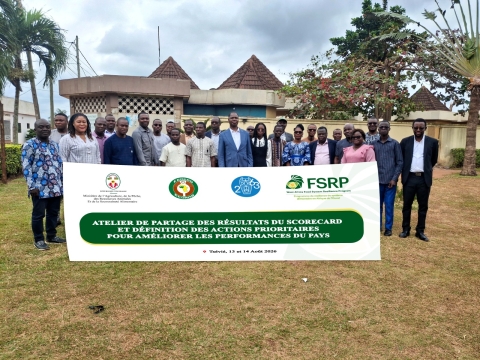
To reinforce the need for accountability in the implementation of its funding, citizen monitoring of activities by civil society has been integrated into the monitoring and evaluation mechanism of the Food System Resilience Programme in West Africa (FSRP-Togo). To this end, training was organised from 18 to 19 January 2024 in Kpalimé (West Plateaux region) for members of civil society organisations who are members of the Coordination pour le suivi évaluation par la société civile (COSESC) (Coordination for monitoring and evaluation by civil society), with a view to ensuring a real understanding of the FSRP's intervention strategies, the key concepts and principles of results-based management, and the monitoring tools for exercising citizen control.

In the space of two days, almost 25 Togolese civil society players, including 10 women, have been equipped to better monitor and control the actions of the FSRP in Togo.

This participative and interactive training session was also an opportunity to share the objectives, expected results, intervention strategy, monitoring and evaluation mechanism and tools, gender mainstreaming, complaint management mechanisms and gender-based violence within the framework of the FSRP. The concepts of citizen control of public action (CCAP) were also presented, with examples.

Togo: the FSRP strengthens the capacities of its stakeholders to take greater account of gender in its activities

Published on 5 January 2025

Women in the agricultural sector, whether producers, workers or agricultural entrepreneurs, face greater difficulties than men in gaining access to productive resources, markets and services. Most women carry out their activities at family level, using low-performance technologies and on a small scale, both in production and in processing and marketing. They have fewer opportunities to farm and less chance of accessing land on a rental basis. Their access is usually limited to plots that are of poorer quality, smaller and further from their homes. These disparities between men and women are a constraint on the development of profitable productive activities and the eradication of poverty in rural households.

To make an effective contribution to overcoming these gender inequalities in Togo's agricultural sector, the FSRP has supported capacity-building for the national institutions and players involved in its implementation, on the strategy and tools for integrating the gender and youth dimensions into all the project's components and activities in order to make it more inclusive and sensitive to this disadvantaged group.

This training course, run by CORAF's regional gender adviser, Dr Mariam MAÏGA, from 5 to 8 December 2023 in Lomé, brought together representatives of technical structures, members of the ministry's gender focal unit, agricultural research centres, extension services, inter-professional players, the network of women farmers and civil society.

Over four days, subjects relating to the concept and tools of gender analysis, the impact of climate change, resilience, analysis of gender aspects in the agri-food system and the gender action plan were addressed.

Ultimately, this training will make it easier to take account of the specific needs of disadvantaged groups in accessing and adopting technologies that are sensitive to climate, gender, nutrition, access to developed land, inputs, quality seeds and extension services, among others.

Togo: the World Bank's Director of Operations discovers the results of the Anyron Planned Agricultural Development Zone

Published on 4 January 2025

The visit, which took place on 13 November 2023, was part of the cooperation between Togo and the World Bank Group to discuss the main challenges facing the structural transformation of Togo's agriculture.

It comes six months after the visit of the President of the World Bank, during which the FSRP TOGO financed the purchase of 34,000 tonnes of NKP 15 15 15 fertiliser for agricultural producers.

"I've come here because I want to listen to you and find out what we can do differently to improve your yields and your living and working conditions", said the World Bank's Director of Operations, Marie-Chantal Uwanyiligira, during her discussions with the farmers.

Théophile Komi DZAKPA, secretary general of the ZAAP management committee, said: "We were particularly impressed firstly by the visit, and secondly by the openness and attention shown to us by the delegation. This encourages us to make a greater effort in our farming activities", he confided, before going on to say "The Anyron ZAAP, where we are, was created in 2021 and covers 60 hectares for 88 producers, 62 of whom are women. At the beginning, everyone was doing their own thing. But with the support of our authorities, we are now organised. In three years, harvests have risen from 600 kilos to 3 tonnes per hectare to date. We have sold 10.45 tonnes to Togo's national food security agency (ANSAT) and currently have 102 tonnes in stock for our needs. On average, we have a yield of 3,150 kg per hectare," he said.

Other topics covered included improving agricultural work, access to water in all seasons, storage and the development of tracks to facilitate the movement of produce.

As a reminder, for the period from 2024 to 2030, Togo, with the support of the World Bank, is in the process of drawing up a new project called the "Agricultural Sector Modernisation Project", worth US$100 million. It will focus on solutions to sustainably contain the effects of the various food crises, particularly those caused by climate change.

More than just a visit, it was a time for in-depth discussions, listening to producers and hearing their stories.

Togo: the FSRP makes its complaints management mechanism operational at all levels of referral

Published on 3 January 2025

The FSRP's Complaints Management Mechanism (CMM) is a system for clarifying misunderstandings, dealing effectively and fairly with complaints and resolving complaints and problems arising from project implementation. Divided into six categories of complaint, the MGP functions as an early warning system and can help to identify and resolve problems before they escalate, thus avoiding costly and time-consuming disputes.

For the FSRP Togo, this mechanism consists of six levels of referral (village, canton, commune, prefecture, region, central) and five levels of processing: cantonal, communal, prefectural, regional and central. At each processing level, a complaints management committee is set up to receive, record, process (resolve), review and archive complaints.

To facilitate the complaints management process, the FSRP has begun to build the capacity of the members of the project's complaints management committee. The first stage of the tour, which began on 31 October 2023, visited the seven prefectures of the Savanes region and brought together around fifty participants in each prefecture. They were given a better understanding of how to fill in registers, write up minutes and fill in complaint management forms, including those relating to gender-based violence, sexual harassment and all other complaints arising from the implementation of the project.

To this end, the project has provided all the committees with registers for recording and acknowledging complaints, registers for resolving complaints and minutes, and forms for managing gender-based violence/sexual harassment, which were distributed during capacity-building sessions in each prefecture.

Togo: more than 2,0609 people trained in the processing of foodstuffs with high nutritional value

Published on 2 January 2025

With a view to helping households improve their resilience in the face of food insecurity and malnutrition, women leaders and women from organised groups (RENAFAT, cooperatives and others) have benefited from training in the processing of foodstuffs with high nutritional value, including soya, orange-fleshed sweet potatoes (PDCO) and the preparation of moringa sauces and other vegetables. The aim of the training is to promote nutrition education and good food practice, and to popularise basic concepts of nutrition and food hygiene.

The training took place in the country's three northern regions (Savanes, Kara and Central) and consisted firstly of training the trainers, then training the women leaders from 19 districts, divided into 21 sessions, and finally relaying the training to the contact groups.

In the prefecture of Kpendjal, for example, the sixty or so women trained expressed their joy and gratitude to the FSRP, which had enabled them to benefit from this training through the nutrition division of the Ministry of Health. "We really thank the FSRP project, because thanks to it we have learned how to make doughnuts, milk, cheese and many other products not only for our own consumption but also for sale. This enables us to help our husbands with the family expenses and gives us financial independence", they emphasised.

To facilitate the training, the FSRP provided the women with cooking kits consisting of aluminium pots and pans, SMOAC-type stoves, wooden spatulas, aluminium cups and ladles, ordinary stainless steel table spoons, plastic buckets and dishes, and 555-type plates and dishes. This multi-faceted support from the FSRP was greatly appreciated by the beneficiaries, who broke into a dance and expressed their great satisfaction in the following terms: "What the FSRP project has done for us is something we never dreamed of. Projects have been coming to visit us for a long time, but they haven't offered us this equipment, which meant that we had difficulty carrying out the training sessions. We used to lend utensils here and there, but with this equipment from the FSRP, we're really fulfilled.

Through this multifaceted support, the FSRP is helping to reduce poverty among women in rural areas and to lay the foundations for effectively combating food and nutritional insecurity in Togo.

By the end of the training, more than 20,609 women will have been strengthened to date.

Togo: more than 2,0609 people trained in the processing of foodstuffs with high nutritional value

Published on 1 January 2025

With a view to helping households improve their resilience in the face of food insecurity and malnutrition, women leaders and women from organised groups (RENAFAT, cooperatives and others) have benefited from training in the processing of foodstuffs with high nutritional value, including soya, orange-fleshed sweet potatoes (PDCO) and the preparation of moringa sauces and other vegetables. The aim of the training is to promote nutrition education and good food practice, and to popularise basic concepts of nutrition and food hygiene.

The training took place in the country's three northern regions (Savanes, Kara and Central) and consisted firstly of training the trainers, then training the women leaders from 19 districts, divided into 21 sessions, and finally relaying the training to the contact groups.

In the prefecture of Kpendjal, for example, the sixty or so women trained expressed their joy and gratitude to the FSRP, which had enabled them to benefit from this training through the nutrition division of the Ministry of Health. "We really thank the FSRP project, because thanks to it we have learned how to make doughnuts, milk, cheese and many other products not only for our own consumption but also for sale. This enables us to help our husbands with the family expenses and gives us financial independence", they emphasised.

To facilitate the training, the FSRP provided the women with cooking kits consisting of aluminium pots and pans, SMOAC-type stoves, wooden spatulas, aluminium cups and ladles, ordinary stainless steel table spoons, plastic buckets and dishes, and 555-type plates and dishes. This multi-faceted support from the FSRP was greatly appreciated by the beneficiaries, who broke into a dance and expressed their great satisfaction in the following terms: "What the FSRP project has done for us is something we never dreamed of. Projects have been coming to visit us for a long time, but they haven't offered us this equipment, which meant that we had difficulty carrying out the training sessions. We used to lend utensils here and there, but with this equipment from the FSRP, we're really fulfilled.

Through this multifaceted support, the FSRP is helping to reduce poverty among women in rural areas and to lay the foundations for effectively combating food and nutritional insecurity in Togo.

By the end of the training, more than 20,609 women will have been strengthened to date.

Togo: the country demonstrates its commitment to the fight against bio-aggressors

Published on 1 January 2025

Pests and diseases are a major constraint on agricultural development. In line with National Specialisation Centres (NSC) approach promoted by CORAF, Togo, through the Institut Togolais de Recherche Agronomique (ITRA), is positioning itself as an NSC to tackle the challenge of pests and diseases that are hampering food security in sub-Saharan Africa.

ITRA and experts from the region met in Lomé from 09 to 11 August 2023 to discuss issues relating to pests and diseases affecting crops and livestock. These  specialists, including plant pathologists, entomologists, nematologists, weed scientists, as well as veterinarians from Togo and other ECOWAS member countries and Chad, bear witness to the regional commitment to a collective response to these crucial challenges.

A regional approach to combating pests and diseases

The establishment of the NSC on pests and diseases in Togo reflects the region's determination to tackle major agricultural issues from a common perspective. This step forward represents a significant contribution to food security and agricultural development in sub-Saharan Africa and beyond. Similarly, the establishment of this Centre in Togo has the support of the national authorities and is part of the Programme on Food System Resilience in West Africa (PRSA/FSRP), funded by the World Bank.

In addition, the National Specialisation Centre (NSC) concept is perfectly aligned with the regional commitment to integration, particularly in the ECOWAS region. This approach aims to pool research efforts to meet common agricultural challenges and exploit the comparative advantages of each country in a specific value chain.

Synergy for mutual research

Togo joins other countries in the region that have already set up NHAs in areas such as maize, coarse grains, livestock, fruit and vegetables, roots and tubers, rice, plantain, aquaculture and mangrove rice. This initiative reflects the growing importance of agricultural research and development in meeting regional food and environmental challenges.

By capitalising on the experiences of previous NSCs, Togo is well positioned to advance pest management and contribute to regional food security. The successful launch of the CNS bioagresseurs demonstrates Togo's willingness to address agricultural challenges in a proactive and innovative way, with the support of CORAF and ECOWAS and other regional partners. This example illustrates how agricultural research and development can play a crucial role in achieving sustainable and resilient agriculture, while strengthening regional cooperation and partnerships.

Togo: the Government commits to respecting environmental and social standards in the implementation of the FSRP

Published on 15 December 2024

The Togolese government has received additional funding from the Global Agriculture and Food Security Programme (GAFSP) to implement the West African Food Systems Resilience Programme (FSRP), the aim of which is to increase preparedness for food insecurity and improve the resilience of food systems in Togo.

In accordance with the environmental and social standards (NES) applicable to projects financed by the World Bank, an Environmental and Social Commitment Plan (PEES) has been drawn up. The development of this plan, which is a prescribed instrument for assessing and managing environmental and social risks and impacts, demonstrates the government's commitment to complying with environmental and social standards. It sets out the measures and actions for effectively managing the environmental and social risks associated with the project's activities, and specifies the resources, levels of responsibility and deadlines for implementation.

The PEES document thus drawn up is part of the day-to-day management of the FSRP and can be consulted at the FSRP/Togo national coordination office ( https://agriculture.gouv.tg/documentation/ ).

Togo: agricultural tools and inputs acquired for 1,727 market gardeners, including 719 women

Published on 15 December 2024

In support of the implementation of the Emergency Programme to Strengthen Resilience in the Savannah Region (PURS), the West African Food System Resilience Programme (FSRP) in Togo distributed agricultural inputs and tools to 1,727 market garden producers, including 719 women from the Savannah Region and the Kéran Prefecture, on 24 August 2023 in Dapaong.

Aimed at improving the productivity of the targeted farms, these inputs and tools, estimated at more than 613 million FCFA, are made up of certified tomato, chilli and onion seeds for each producer; market gardening tools (spraying machines, wheelbarrows, watering cans, rakes, shovels, hoes, cutters, etc.), fertilisers and biopesticides.

As a beneficiary, Mrs Minlékibé does not hide her joy: "I am particularly moved because the FSRP project that I heard about, I had never imagined being a beneficiary. But today I am one. I would like to thank all the partners for the support they have given us, and I would like to express my gratitude to the Head of State for allowing these tools to reach us.

Regional and central directors, coordinators, and local and administrative authorities from the region present at the official distribution ceremony for the agricultural inputs and tools encouraged the beneficiaries to make good use of them in order to improve their production and therefore their income. 

Togo: 180 groups of women and young people made aware of seed regulations and inclusive employment in the sub-sector

Published on 12 December 2024

From 27 to 28 July 2023, a regional awareness-raising tour brought together women's and youth groups in Atakpamé and Kara on seed regulations and inclusive employment in Togo's seed sub-sector.

Organised as part of the implementation of the Programme for the Resilience of the Food System in West Africa (PRSA-Togo), this activity enabled new people enter the agricultural seeds and seedlings value chain in order increase supply of quality seeds and seedlings in the country. For two days, officials from the Agricultural Seeds and Seedlings Department informed 180 youth and women's groups about the various aspects of seed regulations in the ECOWAS zone, as well as job in Togo's seed sector. This awareness-raising event was well attended, with active participation from all stakeholders.

In both Atakpamé and Kara, participants shared their experiences as seed producers and the impact of the support they have received from the Ministry of Agriculture through its various development projects. Wolou Assamati, a seed producer based in Atakpamé, gave an example: "My name is Assamati Wolou and I'm a seed producer. I've been producing seeds since 2009. At the beginning, we planted areas of 2 hectares, sometimes 1 or even 0.5. But in 2013, the DSP and the PADAT and PPAAO projects trained us. Things changed from then on. At the moment, I have more than 15 hectares of maize and 20 hectares of soya. With the DSP, we certify the seeds and have also set up sales outlets in the villages to organise the marketing of our seeds. (...) We also work with inspectors who visit our fields 2 or 3 times before harvest.

In Kara, the proceedings were chaired by the Regional Director of Agriculture for the said region and provided an opportunity discuss the criteria for accessing the PRSA's financial instruments through its windows and the contribution of the seed sector support fund set up since 2014 by the Government. Discussions also focused on the major innovations undertaken within the Ministry of Agriculture to boost the sector, in particular the agricultural transformation agency and the new department of entrepreneurship and agricultural financing.

It should be noted that this awareness-raising tour comes as a prelude to CORAF's technical support, which consists of training seed producers on seed value chains and the creation of an inclusive business model in order to contribute effectively to the scaling-up and promotion of quality seeds.

Subscribe to Togo