- Sobre
- Partes interessadas
- Recursos
- Oportunidades
- Notícias
- Reclamações


Togo : acquisition et distribution de 315 géniteurs de pintades à 45 éleveurs de la région des savanes
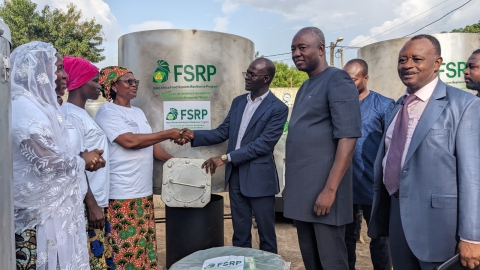
As part of its many initiatives to support farmers, FSRP Togo has acquired 315 guinea fowl broodstock, including 225 females and 90 males, for distribution to 45 farmers in the Savannah region.
These poultry broodstock, acquired as part of the FSRP implementation, come from the semi-modern farms of the commercial breeders of the Agricultural Sector Support Project (PASA). The complementary nature of the two projects means that Mr TOURE Abdoumoumouni, a PASA commercial breeder and FSRP broodstock supplier, now has new ambitions. Starting with 5 head, Mr TOURE now has more than 600 head of guinea fowl: “I started my farm in 2013 with 5 head in a small pen. Most of the time, my guinea fowl slept in the trees and laid their eggs in the bush, which meant that not only the eggs but also the birds were stolen. I carried on like that until 2015, when the PASA project built me a traditional improved poultry house (PTA). Very quickly, my rearing unit began to improve, especially with the support of the technical services. In 2018, I again benefited from support from PASA’s competitive funds. This support gave me a major boost, because it was thanks to it that I was able to build this semi-modern henhouse, which enabled me to secure my breeding and easily increase the number of animals. I now have over 600 guinea fowl. Although I’m a PASA beneficiary, I’m now a supplier to the FSRP, which has just bought 315 guinea fowl for over a million CFA francs. To tell the truth, I never dreamed of such a thing. I am so moved by this action by FSRP. This money will enable me to reconstitute the breeding nucleus, increase the number of birds and, of course, meet the family’s needs. he told us.
Of the 315 guinea fowl broodstock purchased by FSRP, each breeder received 7 broodstock, including 2 males and 5 females.
In Gando, in the prefecture of Oti Sud, Mrs Christine tells us about her breeding project after receiving these 7 guinea fowl. Her ambition is to become a leading producer in the Savannah region. “My name is SANDO Christine, and I farm at Takpapiéni in the canton of Gando, in the commune of Oti Sud 1. FSRP project gave me 7 guinea fowl today, in addition to an improved henhouse that it had already built for me. As a woman, I myself had a project, which was to become a reference breeder in Gando here. The support from FSRP has given me more strength to expand my farm and to serve the whole Savannah region in the long term, God willing.
Like Christine, FSRP Togo built improved traditional poultry houses (PTAs) for each beneficiary before handing over the broodstock. These actions are part of the PURS project and help to strengthen the resilience of these players, improve their productivity, reduce poverty in rural areas and increase their income.
Togo 704 géniteurs ovins caprins acquis et distribués à 176 éleveurs de petits ruminants de la région des savanes
L’élevage des petits ruminants, comprenant les ovins et les caprins, représente une source essentielle de protéines animales au Togo. Ce secteur fournit une part importante de la viande consommée dans les zones urbaines et rurales, tout en constituant une source majeure de revenus pour les ménages ruraux. Par ailleurs, il contribue significativement au renforcement de l’économie nationale.
Cependant, cette activité, pratiquée selon des méthodes traditionnelles, est confrontée à des défis majeurs, notamment un taux élevé de mortalité lié à diverses maladies et à l’insécurité dans la région des Savanes, principale zone d’élevage du pays.
Pour faire face à ces contraintes, le Programme de Résilience du Système Alimentaire en Afrique de l’Ouest (FSRP-Togo) a intégré, dans le cadre de son Programme d’Urgence pour la Résilience (PURS), une initiative visant à soutenir les petits éleveurs. Cette intervention consiste à leur fournir des géniteurs de qualité, tant pour les petits ruminants que pour les volailles.
La phase initiale de ce programme a impliqué l’identification de centres de production et de fermes capables de fournir les géniteurs nécessaires. À l’issue de cette étape, le FSRP-Togo a acquis des géniteurs ovins et caprins, qui ont été distribués aux éleveurs ciblés, en collaboration avec l’Institut de Conseil et d’Appui Technique (ICAT).
Dans la région des Savanes, 176 éleveurs ont été sélectionnés pour bénéficier chacun d’un noyau reproducteur composé d’un mâle et de trois femelles. Parmi eux, 121 pratiquent l’élevage d’ovins et 55 celui des caprins. Au total, 704 géniteurs ont été distribués, incluant 121 béliers, 363 brebis, 55 boucs, et 165 chèvres.
Pour garantir la santé et les performances reproductives des géniteurs, des tests de brucellose ont été effectués avant leur remise aux bénéficiaires. M. Tchalon, biologiste à l’Institut Togolais de Recherche Agronomique (ITRA), souligne l’importance de ces analyses : « Nous effectuons des tests de brucellose sur les géniteurs avant de les remettre aux bénéficiaires. Cette zoonose, transmissible à l’homme, peut déséquilibrer le système reproductif des animaux et entraîner des avortements. Ces tests nous permettent de nous assurer de leur état de santé et de leurs capacités reproductives. »
Les témoignages des bénéficiaires mettent en évidence l’impact de cette initiative. Kanfiyéne, éleveur à Naki-Est, partage son expérience : « J’élevais une dizaine de moutons qui me rapportaient un peu d’argent, mais j’ai subi des pertes importantes. Grâce au FSRP, j’ai reçu quatre géniteurs, dont un mâle. Cela m’a redonné espoir. »
De son côté, Daniel, éleveur à Tchamonga, exprime également sa satisfaction : « Je pratique l’élevage par passion, mais je manquais de moyens pour développer mon activité. Avec ces géniteurs robustes, je suis convaincu que mon troupeau s’agrandira et sera plus performant. »
En outre, Daniel avait déjà bénéficié d’une bergerie traditionnelle améliorée construite grâce au soutien du FSRP, renforçant ainsi les conditions d’élevage.
Dans les sept préfectures de la région des Savanes, 176 éleveurs ont bénéficié de cette initiative, avec un total de 704 géniteurs ovins et caprins, dont 484 ovins et 220 caprins. Cette intervention contribue non seulement à renforcer la résilience des éleveurs, mais également à améliorer la sécurité alimentaire et économique dans la région.
Le FSRP-Togo prévoit de poursuivre et d’étendre ses actions en faveur d’un élevage durable et performant, contribuant ainsi au développement rural et à l’économie nationale.
Transformation des farines à haute valeur nutritionnelle : les femmes de Yadè Sodè font la fierté de la Commune de Kozah 2 à Kara
In Yadè Sodè, in the commune of Kozah 2 in the Kara region, 10 women driven by the desire to be financially independent are now creating wonders with the food products they process. They amaze children, their husbands and other women with their products, which help to improve household nutrition and increase their incomes.
When you talk to them, they are quick to reveal their secrets, which are the result of the training they have received as part of the implementation of the West Africa Food System Resilience Programme in Togo and the partnership with the Ministry of Health.
Three of these women from the Merveille cooperative were chosen to take part in the training of trainers. They learnt how to process soya into enriched flour, the nutritional elements of the orange-fleshed sweet potato and how to prepare a sauce made from moringa leaves.
After two years of implementing the activities, the impact on the health of families, thanks to the nutrients provided, and on the cooperative is legion, according to its President, Mrs Adjélékou Préname: “What we learnt during the training of trainers was above all hygiene in the processing of soya into flour and cheese. Before, we didn’t take into account certain details that meant our finished products weren’t of good quality. Today, we’re proud to offer quality products that everyone in the family can enjoy.
They produce 200 kilograms and have seen their turnover increase from 50,000 CFA francs to 150,000 CFA francs per month.
In addition, children aged between 6 months and 5 years who are vitamin deficient can correct their vitamin deficiency by regularly eating moringa-enriched flours.
Highly ambitious, the women of the Merveilles cooperative are aiming to increase their production from 200kg to 500kg per month and sell the finished products in supermarkets and internationally. To this end, they have decided to invest in the production of food crops such as maize, soya, moringa and orange-fleshed sweet potatoes, and have acquired a 1 ha plot of land.
One of the special features of the women from the ‘Merveille’ cooperative is the packaging of the enriched soya flour produced using the techniques learned during the training course.
They praise the support of the FSRP and its partners, which has enabled them to increase their income despite the traditional production process for finished products.
To become more professional and modernise their activities, these women are aiming to acquire modern processing equipment such as a mill, cooking pots and quality packaging, either from their own funds or on loan. They plan to certify their products so that they can be displayed in shopping centres and pharmacies.
As a result of the support they have received from the FSRP Togo, the women of the “Merveilles” cooperative are now being held up as examples and asked to support other women in other localities who wish to become agricultural processors.
Togo : 150 commerçantes s’imprègnent des procédures douanières et autres règlements du corridor Abidjan-Lagos
Women play a fundamental role in intra-regional trade. They account for more than 70% of those involved in local or cross-border trade in West Africa. This strong presence of women in regional trade is a sign of the dynamism of the economy and trade in West Africa.
However, they face difficulties in accessing the information they need to make the most of business opportunities on local and regional markets, and are largely unfamiliar with customs procedures and other regulatory requirements on the Abidjan-Lagos corridor.
In order to provide an effective solution to these difficulties, the West Africa Food System Resilience Programme (FSRP) has supported the training of 150 women and young traders in cross-border trade, customs procedures and other regulatory requirements on the Abidjan-Lagos corridor.
The aim of the training was to enable traders to master customs procedures and optimise their knowledge of the corridor’s regulatory requirements.
In Aného, in the Lakes prefecture, as in Atakpamé in the Ogou, women traders
were followed by presentations on: (i) the issues and challenges of implementing the FTAA for women; (ii) the Guided Trade Initiative (GTI) and the FTAA trade documents; (iii) the organisational framework, rules of origin and procedures for clearing goods through customs; (iv) the FTAA protocol on women and young people in trade; (v) cross-border trade and the mechanism for eliminating non-tariff barriers (NTBs); (vi) cross-border trade and the facilities offered by the West African Association for Cross-Border Trade in Food, Agriculture, Forestry and Fisheries Products (АОСТАН).
This reinforcement will contribute to indicator R13.2 of component 3 relating to the “Number of farmers (value chain actors) having received goods or services to improve their marketing in the selected value chains”. In the long term, the activity could also contribute to ODP indicator 6 relating to the share of production subject to intra-regional trade in certain value chains (rice, soya, poultry).
4ème édition du Marché des Innovations et Technologies Agricoles (MITA) : Plus de 67 technologies et innovations partagées à Lomé
The fourth Agricultural Technologies and innovations Market (MITA), organized by CORAF in partnership with the Togolese Institute for Agricultural Research (ITRA), took place from 21 to 25 October 2024 in Lome, Togo. Under the theme: “Facilitating access to agricultural technologies and innovations for the integrated management of pests, plagues and diseases of plants and animals”, this strategic event brought together key players from the agricultural and research sectors, becoming a platform of choice for the adoption of innovative solutions in West and Central Africa.
MITA 2024 was an opportunity to facilitate constructive exchanges between researchers, innovators, policy-makers and young agricultural entrepreneurs. The aim was to promote innovations capable of enhancing food security in the region. This year’s event was attended by 264 participants, including 84 women and 73 young people, demonstrating the multi-sectoral and inter-generational commitment to more sustainable and resilient agriculture.
This edition was enhanced by two major events: the 1st edition of the West and Central African Youth Summit, focusing on climate-smart agriculture, and the prestigious Abdoulaye Touré Agricultural Innovation Prize. The Youth Summit brought together young people from a wide range of agricultural backgrounds, giving them a platform to exchange views with experts and present their innovations. The Abdoulaye Touré Prize rewarded six young innovators with $10,000 each for their exemplary contributions to the agricultural sector. These initiatives illustrate the ambition to promote young talent as drivers of change in African agriculture.
Of the 67 technologies and innovations shared, 53 attracted particular attention, including 38 crop varieties and 15 agricultural equipment and animal technologies, on display at the ITRA technology park in Davié. These solutions ranged from crop varieties resistant to climatic stresses to tools adapted for the sustainable management of agricultural land and resources.
Four projects by young agro-entrepreneurs were presented in pitch form to a panel of judges made up of representatives from financial institutions and business leaders. Among these, Mr KONDOW Moubarack’s biological insecticide project, designed to combat cocoa mirids, stood out as the best innovation, demonstrating the potential of local solutions to regional agricultural challenges.
By bringing together players from various countries, the MITA once again demonstrated the importance of bilateral, regional and international cooperation in the agricultural sector. The meeting highlighted the role of science, technology and innovation (STI) in strengthening food systems, addressing the key components of food and nutritional security.
The 2024 edition ended on an optimistic note, setting the date for the next edition of MITA, scheduled for 20-24 October 2025 in Mali. The theme of this year’s event will be “Technologies and Innovations for Integrated Soil Management”, and the Abdoulaye Touré Prize and the Youth Summit will once again be part of the programme, underlining the continuity of a promising dynamic for African agriculture.
In short, MITA 2024 was a lever for agricultural transformation in West and Central Africa, strengthening the resilience of food systems through innovation.
Intégration du commerce et des marchés agricoles régionaux : la CEDEAO a fait le bilan de mise en œuvre de la Composante 3 du FSRP avec les pays
From 29 to 31 October, the Togolese Capital Lome hosted a crucial meeting for the stakeholders and implementing partners of the West African Food System Resilience Programme (FSRP). The workshop provided an opportunity to take stock of activities under component 3 of the programme, devoted to the integration of trade and regional agricultural markets. This mid-term review of the programme, which was launched in June 2022, was a strategic step in measuring the impact of actions taken in the region to boost food security.
The year 2024, a pivotal one for the FSRP, represents a period of evaluation and adjustment of activities with a view to achieving the objectives set for 2026. During the three-day workshop, discussions focused on analysing the progress made, the successes achieved, and the challenges encountered, paving the way for recommendations to overcome the obstacles identified.
The activities of component 3 of FSRP aim to create a unified commercial environment, by harmonising sanitary and phytosanitary standards between Member States, modernising transport and storage infrastructures, and promoting strategic trade corridors. These initiatives help to reduce transaction costs, while improving access to information on agricultural markets for better planning and more informed economic decision-making by producers.
During the meeting, and in the light of the fruitful exchanges with the countries, all the stakeholders reaffirmed their desire to benefit from ECOWAS support to better understand and facilitate the implementation of Community regulations and measures with a view to improving the quality of local products and increasing the competitiveness of producers on the regional market. Intra-regional trade in agricultural products is expected to increase, strengthening the resilience of supply chains to climatic and economic disruptions.
Funded by the World Bank, the FSRP closely links national and regional actions to ensure a coordinated response to the region’s food challenges. Component 3 plays a fundamental role in this process, aiming to stimulate agricultural trade by developing the main trade corridors and supporting priority value chains.
The joint efforts of regional and national stakeholders demonstrate a shared vision of agricultural market integration as a lever for food security and sustainable development in West Africa. ECOWAS will continue to play a pivotal role in supporting Member States in achieving the ambitions of FSRP component 3 of which remains a key driver for the future of agricultural trade and resilience in the region.
Burkina Faso/Filière agro-alimentaire: le PRSA-Burkina Faso forme plus de 52 promoteurs aux normes de qualité des produits agro-alimentaires
As part of the implementation of components 2 and 3 of the West Africa Food System Resilience Programme (FSRP), Burkina Faso (FSRP-BF), a microproject co-financing process has been in place since November 2023. The aim of this mechanism is to support promising initiatives by players and promoters in the country’s strategic agri-food sectors, by improving access to the financial and technical resources needed to increase the productivity, competitiveness and incomes of beneficiaries. The sectors concerned include rice, maize, cowpeas, onions, tomatoes, moringa, orange-fleshed sweet potatoes and certain fruit crops.
Following a selection process, a total of 304 micro-projects were selected, representing various links in the value chains of the selected sectors. Subsidies were allocated to beneficiaries to facilitate the implementation of their projects, thereby strengthening local capacities for the production and processing of agricultural products.
To guarantee the quality of the agri-food products produced by these micro-projects, the FSRP-BF, in partnership with the Agence Burkinabè de Normalisation, de la Métrologie et de la Qualité (ABNORM), organised a training session from 28 to 29 October 2024 in Koudougou. The training session provided an opportunity to raise awareness and train players in the processing chain on quality standards and the product certification process. More than 52 promoters, including 40 women, from the maize, cowpea, tomato and orange-fleshed sweet potato sectors benefited from this essential training.
The participants received in-depth training on various key aspects of production and processing, including food standardisation, certification requirements, good manufacturing and hygiene practices, as well as packaging, labelling and legal metrology. This capacity-building will not only enable them to improve the quality of their products, but also to access more lucrative markets.
The training is part of a strategic approach to promoting food security and the resilience of agricultural systems in Burkina Faso. It represents an essential lever for the sustainable development of the agri-food sector, by bringing local products into line with international quality standards. The aim of these efforts is to make Burkina Faso products more competitive on national and international markets, thereby helping to improve living conditions for producers and strengthening the country’s food sovereignty.
Le PRSA-Burkina Faso se dote d’un plan d’action pour la mise en place de Villages Intelligents face au Climat
Suite à l'atelier de renforcement des capacités organisé à Bamako par le CORAF et l'Alliance Bioversity International and CIAT, dans le cadre du projet Accélération des impacts de la recherche climatique du CGIAR pour l'Afrique (AICCRA), les acteurs du Programme de Résilience du Système Alimentaire (PRSA) ont renforcé leurs connaissances sur la mise en œuvre des Villages Intelligents face au Climat (VIC). À la suite de cette formation, le PRSA Burkina Faso (PRSA-BF) a tenu un atelier national de restitution à Manga, du 30 septembre au 4 octobre 2024, afin d'élaborer un plan d'action pour l'implémentation des VIC dans le pays.
L'événement, qui a rassemblé des chercheurs, des experts en météorologie, des représentants d'ONG et des acteurs du secteur agro-sylvo-pastoral, a été marqué par la participation du Dr Robert Zougmore, Directeur Programme AICCRA, Alliance Bioversity et CIAT. L'objectif principal était de doter le PRSA-BF d'un plan d'action concret pour intégrer les VIC dans ses zones d'intervention, en s'appuyant sur l'expérience pilote du village climato-intelligent de Ouda, dans la région du Centre-Sud.
Les Villages Intelligents face au Climat : une approche prometteuse
L'approche VIC, initialement introduite par le programme CCAFS, s'est avérée prometteuse pour le développement de technologies et d'innovations climato-intelligentes en Afrique de l'Ouest. Elle favorise une démarche participative pour le développement de solutions adaptées au changement climatique, intégrant des innovations technologiques, institutionnelles et socio-économiques, ainsi que des politiques climato-intelligentes.
L'atelier de Manga a permis de consolider les connaissances sur les VIC, notamment en ce qui concerne la formulation et la mise en œuvre de cette approche. Une sortie de terrain à Ouda a permis aux participants d'observer les bénéfices concrets des technologies climato-intelligentes, telles que l'utilisation de semences améliorées, de la fumure organique, et des biopesticides, ainsi que des services agroclimatiques. Les échanges avec la communauté de Ouda ont illustré comment ces technologies contribuent à l'amélioration de la résilience des populations face aux aléas climatiques et à l'augmentation des rendements agricoles.
Une approche participative pour l'élaboration d'un plan d'action VIC pour le PRSA-BF
Durant les trois jours de l'atelier, les participants ont travaillé à l'élaboration d'un plan d'action pour la mise en œuvre des VIC au Burkina Faso. Les discussions ont porté sur la sélection des villages pilotes, la sécurisation foncière, l'encrage institutionnel, ainsi que l'identification des parties prenantes et des risques. Il a été convenu de mettre en place quatre VIC : un dans le sous-bassin du Kou, un dans la Sirba, et deux dans le Mouhoun Inférieur.
Le plan d'action élaboré comprend un chronogramme détaillé et un dispositif opérationnel qui sera intégré dans le Plan de Travail et Budget Annuel (PTBA) 2025 du PRSA-BF, après validation par la Banque mondiale. Ce plan marque une étape décisive pour l'adoption de solutions climato-intelligentes et renforce l'engagement du PRSA-BF à promouvoir la résilience des communautés rurales à travers la diffusion de technologies climato-adaptées.
Des résultats tangibles et des perspectives prometteuses
Les objectifs de l'atelier ont été pleinement atteints, offrant au PRSA-BF un cadre stratégique pour l'implémentation des VIC dans ses zones d'intervention. Le succès de cette démarche devrait permettre d'amplifier les résultats du PRSA-BF, notamment en contribuant à l'atteinte des indicateurs liés à la diffusion des technologies climato-intelligentes et à la résilience des systèmes alimentaires.
En résumé, l'initiative de mise en place des Villages Intelligents face au Climat au Burkina Faso s'inscrit dans une stratégie plus large visant à positionner les communautés rurales sur une trajectoire durable vers la sécurité alimentaire et nutritionnelle, tout en intégrant les principes de gestion intégrée des paysages et d'agriculture climato-intelligente. Les résultats atteints à Manga augurent d'un avenir prometteur pour la résilience climatique au Burkina Faso et au-delà
Immersion dans les centres nationaux de spécialisation : le CORAF contribue à la relève générationnelle scientifique
At the age of 25, Marie-Claire KONÉ, a young woman of Malian origin, embodies hope and ambition in the field of agricultural research. A third-year research student at the Faculty of Agronomy and Animal Medicine, Marie-Claire not only excels in her studies: she is also the major of her class, a recognition that testifies to her dedication and talent.
Young graduates from vocational schools often face obstacles such as a lack of practical learning environments, professional experience and networks. To overcome these challenges and strengthen the skills of young researchers at universities and public research institutions in West and Central Africa, CORAF has set up an immersion program at national centers of specialization in West Africa.
Marie-Claire had the opportunity to take part in this immersion program in Senegal, organized by the Conseil Ouest et Centre Africain pour la Recherche et le Développement Agricoles (CORAF) as part of the Food System Resilience Program in West Africa (‘FRSP’). This experience took place at the headquarters of the Regional Center of Excellence (CRE) on dry cereals and associated crops (CERAAS), a center renowned for its contributions to improving agricultural production in a context of climate change. Over the course of a month, Marie-Claire explored four state-of-the-art platforms at CERAAS: the genotyping platform, the biochemistry research and training platform, the phenotyping platform and the bioinformatics facility. Each week in these high-tech environments was a revelation for her. Supervised by experts, she discovered new and fascinating fields, in particular genotyping, which redirected her professional ambitions.
“This immersion trip was a real revelation for me. I’d never had the opportunity to work in a research laboratory of this scale, and it changed my view of science and my own abilities,” Marie-Claire confides enthusiastically. “CORAF’s support has been invaluable. They have opened doors that I didn’t think I could get through, especially as a woman in a field still largely dominated by men,” said Marie-Claire KONÉ.
Like Marie-Claire, ten other students and young scientists (50% of them women) have benefited from this immersion program in the specialization centers. Talla LO from Senegal and Hassane YAYE ABDOU from Niger spent their respective stays at the aquaculture specialization center in Nigeria. CISSE Awa Marie Coll and Talla KANE, both from Senegal, were hosted at the CRE-Fruit et légumes in Burkina Faso. Marie-Claire is particularly grateful for this opportunity as, until now, similar opportunities at her university were mainly reserved for men. Her selection by CORAF was a great surprise and a source of pride. “I hope my story will inspire other young Malian women to pursue careers in agricultural research, a crucial field for Africa’s future,” she insisted.
With ambitious dreams for the future, Marie-Claire aspires to a PhD and hopes one day to become her country’s Minister of Agriculture. Her journey is proof that, with hard work and the right opportunities, anything is possible. “I encourage all young girls to go into agricultural research. Our continent needs our ideas, our determination and our passion to solve tomorrow’s challenges,” she concludes with determination.
With ambitious dreams for the future, Marie-Claire aspires to obtain a doctorate and wishes to one day become her country’s Minister of Agriculture. His journey is proof that, with hard work and the right opportunities, anything is possible. “ I encourage all young girls to embark on agricultural research. Our continent needs our ideas, our determination and our passion to solve the challenges of tomorrow,” she concludes with determination.
For Prof Niéyidouba LAMIEN, Program Manager at CORAF, “CORAF’s initiative to organize immersion trips for research students is crucial. It helps to mentor and inspire young people to pursue a career in research, ensuring a succession to the aging generation of researchers in West Africa.”
Through this initiative, supported by the World Bank-funded West Africa Food Systems Resilience Program (FSRP), CORAF seeks to strengthen the skills of young researchers across the region, offering them practical experience and high-level training.
Apresentação do FSRP

Notícias
Eventos
Como podemos ajudá-lo?