Passar para o conteúdo principal

Ghana/Développement de la filière avicole : des échanges initiés avec les acteurs du secteur

Publicado em 6 Março 2024

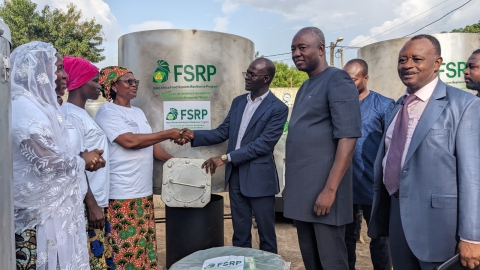
The West Africa Food System Resilience Programme (FSRP) has engaged a selection of qualified Ghanaian poultry industry anchor farmers and production groups to straighten-out final arrangements for the take-off of the FSRP Poultry Intensification Scheme. The scheme targets the production of at least 2million broiler birds by the end of this year, to contribute to the Ministry of Food & Agriculture’s strategy to revive the broiler industry and increase the rate of adoption of modern and improved climate–resilient poultry production, processing & marketing techniques.

In line with FSRP strategic sub-regional arrangements, Ghana is to focus on Rice, Maize, Soyabeans and broiler Poultry, under a $150m World Bank funding, of which $12.5m has been assigned to the first phase of the FSRP Poultry Intensification Scheme to support poultry farmers with inputs. Each phase of the scheme will run for 3 years. At the end of each production year, the anchor farmer would pay-back 70% of the input costs and retain 30% of the amount for re-investment into the general operations of the business.

The deliberations bordered around critical value chain issues including: feed quality and supply, vaccinations, strict compliance with bio-security requirements, monitoring of the weight and general healthcare of the birds, the quantities to be supplied per cycle, processing and packaging, the timeliness of delivery, the pricing and marketing of frozen processed Ghanaian broilers.

Present at the brainstorming session were lead poultry industrialists including, Mr. Victor Oppong Agyei, President of the Poultry Farmers Association who expressed gratitude to Government and the World Bank for instituting the FSRP Poultry Intensification Scheme and pledged members’ compliance with the modalities of the scheme for the ultimate advancement of the Ghanaian poultry industry.

Senior officials of the Animal Production Department and the Veterinary Services Directorate of the Ministry of Food and Agriculture (MoFA) prompted the industrialists that the quality of their birds, packaging, strict professionalism, and perfection in the conduct of poultry business are key to guaranteed ready markets and mass patronage. Mr. Osei Owusu Agyeman, Project Coordinator of FSRP highlighted the three key guiding principles of FSRP, being ‘Sustainability, Ownership and Public-private partnership’ and challenged beneficiaries to strive to ensure that the Ghanaian poultry industry thrives and expands beyond the scheme.

Togo/Développement de la riziculture dans la région des savanes : la rizerie de Tône accroit son rendement de 800 à 2 000 tonnes

Publicado em 6 Março 2024

As part of its activities in the Savannah region of Togo, the West Africa Food System Resilience Program (FSRP) has acquired and distributed inputs to more than 500 producers, each of whom received 10 kilograms of rice seeds and 75 kilograms of fertilisers (NPK 15 15 15 and Urea) free of charge at subsidised cost, with repayment in kind (in paddy rice) at harvest. To make it easier for producers to monitor production, collect the rice harvest and market surplus production, an agreement has been signed with the Tône rice mill, an aggregator specialising in the collection, processing, and marketing of rice in the Savannah region.

Thanks to this agreement, the rice mill has had an encouraging impact, as its manager tells us: “Today, with the support of the FSRP, our area of intervention, which was limited to Barkoissi, now covers the entire Savannah region, as far as Kanté in the Kara region. We have gone from 1,700 producers to 16,800 producers, an increase that has had a considerable impact on the quantity of production, which has risen from 800 tonnes to 2,000 tonnes of paddy”, she told us, before continuing: “As for jobs, the rice mill has gone from 32 to 73 people. At the processing level, the number of jobs has risen from 12 to 23, and the number of women sorters from 20 to 50.

It should also be noted that, unlike in previous years, this year the Tône rice mill has not had recourse to bank credit, often at high interest rates, but has enough production to meet the demand for local rice on the national market throughout 2024. It plans to install mini-factories for pre-processing paddy in high-yield areas such as Gando, Takpamba and many other localities.

FSRP/Phase 3 : le Sénégal rejoint le programme avec un appui financier de 200 millions de Dollars

Publicado em 5 Fevereiro 2024

As part of the implementation of the multi-phase programmatic approach of the West Africa Food System Resilience Program (FSRP), the World Bank approved on 18 January 2024 a financing of 200 million dollars in support of the third phase of the program (FSRP-3) for Senegal.

This financial support will enable Senegal to join the 7 countries of phase 1 (Burkina Faso, Mali, Niger and Togo) and phase 2 (Ghana, Sierra Leone and Chad).

Implementation of the FSRP in Senegal will make it possible to strengthen the level of preparedness in the face of food insecurity and improve the resilience of food systems in the country of Teranga. FSRP-3 offers a unique opportunity to remedy the main factors of food insecurity in Senegal and establish the resilience of its food systems. It will make it possible to tackle the factors holding back sustainable production, productivity and competitiveness, while promoting adaptation to and mitigation of climate change.

With more than 600,000 direct beneficiaries – 40% of whom are women – FSRP-3 will help to set up digital advisory services to improve the efficiency of agriculture and the prevention and management of food crises. Beneficiaries include farmers and livestock breeders, small-scale producers and processors, and agricultural micro-entrepreneurs. Financial service providers and public and private institutions will also benefit from the programme.

FSRP in Senegal will help to strengthen capacities for adaptation to climate change and agricultural research systems. The programme will also strengthen the policy environment relating to landscape governance and integrated management to improve food production, the provision of ecosystem services, the protection of biodiversity and the livelihoods of local populations. Support will be provided for the regional food market and trade integration, which will facilitate trade of agricultural products and inputs, both within and across national borders in West Africa.

As in the other FSRP participating countries, the implementation of the programme in Senegal is an opportunity to remove barriers to food trade, invest to improve regional trade and allow the free movement of capital across borders with a view to building the resilience of regional food systems.

Officially launched on 15 June 2022, FSRP with the entry of Senegal thus increases its area of intervention in 8 countries and the number of direct beneficiaries to more than 5 million vulnerable people. This programme, coordinated at regional level by ECOWAS, also involves CILSS and CORAF, and aims to increase preparedness against food insecurity and improve the resilience of food systems in participating countries. It provides a platform for partnerships with many other institutions.

Amélioration de la production rizicole en Afrique de l’Ouest : l’outil RIICE présenté aux acteurs et partenaires

Publicado em 5 Fevereiro 2024

More than 70 stakeholders and partners in the West African rice sector familiarized themselves with the Remote Sensing Information and Insurance Tool (RIICE) during a technical workshop organized by the ECOWAS Rice Observatory (ERO) on January 25, 2024 online.

This introductory workshop enabled stakeholders in the rice sector from Nigeria, Côte d’Ivoire and 6 countries in the West Africa Food System Resilience Program (FSRP) – Burkina Faso, Ghana, Mali, Sierra Leone, Senegal, and Togo – to understand how RIICE works and how it is deployed in the field.

Despite the importance of rice in Africa, the lack of detailed data on cultivated areas and yields is a challenge for research and policy. The use of this tool aims to fill this gap and revolutionize data-driven decision-making in rice production, contributing to insurance and sustainable agricultural practices in the region.

RIICE uses remote-sensing to improve rice production systems and provides spatially explicit data on rice cultivation, yield forecasts and information on seasonal losses. It is currently supported by initiatives of the Consultative Group on International Agricultural Research (CGIAR) in collaboration with AfricaRice and the International Rice Research Institute (IRRI).

The ERO national chapter teams have shown an interest in better understanding the RIICE to ensure its deployment in the field. With the support of ECOWAS, through the ERO Executive Secretariat, the RIICE is currently being tested in some countries and is to be extended to the region as it aligns with the mandate of the ERO technical committee on research and development of water systems.

Tchad : les acteurs du FSRP formés à la mise en place de plateformes d’innovation

Publicado em 5 Fevereiro 2024

With a view to accelerating the implementation of the West Africa Food System Resilience Programme (FSRP) in Chad, stakeholders and partners are being trained in innovative approaches and mechanisms for the production and dissemination of agricultural technologies.

More than 50 people from the various provinces in which the FSRP is being implemented in Chad have been trained in techniques for setting up innovation platforms. This training, provided with the support of CORAF, was led by the Laboratoire de Recherche sur l’Innovation pour le Développement Agricole (LRIDA) at the University of Parakou in Benin.

FSRP Tchad focuses its activities on the priority value chains of maize, wheat, and sesame. Through the innovation platform mechanism, the aim is to help ensure the successful transfer of agricultural technologies and innovations.

Through discussions and experiences sharing, participants learned that innovation platforms are a tool for dialogue between the various actors in the value chain to collectively identify challenges and find opportunities to improve production and marketing through the adoption of the best technologies and innovations. The innovation platforms bring together research structures, producers’ organizations, technical advisory and agricultural extension services, NGOs and civil society.

Through practical exercises, trainers and learners have diagnosed problems, explored opportunities and sought solutions to challenges. This is the approach promoted by innovation platforms to integrate rural producers into value chains in West Africa. By coming together in this way, social and economic actors try to resolve the constraints they face. In doing so, they build new synergies. Through a collaborative interrelationship, agricultural producers, processors, buyers, transporters, researchers, extension workers, etc. learn from each other, understand each other better and develop win-win exchanges.

Togo : 120 femmes issues de 60 coopératives formées sur les technologies de production et d’utilisation de la farine riche de céréales

Publicado em 5 Fevereiro 2024

To help households improve their resilience in the face of food insecurity and malnutrition, the Food System Resilience Programme in West Africa (FSRP-TOGO) is supporting the training of 720 women processors in the production and use of cereal-rich flour for children incorporating moringa, néré and/or orange-fleshed sweet potato (PDCO), and in good hygiene and quality practices.

In collaboration with the Togolese Coordination of Farmers’ and Agricultural Producers’ Organisations (CTOP) and the Ministry of Health’s Nutrition Division, this capacity-building took place in the country’s six agricultural regions from 22 to 27 January 2024, bringing together ten cooperatives of 20 people per region for a total of 120 women trainers nationwide. These women will in turn train 600 women processors throughout the country in good processing and hygiene practices, with the aim of helping to diversify and improve the nutritional value of processed products, specifically orange-fleshed sweet potatoes, néré, moringa and the production of rich flour for children in accordance with recommended standards.

In Sokodé, in the central region, the training took place in two stages (theoretical and practical) and will help to eradicate hunger and malnutrition in rural households with a view to making up for micronutrient deficiencies such as iron, vitamin A and iodine deficiencies, one of the main causes of which is low consumption of foods rich in micronutrients.

The training modules focused on (i) the basics of a balanced and diversified diet, (ii) supplementary feeding for children aged 6 to 23 months and (iii) basic hygiene.

All these modules were accompanied by recommendations and discussions with the women who, once trained, will go on to organise cooking demonstration sessions within their respective contact groups.

Ghana : lancement officiel du FSRP

Publicado em 12 Janeiro 2024

Family photo of the political, administrative, and customary authorities as well as representatives of the World Bank and ECOWAS after the official launch.

“Joining forces for Food system risk Management in West Africa” was the theme under which stakeholders and partners officially launched the West Africa Food System Resilience Program (FSRP) for Ghana on 7 December 2023 in Kumasi.

Attended by administrative, political and customary authorities, as well as the World Bank and ECOWAS, the launch ceremony focused on outdooring FSRP to Ghana, mobilizing stakeholder support for its implementation and promoting business opportunities under FSRP.

ECOWAS, which was invited to the ceremony, congratulated Ghana on its participation in this flagship program which it sees, as the programme’s coordinating institution, as a unique tool that will strengthen regional integration by facilitating regional trade in food products, as well as exchanges of technologies and innovations and the mobility of researchers and stakeholders between countries, which will contribute considerably to the implementation of ECOWAP, the regional agricultural policy, and thus accelerate the transformation of the agricultural sector in the sub-region.

The representative of the Regional Coordinator of the FSRP, Dr Gaoussou Diarra, reiterated ECOWAS’s willingness to provide institutional and technical support to all stakeholders and partners to ensure the success of the program.

At the end of the day, the 300 participants noted the government’s commitment to joining forces with sister West African nations and the World Bank to promote the best interests of Ghanaian farmers. With the presentations of the main activities of the FSRP Ghana, the public was better informed of the magnitude of the work to be done and its expected impact on the lives and livelihoods of the targeted beneficiaries. The operational principles of sustainability, ownership, and public-private partnership of the FSRP were clearly explained.

The beneficiary communities also noted the commitment of the political, administrative and customary authorities to the success of the FSRP in Ghana.

Togo: les bonnes pratiques de maraichage écologique enseignées aux producteurs maraichers de la région des savanes

Publicado em 12 Janeiro 2024

Practical training session on good ecological market gardening practices

350 market gardeners from the Savannah region of Togo were trained on good ecological market gardening practices in the seven prefectures from 14 to 17 December 2023 as part of the implementation of the FSRP.

The Savannah region remains an excellent off-season market gardening area. The cropping systems are diversified, with a fairly large proportion of food crops for both consumption and sale. However, the ever-increasing demand for market garden produce has led to the use of pesticides, which is harmful to human health and has an impact on production capacity.

To help reduce the use of pesticides in their activities, the growers have learned new ecological cultivation practices. The aim of this training is not only to improve the productivity of market garden farms, but also to support market garden producers in setting up and managing their plots of land in accordance with good agricultural practices, and to improve their access to the market.

In Tambonga, in the prefecture of Tandjouaré, Mrs Kolani Damnou makes no secret of her satisfaction: “We have always worked individually, if not in groups, and I personally had never felt this attention from a project. We recently received market gardening kits from the FSRP and now you’re here to train us in ecological market gardening. You can’t imagine how much this fulfils our expectations here in Tambonga. I’m sure that with this training, we’ll see some big changes”.

As for Mrs Nakoro in Nali, Oti Sud, this training has enabled her to acquire new knowledge: “With this training, I have improved my knowledge of composting techniques. I learned how to transplant, maintain, and protect crops. So I’m not like I was before; I’ve changed scale”.

Togo : le FSRP forme les acteurs à la mise en place et l’animation de plateformes d’innovation autour des chaînes de valeur prioritaires

Publicado em 12 Janeiro 2024

Participants in the training course on setting up innovation platforms

43 people, including 13 women, from agricultural research and advisory support services (ITRA and ICAT), members of inter-professional organizations, agricultural training centres, universities and NGOs took part in this training of trainers, with a view to acquiring techniques and approaches for setting up an innovation platform.

Innovation platforms are places where people can learn, share knowledge and experience, help each other, and incubate technologies and innovations. They are also places where people can find out about research products, the needs of potential users and the difficulties and constraints faced by the various segments of the value chain, so that they can work together to find ways of overcoming these constraints.

This training course, facilitated by CORAF and organized in Kpalimé in the Plateaux-West region, helped to build the capacities of innovation platform specialist-animators who will be recognized as champions for the establishment and facilitation of innovation platforms in the FSRP’s intervention zones. The aim is to contribute to the large-scale adoption of technologies and innovations capable of transforming agriculture in these areas.

Subscribe to