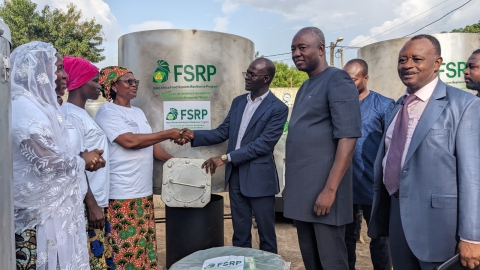
Ghana: farmmate tomato programme yields 240 tonnes in the upper east region with the support of FSRP

Published on 15 January 2026

Incoming harvests from a Tomato production collaboration between the West Africa Food System Resilience Programme (FSRP) and FarmMate Ltd in the Upper East Region are meeting targeted yields of 240 tonnes in the first round.

This forms part of interventions by FSRP - under the Ministry of Food & Agriculture, to address the yearly nationwide incidence of tomato shortages and fluctuating prices, especially during the dry season. The scheme is being carried out through financial support from the Government of Norwegian and coordinated by the World Bank to revamp the Ghanaian tomato industry for year-round availability of the produce by way of dry season production.

FSRP’s value chain commodities (rice, maize, soya, tomatoes and broiler poultry) are produced using climate-smart agricultural practices and innovations. Under the programme, farmers are receiving inputs from FSRP in the form of smart seeds, agro chemicals like enhanced blended fertilizers with micronutrients, organic manure and pesticides (organic and inorganic) and extension advisory services. FarmMate on its part, is giving farmers close extension support, monitoring and immediate offtake of harvests.

From the farms, FSRP/FarmMate tomatoes are conveyed mostly to the Greater Accra Region, to major markets (like Agbogbloshi and CMB) and premium markets (like Palace Mall and Shoprite, within 24-36 hours.

The FSRP-FarmMate collaboration is geared at leveraging productive private sector linkages with farmers to optimise the production and facilitate timely off-take and marketing of tomatoes for the fresh and value addition (tomato puree) markets. The FSRP-FarmMate collaboration covers 200 acres across the country, 110 of which are in the Upper East Regions with about 100 farmers in the Zebila (in the Bawku West District), Pwalugu (in the Talensi District) and Tono Irrigation Scheme and Navrongo (in the Kasena Nankana District). The other locations are: Ningo-Prampram, Okere, Kwahu East, Akumadan Irrigation Scheme and Asunafo South districts.

Beyond the collaborations with FarmMate, the FSRP Tomato Support Programme is being carried out in 20 Districts in six (6) regions. It involves 1,500 farmers, of which 40% are women. So far, the intervention has resulted in yields of approximately 10Tons per hectare and at the end of the 2025 dry season. Yields are expected to reach 15 Tons per hectare. FSRP targets the production of 6000 Metric tonnes of tomatoes by the end of the intervention.

Tomatoes are an essential part of the Ghanaian diet, accounting for 40 percent of vegetable expenditures. However, only 34 percent of the 1.4 million tons of tomatoes consumed annually in Ghana are produced locally. This results in substantial imports (especially between Dec and May). Challenges that confront the local tomato industry include: the use of poor-quality seeds; the absence of seeds well adapted to local seasons and climate variabilities; pests & diseases control lapses; poor agronomic/farm practices; post-harvest losses (ranging from 20% to 60%); and the absence of innovative storage methods. All these leads to low average yields of 8.3 metric tons per hectare (instead of potential yields of 20 metric tons per hectare); leading to sharp fluctuations between glut/low prices (during peak season harvests) and shortages/dramatically high prices (during off-seasons).

Togo: 200 agricultural producers and seed growers attend open days at ITRA's technology and innovation satellite parks in Sarakawa and Dapaong

Published on 15 January 2026

As part of the implementation of the Food System Resilience Programme in West Africa (FSRP), the Togolese Institute for Agricultural Research (ITRA) organised its first open days and guided tours of technology and innovation satellite parks on 18-19 December 2025 in Dapaong and on 16 December 2025 in Sarakawa.

Following the success of the first Agricultural Technology and Innovation Park (PTIA) established in Davié in 2023 with the support of CORAF, the national coordination of FSRP-Togo assisted ITRA in setting up satellite technology and innovation parks in Sarakawa (Kara region) and Dapaong (Savanes region). These satellite parks, also known as local technoparks, were created to bring innovations from research closer to producers in remote areas and encourage their adoption. They serve as platforms for demonstration, learning, training and dissemination of agricultural technologies.

The organisation of these first open days and guided tours gave nearly 200 visitors (agricultural producers, seed producers and other stakeholders in the sector) the opportunity to discover and evaluate several improved crop varieties. These include soybeans (CRASS-1910P1, ITRA-SJ171), sorghum (Soubatimi and Pépé Kalé varieties), rain-fed rice (WAB0019634, WAB0019715), legumes, particularly cowpeas (WANG KAE), peanuts (IS1, L-GHA ITRA-SH2, ITRA-RAF and SH470P), and a variety of sweet potato varieties (Apomuden 1 and 2, Amouzoukopé, Djété Jaune). These technologies have been appreciated for their earliness, yield and potential for adaptation to local agroecological conditions.

Since 2022, several major achievements have been made possible thanks to the support of the national coordination of the FSRP Togo, including:

  • the establishment of two (02) satellite parks in the Kara and Savanes regions;
  • the conduct of field trials over two (02) agricultural seasons (2023 and 2024) in the six (06) agricultural regions of Togo, focusing on rice, maize, sorghum and legumes (groundnuts, cowpeas, soybeans);
  • the organisation of Periodic Technology Review Workshops (APRT) in the six agricultural regions;
  • the strengthening of technology transfer through ITRA's System Research Support Mechanism (DARS).

Thanks to these interventions, the following results have been recorded to date:

  • More than 900 producers have participated directly in field trials, promoting the adoption of technologies and good agricultural practices;
  • 244 leading producers and around 150 agricultural advisers have been trained in the use of the FeSeRWAM interactive digital platform, enabling better support for producers in variety selection and fertiliser management;
  • Nearly 200 agricultural producers and seed growers actively participated in open days and guided tours of the technology and innovation parks in Sarakawa and Dapaong;

The gradual adoption of these different technologies has enabled producers to achieve substantial improvements in their yields.

  • Producers who have adopted improved sorghum varieties (Soubatimi) report a significant increase in yields of up to 5 t/ha, compared to around 1 t/ha for local varieties.
  • Similarly, groundnut producers using the IS1 variety have seen their yields increase to 2 t/ha, compared to 0.5 t/ha previously.

These yield improvements contribute to higher incomes for producers, leading to significant positive changes in their living conditions.

Togo: 60 motor cultivators handed over to agricultural cooperatives to boost productivity with the support of the FSRP

Published on 26 December 2025

Dapaong, 12 December 2025: The Chief of Staff of the Ministry of Agriculture, Fisheries, Animal Resources and Food Sovereignty (MAPRASA) officially handed over 60 motor cultivators to agricultural cooperatives in the Savanes region on behalf of the Minister.

The 60 motor cultivators were acquired as part of the implementation of the Food System Resilience Programme in West Africa (FSRP-Togo). This equipment was acquired for the benefit of 5,025 producers (including 2,881 women) operating in the ZAAPs in the Savanes, Kara and Centrale regions. The aim of this support is to improve sustainable access to agricultural mechanisation services, increase productivity and strengthen food security in the targeted areas.

During the symbolic handover of the equipment, the Minister's representative reiterated the President of the Council's vision of making Togolese agriculture a productive, high value-added sector that creates wealth and drives the country's economic growth. He urged the beneficiaries to use the motor cultivators responsibly and rationally in order to ensure their sustainability, stimulate local economic development and contribute effectively to the fight against poverty.

The heavy and light motor cultivators come with essential accessories such as shredders, trailers, carts, mowers, harrows, stone removers, cage wheels and spare parts. Their acquisition meets the needs expressed by producers and is part of a cost-sharing management approach, as highlighted by the FSRP's deputy operational coordinator, , in his speech: "These motor cultivators will be managed on a cost-sharing basis, meaning that beneficiaries will contribute 50% of the purchase price of the equipment. This will ensure that they are used properly, that they are durable and that it will be possible to purchase more in the future for producers who are also in need."

The choice of motor cultivators is the result of an in-depth analysis of soil characteristics, with the aim of preserving soil structure and contributing to the gradual restoration of degraded land through sustainable agricultural practices. This equipment is also designed to be accessible to women and young people, who are key players in agricultural development.

Agricultural advisers specialising in farm management (CTGEA) and the beneficiaries themselves have been trained at the National Agricultural Training Institute in Tové (INFA de Tové) on the use and management of the equipment. A monitoring and support system is in place to ensure the optimal and sustainable use of the equipment. "The motor cultivators we are handing over today are not just tools, but real levers for transforming agriculture," emphasised the FSRP Coordinator, inviting producers to make judicious use of them.

Speaking on behalf of the Governor of the Savanes region, the Secretary General of the governorate, Kegbero Latifou Seigneur, praised the leadership of the President of the Council, His Excellency Faure E. GNASSINGBE, whose vision and commitment to peace and security enable the population to carry out their agricultural activities in favourable conditions. He encouraged the beneficiaries to use the equipment in a spirit of collective responsibility so that each farming community could reap the full benefits.

In addition to providing 60 motor cultivators, the FSRP has achieved major accomplishments that reflect the scope of its interventions in the field. These include:

  • the distribution of input kits consisting of certified seeds and fertilisers to 81,558 farmers in the ZAAPs, including 36,953 women, representing 45.3% of beneficiaries.
  • The provision of market gardening kits (certified market garden seeds, biofertilisers and tools) to 7,267 producers, including 3,572 women (49.15%);
  • The financing of 413 sub-projects led by young people and women as part of the PURS, reflecting the FSRP's commitment to rural employment and economic empowerment;
  • Support for the construction of 1,600 livestock shelters and the provision of breeding stock for the small ruminant and poultry sectors;
  • The ongoing development of four ZAAPs in the Savanes region, with the construction of superstructures and storage facilities.

These achievements have had a tangible, measurable and significant impact on the living conditions and economic performance of the beneficiaries. For example, 79.1% of beneficiary producers in the Savanes region report an improvement in their agricultural yields; 60.25% of beneficiary women report an increase in their income, compared to 23.36% of men. There has also been an increase in income of +83.6% in the Savanes region and +85.9% in the Kéran prefecture;

Beyond these figures, the FSRP's actions have promoted the sustainable reintegration of many producers who had previously abandoned their farms due to lack of resources, thereby contributing to strengthening agricultural resilience and reviving local economies.

Sierra Leone: Break ground for Sierra Leone’s first-ever fertilizer testing laboratory

Published on 10 December 2025

The West Africa Food System Resilience Program (FSRP), through the Ministry of Agriculture and Food Security (MAFS), has funded the construction of an ultra-modern Fertilizer Testing Laboratory at Njala University — the first of its kind in Sierra Leone.

The groundbreaking ceremony took place today at Njala University’s Mokonde Campus, bringing together key stakeholders including farmers, the National Fertilizer Regulatory Agency (NaFRA), FSRP representatives, MAFS officials, university authorities, and local community leaders. The event marked a major step towards ensuring the quality and suitability of fertilizers used across the country.

Speaking at the ceremony, FSRP Project Manager Dr. Kepifri Lakoh emphasized the critical role fertilizers play in boosting national food production. He said the establishment of a state-of-the-art laboratory is vital to guarantee that fertilizers used in Sierra Leone are properly tested and adapted to the nation’s diverse ecological conditions.

Njala University Vice-Chancellor, Professor Alhaji Mohamed Bashiru, commended President Julius Maada Bio’s leadership for prioritizing fundamental issues of sustainable agricultural development. He noted that the new facility will not only enhance academic research and training but also contribute significantly to the government’s Feed Salone initiative.

Dr. Andrew Koroma, Head of NaFRA, expressed appreciation to the World Bank funded FSRP for supporting the construction of critical agricultural infrastructure. He assured that once completed, the facility will be efficiently utilized to ensure the effective regulation, management, and productive use of fertilizers across Sierra Leone.

Sierra Leone: Armed Forces reduces rice Imports through large-scale rice Farming with the support of FSRP

Published on 10 December 2025

Over the past two years, the World Bank–funded Food System Resilience Program (FSRP) has been supporting the Republic of Sierra Leone Armed Forces (RSLAF) to expand large-scale rice production—helping the government cut down the heavy burden of rice importation. Before 2023, Sierra Leone spent nearly $250 million annually to import rice for government institutions, including the Military, Police, and Correctional Services.

According to the Minister of Agriculture and Food Security, Dr. Henry Musa Kpaka, the government is taking deliberate steps under the Feed Salone initiative to significantly reduce rice imports. A special agricultural unit has also been established within the RSLAF to champion agriculture and rural development.

In 2023, FSRP supported the RSLAF with seeds, fertilizer, and mechanization services such as land preparation and harvesting—enabling the military to cultivate over 200 hectares of rice. With similar support in 2024, production doubled. However, sustaining production at this scale remains critical to meeting the food demands of the military and other institutions.

The Minister of Finance, Sheku Ahmed Fantamadi Bangura, noted that these efforts have already contributed to reducing national rice imports to $160 million, even though machinery constraints persist.

To sustain and expand production, FSRP has in 2025 linked the RSLAF to input dealers and mechanization service providers, strengthened their extension capacity, and facilitated the signing of MoUs with other institutions to integrate locally produced milled rice into their feeding programs.

According to Lt. Col. Habib Jah, “We are committed to the Feed Salone agenda to reduce government expenditure and enhance economic growth. Since partnering with FSRP, our struggles to access basic inputs like seeds, fertilizer, and machinery have been addressed. From the proceeds of the past two years, we have even purchased a tractor. With this progress, we plan to cultivate 500 hectares next year.”

Togo : 42 priority standards approved to boost the country's agri-food sector

Published on 10 December 2025

From 25 to 28 November 2025, the Togolese Standardisation Agency (ATN) organised in Lomé, with the support of the Food System Resilience Programme in West Africa (FSRP-Togo), the validation of 42 national standards in priority sectors such as cereals, tubers and legumes, meat and poultry, horticulture and derived products.

Despite the internalisation of international and regional standards (ISO, IEC, ECOSTAND, CODEX, etc.), Togo did not yet have its own national standards for these priority sectors. This absence was a major obstacle to the competitiveness of products, the improvement of their quality and their access to markets. It was precisely to remove this obstacle and promote the free movement of products at regional and international levels that FSRP-Togo provided support for the development of national standards adapted to both the realities of the country and the requirements of regional and global trade.

Launched in 2024, the development process resulted in 42 draft standards, which were reviewed in a rigorous, inclusive and concerted manner with a view to their validation. Over four days, experts and stakeholders identified the standards to be made mandatory and defined the next steps in a project considered transformative for Togo's food and economic sovereignty.

The meeting was opened by the authorities responsible for promoting investment, who emphasised the importance of an economic framework based on quality, safety and competitiveness. Discussions then highlighted the strategic role of quality standards in improving product safety, business performance, cost reduction and trade dynamism. The objective is clear: to make the 42 standards currently being developed a sustainable tool for enhancing agri-food value chains and strengthening the "Made in Togo" label.

This initiative is part of Component 3 of the Food System Resilience Programme in West Africa (FSRP), dedicated to market integration, regional food trade and the development of agricultural trade. Thanks to the support of the Programme, Togo is now establishing its first national regulatory framework for agri-food, in line with regional policies and standards.

With this unprecedented set of standards, the country is taking a major step towards more competitive and secure production that can conquer regional and international markets. Standardisation is thus becoming a structuring lever for the competitiveness and resilience of Togo's strategic agricultural sectors.

ECOWAS approves new draft regulations to facilitate trade of agricultural, forestry, pastoral and fishery products in West Africa and the Sahel

Published on 17 November 2025

Around forty representatives from ECOWAS member states, CILSS, UEMOA and experts on agricultural and legal issues and their technical and development partners met in Lomé from 10 to 12 November 2025 to examine and approve draft reports and regulations on administrative and technical measures to facilitate trade of agricultural, forestry, pastoral and fishery products in West Africa and the Sahel.

This regional meeting, organized by the ECOWAS Commission, was an opportunity to review the contents of the consultants' reports on obstacles to the free movement of agricultural products at borders, as well as some inconsistencies in existing regulations.

Intra-community trade of agricultural products, cereals, roots, livestock, horticultural products and processed agri-food products plays a key role in stabilising prices, enhancing regional value chains and promoting food sovereignty. It is the main source of income for most rural households and a pillar of regional food security.

Despite its importance, the smooth flow of regional trade faces a series of persistent challenges, including tariff and non-tariff barriers, local restrictions and other export and import bans, which hinder the free movement of goods. These obstacles are compounded by administrative delays resulting from complex customs procedures. In addition, there is a lack of awareness of the regional rules governing intraregional trade, mainly the provisions of the ECOWAS Trade Liberalisation Scheme (TLS). These structural difficulties are exacerbated by inadequate logistics and storage infrastructure and a lack of coordination between States, the latter manifested in the poor implementation of reforms that have been adopted.

To help remove the above-mentioned constraints, the ECOWAS Commission conducted in 2019 a study to identify administrative and technical measures promoting the free movement of agricultural, forestry, pastoral and fishery products in West Africa. Five years on, in view of regulatory developments, it was deemed necessary not only to update the draft reports of this study, but also to propose draft regulations aimed at harmonising the administrative and technical measures identified by the study to facilitate intraregional agricultural trade.

In working groups and plenary sessions, participants reviewed the documents submitted for their consideration and made the necessary corrections and updates.

Over three days, participants shared their experiences and ideas and made suggestions for improving the draft regulations proposed by the consultants. The aim of the work was to make the TLS operational by providing the region with high-quality documents, thereby helping to build a more prosperous and sustainable future for the sub-region.

The draft regulations, enriched by the amendments made at the Lomé meeting, will shortly be submitted to the ECOWAS Commission's directorates for amendment before being forwarded to the States for consultation with key players in cross-border trade. The documents will then be submitted to the relevant experts for approval by the Council of Ministers. This extensive consultation aims to ensure ownership of the content of the texts and, consequently, their implementation once adopted by the regional authorities.

Regional validation of the results of the feasibility study on the risk financing mechanism for food security in West Africa

Published on 10 November 2025

On 29 October 2025, ECOWAS, through the Regional Agency for Agriculture and Food (RAAF) and with the support of the World Bank under the Food System Resilience Programme in West Africa (PRSA/FSRP), organised a regional workshop by videoconference to validate and disseminate the results of the feasibility study for a regional agricultural and food risk financing instrument for the benefit of the Regional Food Security Reserve (RFSR) a regional workshop to validate and disseminate the results of the feasibility study for a regional agricultural and food risk financing instrument for the benefit of the Regional Food Security Reserve (RRSA).

The meeting brought together some 40 representatives from member states, regional institutions (ECOWAS, UEMOA, CILSS, BIDC), technical and financial partners (World Bank, WFP, FAO) and the WTW/Munich Re consultancy. Over the course of a day, participants approved the technical results of the study, discussed the operational conclusions and identified the main steps for implementing the future mechanism.

Since its creation in 2013, the RRSA has been an essential instrument of solidarity and rapid response to food crises. However, in the face of intensifying shocks and growing financial needs, the mobilisation of physical stocks alone is no longer sufficient to ensure regional food security in the long term. It is with this in mind that the design of a regional disaster risk financing (DRF) mechanism was initiated, with the aim of complementing and strengthening the function of the regional reserve.

This innovative mechanism will ultimately enable ECOWAS to have access to advance financial resources, triggered in an objective, transparent and rapid manner with parametric indices. This is a major development, marking the transition from a reactive approach to a genuine culture of prevention.

The feasibility study, conducted by the Willis Towers Watson (WTW) and Munich Re consortium under the supervision of the World Bank, laid the technical and institutional foundations necessary for the operationalisation of this mechanism. Participants were able to examine in detail the climate and food risks characterising the region, based on SPI-3 indices and Harmonised Framework analyses. They also reviewed comparative results for different financial instruments (parametric insurance, contingent credit lines, etc.).

Discussions revealed the current undercapacity of the RRSA, which limits its role as a third line of defence at the regional level, as well as the immediate unsustainability of stand-alone parametric insurance due to its cost and institutional requirements. Participants emphasised the need to structure a financial reserve, define a predictable trigger system and explore hybrid approaches, including contingent credit solutions and partnerships with the ARC and WFP.

At the end of the proceedings, the three technical reports were validated and the following recommendations were made: (i) experiment, in the short term, with pilot solutions based on the SPI-3 and CH indices, while strengthening the operational and financial governance of the RRSA; (ii) consolidate, in the medium term, the technical and institutional capacities of the reserve and test a regional multi-index mechanism; (iii) operationalise, in the long term, an autonomous regional insurance mechanism, integrated into the ECOWAS resilience and food sovereignty strategy.

CILSS : 18 senior agrometeorology technicians defended their theses at AGRHYMET CCR-AOS

Published on 5 November 2025

From 20 to 22 October 2025 in Niamey (Niger), 18 students from the advanced agrometeorology technician (TSA) programme at the AGRHYMET Training and Research Department defended their end-of-programme dissertations after two years of theoretical and practical training. Their skills were thus strengthened to support the production of climate services in agriculture to contribute to decision-making on food and nutrition security in CILSS/ECOWAS countries.

This training programme for the 2023-2025 cohort was made possible thanks to funding from the World Bank through the national coordinators of the West Africa Food System Resilience Programme (FSRP) in Burkina Faso, Mali, Niger and Togo. Mr Mallé Zana Timothée and Ms Wandaogo Alimata Sadiatou are part of this graduating TSA cohort.

Mallé Zana Timothée, a Malian national, brilliantly defended his thesis on the theme: "Empowering the transmission of agrometeorological data. The case of the Selingué station in Mali." Before the jury chaired by Prof. Sanoussi Atta, Head of the Training and Research Department, Timothée presented the development of an innovative web application ensuring the entry, validation and automatic transmission of meteorological data observed at the Selingué station, where he has been working for more than eight years. This digital solution will reduce errors, optimise operations and speed up data transmission. The jury greatly appreciated the quality of this research and awarded the candidate a grade of GOOD (15.5/20).

Wandaogo Alimata Sadiatou, a Burkinabe national, brilliantly defended her report as a senior technician in agrometeorology on the theme: "Analysis of the variability of agroclimatic parameters, risks for cereal production and influence on vegetative vigour. The case of the commune of Ouargaye in Burkina Faso". The candidate explained to the jury that the overall objective of her research was to contribute to a better understanding of agroclimatic indicators for the agricultural season in order to improve climate risk management for agriculture in the rural commune of Ouargaye. The jury, chaired by Dr Issa Garba, Head of the Natural Resources Management Department at AGRHYMET, praised the quality of the research work and particularly the methodological approach, which was considered rigorous and sound.

The recipients expressed their gratitude to the World Bank through the National Coordinators of the Food System Resilience Programme in West Africa (FSRP) – Burkina Faso, Mali, Niger and Togo – which enabled them to strengthen their capacities over two years in this sub-regional institution.

MITA 2025 : More than 300 participants took part in the 5th edition of the Agricultural Innovations and Technologies Market, dedicated to integrated soil management

Published on 5 November 2025

Under the theme "Facilitating access to agricultural technologies and innovations for integrated soil management", the 5th edition of the Agricultural Innovations and Technologies Market (MITA) officially opened in Bamako, Mali, on Monday 20 October 2025.

This edition of MITA 2025 highlighted the challenges and solutions for restoring soil fertility and strengthening the resilience of agricultural systems in the face of climate change. MITA 2025 mobilised strong political commitment to support research and accelerate the scaling up of agricultural technologies and improve the climate adaptation capacities of FSRP beneficiary countries and beyond.

Organised by CORAF, with support from the World Bank through the Food System Resilience Programme (PRSA/FSRP) and the AICCRA programme, MITA 2025 brought together more than 300 technology providers and initiative leaders, agricultural entrepreneurs, producer organisations, women entrepreneurs and public decision-makers.

Over five days, participants discussed innovative solutions for integrated soil management, fertility conservation and the dissemination of climate-smart agricultural technologies.

Thursday 23 October 2025 was dedicated to Mali and featured a visit by MITA participants to the technology park of the Institute of Rural Economics (IER) in Sotuba. Participants had the opportunity to discover Malian agricultural innovations by visiting several stands and demonstration plots. This immersion continued in the animal park, where visitors were able to appreciate high-quality livestock specimens such as Boer goats and Wasase chickens. The visit also highlighted advances in Mali's national research on food security and nutrition, with presentations on fortified millet, optimised livestock feed and a variety of processed products, illustrating the diversity and potential of local solutions developed to support the agro-sylvo-pastoral sector.

The first Abdoulaye Touré Innovation Award at the 5th edition of the Agricultural Innovation and Technology Market, in the category "agricultural innovation for adequate and sustainable financing and trade", went to Burkina Faso. The lucky winner was Dr Abel TANKOANO from the Institute for Research in Applied Sciences and Technologies, for his work on the use of cashew apples in human food.

Subscribe to