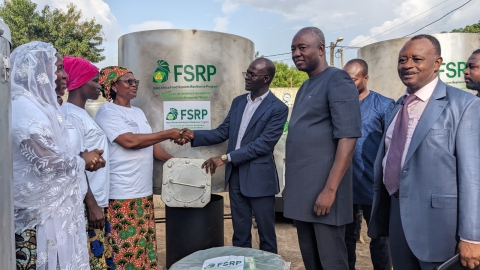
Burkina Faso: Over CFAF 15 billion to be invested by 2025 to boost food resilience with the support of the FSRP

Published on 15 February 2025

The second session of the Steering Committee of the Programme for the Resilience of the West Africa Food System in West Africa, Burkina Faso (FSRP-BF), was held on Monday 30 December 2024, under the chairmanship of Mr Moussa ZIDA, Head of Budget Programme 075 entitled "Hydro-agricultural Development and Irrigation". The session provided an opportunity to review the programme's annual results and adopt the work plan and budget for 2025.

By 30 September 2024, FSRP-BF had achieved promising results, with a physical implementation rate of 74% and a financial implementation rate of 78.38%, coupled with a disbursement rate of 50.90%. In addition, 78% of the target number of direct beneficiaries were reached, reflecting significant progress towards achieving the programme's objectives.

In terms of concrete achievements, support for ploughing has seen more than 6,000 hectares of lowlands and uplands developed for the benefit of 11,399 farmers, 42% of them women and 39% young people. In addition, 37,500 tonnes of fertiliser and 1,338 tonnes of improved seed were distributed to 472,479 farmers, 28.7% of whom were women and 32% young people. In terms of technical studies, 2,680 hectares of lowlands have been developed.

These achievements reflect FSRP-BF's commitment to responding effectively to the challenges of food security and resilience in a context of growing challenges.

For the year 2025, the PRSA-BF plans to invest more than CFAF 15 billion in the implementation of its activities. According to Moussa ZIDA, this amount could be increased to take into account the new strategic orientations of the ministry in charge of agriculture. The main interventions will focus on the development of irrigated perimeters, lowlands and market gardens, and the construction of storage infrastructures adapted to the needs of producers.

Mr ZIDA praised the PRSA-BF management unit for its active contribution to the implementation of the Agropastoral and Fisheries Offensive 2023-2025, while encouraging it to maintain this momentum. He also stressed the need to consider the recommendations of the latest joint Government/World Bank mission to optimise the results of the programme.

With ambitious investments and a strengthened strategy, the PRSA-BF is positioning itself as a key player in the structural transformation of Burkina Faso's agricultural sector and the sustainable improvement of living conditions for the population.

Niger: distribution of 143.5 tonnes of improved seeds in 32 communes

Published on 15 February 2025

As part of an initiative to improve farmers' access to climate-smart agriculture (CSA) technologies, Niger's Food System Resilience Programme (PRSA) has distributed 143.5 tonnes of improved seeds across 32 communes in four regions targeted by the programme. For the 2023 agricultural season, these seeds, made up of cowpea, rice and maize, have benefited 9,383 producers.

One of the beneficiaries is Mr Ousmane Sabo, a rice farmer in the commune of Zermou, in the Zinder region. He explains:

"The rice seeds supplied by PRSA-Niger enabled me to plant almost a hectare last year, increasing my production compared with previous seasons. Thanks to these seeds, I was able to produce up to 20 75kg bags of paddy rice, compared with just 4 bags previously. With a good rainy season this year, I expect to produce more from the same area. This harvest has enabled me not only to meet my family's food needs, but also to sell part of it to cover health and clothing costs.

As well as having a direct impact on production, this support from PRSA-Niger encourages the dissemination of improved practices among local growers, who are often reluctant to adopt new varieties. Mr Sabo highlights the transformation of his farm and its pioneering role:

"At first, other growers were sceptical about the effectiveness of these seeds. But after seeing the results, I'm determined to carry on."

In 2023 and 2024, PRSA-Niger distributed almost 400 tonnes of improved seeds in the programme's intervention zones, helping to strengthen agricultural resilience to climatic hazards and improve food security in the country.

Ghana: the PRSF builds the capacity of implementing actors on environmental and social management issues, gender and gender-based violence

Published on 15 February 2025

The West Africa Food System Resilience Programme (FSRP) has mobilised 120 agricultural extension workers, 56 programme officers and 56 district directors of agriculture to disseminate and encourage environmental and social risk management (ESRM) practices among farmers in the southern, central and northern zones of FSRP project sites in Ghana. They also improved their knowledge of gender concepts and the analysis and handling of gender-related incidents.

The FSRP is required under the World Bank's Environmental and Social Framework (ESF) and Ghana's national environmental requirements to ensure that all project activities comply with the requirements of the framework by conducting all project activities in an environmentally sustainable and socially acceptable manner. Where there are gaps in any of the policies, the most stringent policy will be applied. In addition, to competently manage stakeholder expectations, the scope of the project must be sufficiently detailed for stakeholders to understand it.

Participants will in turn be responsible for guiding farmers to comply with the ESRM requirements and integrate gender dimensions into all project activities. They are also expected to play a monitoring role in this regard and alert the PRSF project implementation unit to respond in a timely manner to stakeholders' concerns regarding project activities.

To this end, participants were introduced to the World Bank's Environmental and Social Framework (ESF), Environmental and Social Commitment Plan (ESCP), Stakeholder Engagement Plan (SEP), Labour Management Procedure (LMP), Integrated Pest Management Plan (IPMP), Sexual Exploitation and Abuse and Sexual Harassment (SEA/SH).

The FSRP is expected to achieve a 40% inclusion rate of women in all project activities, in line with the gender strategy developed for the project. Ghana's gender action plan to achieve this goal requires that all implementing partners be trained to intentionally mainstream gender in all project sub-projects.

The session on gender, which covered basic gender concepts, gender analysis tools, the seasonal calendar, the daily activities table, the gender division of labour and extension advisory services, provoked emotional discussions among the participants, particularly on the stereotyped domestic roles of the two sexes.

The PRSP's environmental risk specialist, Emelda Adii, pointed out to participants that some stakeholders see projects as risk factors to be avoided and are therefore unwilling to participate in project activities. It is therefore necessary to involve them with clearer messages, in a transparent and regular manner, taking into account their fears and expectations.

The FSRP's social risk specialist, Adu Nyarko Andorful, pointed out that project sites cannot use bonded labour, such as prisoners, even if they are willing to do the work. He also pointed out that child labour is not permitted on project sites and that such cases must be reported to the FSRP. 

Mali: 4000 ha of degraded land to be rehabilitated through integrated landscape management

Published on 15 February 2025

From 22 March to 2 April 2023, a technical team from the FSRP Mali carried out an information and awareness-raising mission for local stakeholders on the Programme and the concept of Integrated Landscape Management (ILM). This mission was part of the launch of activities relating to Integrated Landscape Management (ILM).

In the Cercles of Ségou and Niono in the Ségou region, the Cercles of Koutiala and Yorosso in the Koutiala region and the Cercles of Sikasso and Kadiolo in the Sikasso region, the FSRP Mali national coordination team informed beneficiaries and raised their awareness of the programme's main activities, as well as those relating to GIP in particular. Participatory mapping was used to collect data for the pre-identification of ILM sites in order to define the programme's ILM intervention areas.

The main stakeholders from the deconcentrated departments of agriculture, water and forests, rural engineering, animal and industrial production, hydraulics and meteorology, as well as the administrative and political authorities of the localities visited, gained a better understanding of the GIP approach. This innovative environmental management mechanism enables people to achieve sustainable improvements in the food security and nutritional status of vulnerable rural households and their resilience to climate risks. ILM is a spatial, ecological and socio-economic approach to natural resource management. Its aim is to ensure the well-being of  populations through a shared vision supported by all stakeholders. It makes it possible to restore natural resources, improve the profitability of agricultural production and anticipate and even manage conflicts at local level.

The stakeholders and partners in the field, working in groups, drew up mental maps showing, among other things, the rice, maize and shallot/onion production zones. They also listed

relief features, degraded land, insecure areas and non-timber forest products. The solutions developed in this respect relate to the adoption of a common development vision over 25 years, and the preparation and implementation of an integrated development plan for the territory  a 5-year period.

A total of 71 priority communes have been selected, based on eleven predefined criteria, to  from the programme. The activities planned for the programme's beneficiaries include the restoration of 4,000 ha of degraded land (1,400 ha in Sikasso, as many ha in Kadiolo, Koutiala and Yorosso, and 1,200 ha in Ségou and Niono). In addition, 50 ha of small will be rehabilitated. There are also plans to develop 1,000 ha of flood plains.

In terms of improving the food and nutrition situation in priority landscapes, the programme will support the strengthening of food and nutrition education in each of the municipalities involved.

Burkina Faso: Innovation Platforms, a lever for agricultural resilience and boosting the onion sector in Boromo

Published on 15 February 2025

From 18 to 19 November 2024, a strategic training course was held in Boromo, in the Boucle du Mouhoun region of Burkina Faso, for members of the onion innovation platform. The aim of this initiative was to build producers’ capacity to deal more effectively with the pests and diseases that affect onion crops.

Some 29 participants from various provinces in the Boucle du Mouhoun region came together to benefit from the advice and techniques provided by experts from the Regional Department of Agriculture, Animal Resources and Fisheries (DRARAH). These sessions will enable farmers to master effective pest control methods, a crucial factor in increasing their productivity and, ultimately, maximising their income.

The training course was officially opened by the Provincial Director of Agriculture, Animal Resources and Fisheries for the Bale region, representing the Regional Director. She praised the commitment of the participants and stressed the importance of these platforms for the development of local agricultural sectors.

Agricultural innovation platforms, such as the one in the Boucle du Mouhoun region, are ideal places for sharing knowledge, testing solutions adapted to local realities and networking the various players involved. By promoting the adoption of good agricultural practices and access to appropriate technologies, these platforms not only help to improve the management of plant health challenges, but also help to improve food security and the livelihoods of rural communities.

The training was part of the activities of the West African Food System Resilience Programme (FSRP), a programme funded by the World Bank. FSRP places particular emphasis on supporting local initiatives such as innovation platforms, which play a key role in empowering producers in the face of climatic and economic hazards.  With this training session, the region’s growers are leaving better equipped to meet the challenges posed by pests and diseases. This proactive approach illustrates the importance of innovation platforms in the sustainable transformation of African agriculture.

These collaborative structures, supported by public and private players, provide frameworks for testing and disseminating agricultural innovations. They are now recognised as a key tool for accelerating the modernisation of food systems in West Africa.

In the Boucle du Mouhoun region, the future of the onion looks promising, thanks to initiatives such as this one, which illustrate the importance of innovation and capacity-building in building a resilient and prosperous agricultural sector.

Chad: the FSRP builds the capacity of 50 young people in the sustainable management of natural resources

Published on 15 February 2025

50 young farmers, including female beneficiaries of the PRSA in the provinces of Logone Oriental, Logone Occidental and Mayo-Kebbi Ouest, were trained from 26 to 27 June 2024 in the prevention and management of pollution and the rational and sustainable use of natural resources. The training focused on the rational use of natural resources and pollution prevention and management.

Over the course of 02 days, the learners acquired new knowledge about water and energy consumption and the problems associated with the irresponsible use of natural resources. In terms of pollution prevention and management, they learned about pesticide/insecticide management techniques and waste management (chemical product packaging). All of this training was followed by practical demonstrations of water pollution pre-treatment (screening, sand removal or oil and grease removal processes).

Overall, we note that economic activities, particularly those with an agricultural base, are often the cause of air, water and soil pollution, and deplete already limited resources. These effects can undoubtedly threaten human health, ecosystem services and the environment on a local, regional and global scale. Current and projected atmospheric concentrations of greenhouse gases (GHGs) threaten the well-being of present and future generations. This calls for more efficient and rational use of resources, pollution prevention and mitigation techniques and practices. Hence the need for this training course, the foundation for the preservation and rational management of natural resources for present and future generations. 

FSRP-Burkina Faso adopts an action plan to set up Climate-Smart Villages

Published on 15 February 2025

Following the capacity-building workshop organised in Bamako by CORAF and the Bioversity International and CIAT Alliance, as part of the Accelerating the Impacts of CGIAR Climate Research for Africa (AICCRA) project, the stakeholders of the Food System Resilience Programme (PRSA/FSRP) strengthened their knowledge of the implementation of Climate Intelligent Villages (CIVs). Following this training, the PRSA Burkina Faso (PRSA-BF) held a national feedback workshop in Manga, from 30 September to 4 October 2024, to draw up an action plan for the implementation of VICs in the country.

The event, which brought together researchers, meteorological experts, NGO representatives and stakeholders from the agro-sylvo-pastoral sector, was marked by the participation of Dr Robert Zougmore, Programme Director of AICCRA, Alliance Bioversity and CIAT. The main objective was to provide the FSRP-BF with a concrete action plan for integrating ICVs into its intervention zones, based on the pilot experience of the climate-smart village of Ouda, in the Centre-Sud region.

The VIC approach, initially introduced by the CCAFS programme, has proved promising for the development of climate-smart technologies and innovations in West Africa. It promotes a participatory approach to the development of solutions adapted to climate change, integrating technological, institutional and socio-economic innovations, as well as climate-smart policies.

The Manga workshop provided an opportunity to consolidate knowledge of ICVs, particularly with regard to the formulation and implementation of this approach. A field trip to Ouda enabled participants to observe the concrete benefits of climate-smart technologies, such as the use of improved seeds, organic manure and biopesticides, as well as agroclimatic services. Discussions with the Ouda community illustrated how these technologies are helping to improve people's resilience in the face of climatic hazards and to increase agricultural yields.

During the three-day workshop, participants worked on developing an action plan for implementing ICV in Burkina Faso. Discussions focused on the selection of pilot villages, land tenure security, institutional anchoring, and the identification of stakeholders and risks. It was agreed to set up four VICs: one in the Kou sub-basin, one in the Sirba, and two in the Lower Mouhoun.

The action plan drawn up includes a detailed timetable and an operational mechanism that will be incorporated into the FSRP-BF's 2025 Annual Work Plan and Budget (AWPB), once it has been validated by the World Bank. This plan marks a decisive step towards the adoption of climate-smart solutions and reinforces the FSRP-BF's commitment to promoting the resilience of rural communities through the dissemination of climate-adapted technologies.

The objectives of the workshop were fully achieved, providing the FSRP-BF with a strategic framework for the implementation of ICVs in its intervention zones. The success of this approach should enable the FSRP-BF's results to be amplified, in particular by contributing to the achievement of indicators linked to the dissemination of climate-smart technologies and the resilience of food systems.

In summary, the Climate Smart Villages initiative in Burkina Faso is part of a broader strategy to position rural communities on a sustainable path towards food and nutrition security, while incorporating the principles integrated landscape management and climate-smart agriculture. The results achieved in Manga augur a promising future for climate resilience in Burkina Faso and beyond.

Niger/Gender and youth mainstreaming: institutions and players involved in implementing the programme

Published on 15 February 2025

From 12 to 14 August 2024 in Niamey, the main players and partners involved in implementing the West African Food System Resilience Programme (PRSA) in Niger acquired in-depth knowledge of the methods and techniques for taking better account of the gender and youth dimension in the programme.

To help reduce inequalities and disparities between the sexes and exclusion in the agro-sylvo-pastoral sector and food and nutritional security, the Niger PRSA is committed to taking into account the specific needs of disadvantaged groups such as women and young people.  As a reminder, the first phase of the PRSA in Niger targets 600,000 direct beneficiaries, at least 40% of whom will be women.

The training course, which was designed to help take account of the specific needs of disadvantaged groups such as women and young people, was chaired by the National Coordinator of the PRSA, who in his opening address invited participants to become closely involved in the work and to put forward suggestions for optimising contributions to balanced, inclusive and sustainable development.

The meeting was attended by members of the PRSA National Coordination Unit, representatives of the regional branches and all the partner structures involved in implementing the programme. It was chaired by CORAF's Gender Advisor, Dr Mariame Maïga, assisted by PRSA-Niger's Social Development Specialist/Gender Focal Point and PRSA-Niger's GBV Specialist.

Integration of ECOWAS regional markets and agricultural trade: EATM-SCORECARD implementation process launched in Burkina Faso

Published on 15 February 2025

The Permanent Secretary for the Coordination of Agricultural Sectoral Policies, Mr Yassia KINDO, chaired the workshop to launch the process of implementing the agricultural trade and market scorecard (EATM Scorecard), on Wednesday 17 April 2024, in Ouagadougou.

The Agricultural Trade and Market Scorecard (EATM Scorecard) is an analytical tool designed to better document intra-regional trade in agri-food products and to strengthen the implementation of regional policies.

It was developed and implemented as part of the West African Food Systems Resilience Programme (PRSA) under component three on regional trade integration of the said programme.

According to Yves Gérard BAZIE, National Coordinator of the EATM Scorecard, the ultimate aim of this tool is to strengthen the resilience of food systems by improving intra-regional trade in agricultural and food products. He explained that a national technical team, made up of state and non-state actors involved in the trade of agricultural products, has already been set up to lead EATM Scorecard activities in Burkina Faso.

The practical phase of the work will involve collecting information on trade in agricultural products to feed into the EATM Scorecard platform. The technical team will then be responsible for reporting on the indicators generated as part of the management of this tool.

The major innovation of the EATM Scorecard compared with other existing platforms is that it deals exclusively with agricultural products. This is a very important tool for Burkina Faso, as it will provide decision-makers with quality data to monitor national policies in terms of trade in agricultural products, and to correct any malfunctions.

The authorities present at the workshop invited all those involved in the trade of agricultural products to cooperate openly in data collection operations.

Burkina Faso/Climate change adaptation: FSRP intends to focus its activities on carbon projects

Published on 15 February 2025

Stakeholders and partners in Burkina Faso's food system came together to discuss the main activities and priority actions with a view to putting in place innovative mechanisms for adapting to climate change.

In Burkina Faso, carbon projects are playing an increasingly important role in efforts to combat climate change and promote sustainable development.

That is why this meeting, initiated by the Ministry of Agriculture, Animal Resources and Fisheries (MARAH), was aimed at building the capacity of specialists in climate change, in preparation for the implementation of carbon projects under the West African Food System Resilience Programme, Burkina Faso Component (FSRP-BF).

The discussions made it possible to assess the institutional and organisational capacities required, to present the requirements for the data and management of carbon projects, to identify shortcomings and needs, and to draw up a joint work plan for all stakeholders in order to develop quality projects.

Carbon projects promote climate-friendly farming practices, improve energy efficiency on farms and encourage the use of renewable energy sources. They involve implementing mechanisms to reduce greenhouse gas emissions by sequestering carbon. The aim is to mitigate the effects of climate change and increase agricultural productivity and household income through the sale of sequestered carbon.

It is important to note that implementing carbon projects requires coordination between local, national and international players, as well as significant financial and technical investment. Awareness-raising and education initiatives will be implemented to inform local populations about the challenges of climate change and encourage them to adopt more sustainable practices.

Carbon projects to be implemented under the FSRP-BF will benefit from technical support from partners such as the REDD+ technical secretariats, UNIQUE and TIPAALGA.

Subscribe to