Burkina Faso/Success of demonstration plots on organo-mineral fertilisation of onions: guided tours for wide dissemination of results within the framework of FSRP

Published on 7 March 2025

The onion sector is booming in Burkina Faso, especially in the target regions of the Burkina Faso Food System Resilience Programme (FSRP-BF). Overall, however, poor farming practices predominate, notably the use of unsuitable varieties and the excessive use of chemical inputs, which greatly degrade the quality of the bulbs and cause a lot of rotting during storage.

The FSRP-BF has taken action by supporting the players in the bulb onion innovation platform through a three-year action plan that has helped to disseminate climate-smart cultivation practices and raise awareness of the need to use quality seeds.

Several demonstration plots were visited by both the authorities and growers in various localities. To share the promising results of these experiments, guided tours were organised to raise awareness and convince growers of the advantages of these innovative cultivation practices.

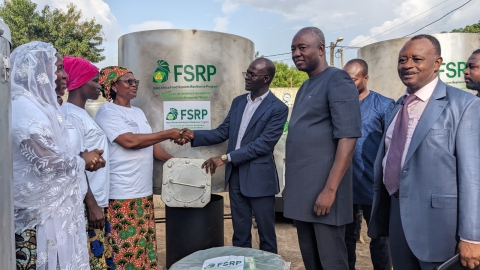
The village of Zigla (in the commune of Manga) welcomed authorities and producers on 27 March 2025 for a regional guided tour of an onion-growing demonstration plot. Under the aegis of Mrs Massadalo Yvette Nacoulma/Sanou, Governor of the Centre-Sud region, the guided tour was an opportunity to discover the good farming practices promoted through the demonstration plot, in particular organo-mineral fertilisation, the use of improved seed and biological pesticides. The results were clear: the demonstration plot produced the highest yields, with better quality bulb onions than the farmers' plot.

Before the village of Zigla, the commune of Tchériba in Mouhoun province hosted a provincial tour on Friday 21 March 2025. Chaired by the High Commissioner of Mouhoun province, this event brought together several players from the innovation platform. At the meeting, growers were able to see for themselves the positive effects of organo-mineral fertilisation on onion yield and quality. Convinced of the benefits observed, they undertook to promote the adoption of this technology to improve not only onion productivity, but also onion conservation.

On the eve of this visit, another meeting took place on Thursday 20 March in Nioniongo, in the province of Passoré. Organised by the Northern Regional Management Unit of the West Africa Food System Resilience Programme (FSRP) as part of the activities of the Northern Onion Innovation Platform, the aim of this regional guided tour was to disseminate the results obtained from the implementation of the demonstration plot on organo-mineral onion fertilisation. The event was chaired by the President of the Special Delegation of Gompossom, representing the Governor of the Nord region. On this occasion, the stakeholders and partners present were able to discuss good agricultural practices and the prospects for extending this technique to a larger number of producers.

These guided tours illustrate the stakeholders' commitment to promoting sustainable farming practices that are adapted to local realities. Thanks to these initiatives, organo-mineral fertilisation is positioned as an effective solution for increasing yields and strengthening producers' resilience in the face of the challenges associated with growing onions in the dry season.

Sierra Leone : transition vers une agriculture commerciale par la mécanisation et le partenariat privé avec l’appui du FSRP

Published on 6 March 2025

Over 70% of Sierra Leone's farming population is found in rural areas, mainly engaged in rain-fed subsistence farming with less than one hectare of land. Given this scale of farming, there has been little or no surplus to meet the country's staple food consumption needs, making Sierra Leone a net importer of food. The problem of low productivity is the result of poor-quality inputs, while climate variability has contributed significantly to further reductions in agricultural production. As a result, the socio-economic conditions of Sierra Leone's farmers are deplorable, leaving them vulnerable to shocks and threats to food security.

Despite the substantial investments made by the government over the last few decades to resolve the problems associated with the agricultural production ecosystem, these efforts have not led to any notable improvements in the sector. The mismatch of intervention channels with the priorities of the country's food system and the ineffectiveness of implementation strategies have been major drawbacks. Understanding the full range of problems associated with the country's agricultural situation, the Food System Resilience Programme (FSRP-SL), an initiative funded by the World Bank and implemented by the Sierra Leone government's Ministry of Agriculture and Food Security (MAFS), has introduced an innovative approach aimed at guiding small-scale farmers towards commercialisation. This involves establishing strategic partnerships with private sector players to provide mechanisation services, including ploughing, harrowing, seed preparation and harvesting in the vast lowland ecologies, as well as the distribution of improved rice seeds, fertilisers and other agrochemicals in fourteen farming districts across Sierra Leone. This effort has facilitated the cultivation of rice on more than 16,500 hectares of lowlands in 2024.

Central to this approach is the implementation of the community-led cluster farming model, which promotes sustainable farming practices and encourages farmers from various neighbouring communities to consolidate their efforts towards large-scale farming. This model makes technology transfer more efficient and productive, while promoting community cohesion and the efficient use of resources. These investments have led to significant transformations, as the project's beneficiaries can testify.


Mohamed Sankoh, a 30-year-old farmer from the Tonkolili district, shared his experience: "I never thought I would be able to get such a high yield from my farm - 30 50kg bags of cleaned husked rice for my household - after farming for 10 years. When the FSRP got in touch with the community, including my household, they encouraged us to join a neighbouring community with larger farmland of 500 hectares. They informed us that machines would prepare our land free of charge and provide us with seeds, fertilisers and herbicides. 

At first, I was reluctant to leave my small plot for another site, but I later realised that the programme was designed to enable us to produce more rice for our families, ten times more than what we were growing individually".

In fact, the FSRP has not only provided inputs and mechanisation support to these farmers, but has also facilitated the transformation of knowledge for adaptive responses to the effects of climate change. To this end, it has organised extension visits to provide advisory services and disseminate early warning messages, which are at the heart of its integrated landscape management effort. This initiative proved its relevance during the widespread flooding that affected the country's main farmlands during the 2024 agricultural season, resulting in an average loss of around 15% of farms. As one of the farmers supported in the Port Loko district pointed out, this effort has had a considerable impact on resolving crop loss issues for farmers.

Isatu Sesay-Taklaneh, a farmer in Magbota, in the Port Loko district, explains: "Major floods occur here every five years. Similar floods occurred this year and affected rice farms, including mine. However, before that, our capacity to respond to this problem was weak. When the FSRP started to support us, we asked for the rapid supply of seeds and fertilisers so that the rice could be planted before any flooding. The programme responded quickly, providing mechanisation, seed, fertiliser and extension support, including early warning messages. However, labour shortages delayed planting in some parts of the field, which suffered more from the floods.

The PRSF's contributions are crucial to the delivery of the Sierra Leone government's Feed Salone programme. The project continues to strengthen the resilience of local food production, giving farmers the means to adapt to climate change and withstand shocks, while guaranteeing the country's food security. 

Tchad : le PRSA officialise son partenariat avec ses acteurs de mise en œuvre opérationnels

Published on 5 March 2025

On 17 March 2025, Chad's Ministry of Agricultural Production and Industrialisation was the scene of an event of great importance for the region's agricultural and food future. The meeting room was the venue for the signing ceremony of agreements under the Programme to Strengthen the Resilience of the Food System in West Africa and the Sahel (FSRP-TD). This ambitious programme aims to strengthen food security and improve the resilience of agricultural systems in an area that is particularly vulnerable to climatic and economic challenges.

At this event, the key players in agricultural development came together to lay the foundations for the strategic cooperation that is vital to the success of this long-term programme. The event began with a speech by the National Coordinator of the PRSA-TD, who welcomed the participants and emphasised the vital importance of this collaboration in achieving the objectives set.  This ceremony marks a decisive turning point for the FSRP-TD, in terms of food security and the sustainability of agricultural systems," she said, stressing the urgency of implementing the programme.

The importance of the event was officially underlined by the Secretary General of the Ministry of Production and Industrialisation, who launched the ceremony with an inspiring speech. She highlighted Chad's priorities in terms of agricultural production and resilience in the face of food crises, saying that this partnership would be crucial to the success of the PRSA-TD in the country.

The agreements were then signed by a range of partner institutions, each playing a key role in implementing the programme. Among the signatories were the Institut Tchadien de Recherche Agronomique pour le Développement, the Agence Nationale d'Appui au Développement Rural, the Agence Nationale de Lutte Contre les Antiacridiennes and the Système d'Information sur la Qualité Alimentaire et d'Alerte Précoce. These entities will form the pillars of this initiative, contributing to targeted actions to improve agricultural practices, anticipate food crises and strengthen the resilience of rural populations in the face of climatic hazards.

Once the agreements had been signed, the National Coordinator presented a detailed analysis of the programme. In a clear and instructive speech, she explained to the partners present the specific objectives of the FSRP-TD, the methodologies that will be used and the steps to be followed to ensure effective implementation. The presentation gave participants a better understanding of the programme's challenges and the expectations of each partner institution.

The atmosphere throughout the ceremony was one of solemnity and determination. The event marked the beginning of a strategic cooperation that should play a crucial role in strengthening the resilience of food systems not only in Chad, but throughout the West Africa and Sahel region. By mobilising local and international players, the FSRP-TD offers hope for sustainable food security capable of withstanding future crises. The expected benefits of this initiative should extend beyond national borders, with positive spin-offs for millions of people in the region.

Togo: 1,800,000 basic cuttings of two new high-performance PDCO varieties distributed to multipliers and processors of high nutritional value foodstuffs

Published on 4 March 2025

Recent progress in the development and supply of improved crop varieties in Togo has helped to improve agricultural productivity and yields.

However, this production has so far been limited to a small group of producers. In addition, with the private sector positioning itself on the promotion of orange-fleshed sweet potatoes (OFSP), ITRA's basic cutting production capacity needs to be strengthened to meet this ever-increasing demand and, above all, to serve areas not yet covered by improved seeds.

The FSRP has therefore supported ITRA in producing the basic cuttings of two high-yield, climate-resilient PDCO varieties in order to make an effective contribution to food security in Togo. The cuttings produced are used to supply the PDCO root multipliers and producers selected in the savannah region.

After production, the FSRP Togo has begun to make these two new high-yield varieties of orange-fleshed sweet potato, which have recently been added to the national catalogue, available to 25 multipliers spread throughout the country and 1,067 women producers and processors of PDCO in the savannah regions.

Carried out through the Togolese Institute of Agronomic Research (ITRA), this FSRP action aims to promote and distribute these improved seeds of high-performance varieties in areas not yet served and thus contribute to the substantial improvement of the productivity and resilience capacities of the targeted populations.

Prior to the distribution of these seeds, the beneficiaries were given training in the intensive production process (good production and conservation practices) for sweet potatoes and varietal recognition.

The producers were then given support in setting up their plots.

FSRP input kits to improve agricultural productivity and strengthen the resilience of producers in the Kéran prefecture in Togo

Published on 3 March 2025

In most regions of Togo, where 90% of the economy is based on agricultural and pastoral activities, farmers face major challenges. These include declining soil fertility, limited access to water and finance, the impacts of climate change and, above all, restricted access to seeds and fertilisers, the costs of which remain high.

In order to strengthen the resilience of vulnerable farmers, who often only practise subsistence farming, the West African Food System Resilience Programme (FSRP) in Togo is implementing initiatives aimed at improving the productive capacities of beneficiary farmers. One of the programme's flagship initiatives is the distribution of input kits consisting of improved seeds and fertilisers.

The 2023 agricultural season in the Kéran prefecture (Kara region) has been a turning point for local producers, thanks to the provision of certified seeds and fertilisers. A total of 1,562 farmers, 45% of them women, benefited from this 50% repayable input credit to improve their yields.

Thanks to the distribution of rice and soya seeds and fertilisers, farmers in the Kéran region have been able to plant a total of 400 hectares spread across the region's 9 cantons. This initiative has not only boosted local production, but has also supported the empowerment of women farmers, who make up a large proportion of the beneficiaries. Sambiani Biyina, a soya farmer, explains: "In 2023, I received 20 kg of soya, which enabled me to plant 0.25 ha. At the end of the season, I harvested 450 kg, which I turned into soya cheese for a profit of 200,000 CFA francs. This money enabled me to take care of some family expenses, help my husband build our house, and increase the area to be planted during the 2024 season (0.5ha).

Support for seeds and fertilisers has enabled Kéran farmers to significantly improve their yields. Rice and soya seeds, adapted to local climatic conditions, were chosen for their resistance and production potential. The use of fertilisers has also helped to maximise soil fertility and increase harvests.

Bonalé Kodjo, a rice farmer in Nambou, canton of Pessidé, is married to two women and has four children. He also has 3 nephews to support. "With the support of the FSRP, I received 10 kg of rice seed, 50 kg of NPK and 25 kg of urea. I grow maize, but given the number of family members and the high demand for rice for consumption, I planted 0.25 ha and harvested 600 kg of rice, which I made available to the family. 
The 120,000 CFA francs I used to spend on rice each year are now used for other things.

This year, with the 25 kg seed I've put together, I'm going to plant 0.75 ha for consumption and sale next year. The project has really helped me out of my vulnerability.

This initiative has had a positive impact not only on agricultural production, but also on the community as a whole. Increased harvests have led to better availability of food on local markets, reducing dependence on imports and strengthening the region's food resilience.

The fact that 45% of beneficiaries are women highlights the importance of including women in the agricultural sector. This support enables them to play a key role in food production and contribute to the food and nutritional security of their families and communities.

The efforts made in the Kéran prefecture illustrate the importance of targeted support to improve agricultural productivity and strengthen resilience in the face of climatic challenges. By providing essential resources such as seeds and fertilisers, this initiative is helping to build a sustainable agricultural future for the region. These essential inputs enable farmers to grow more resistant and productive varieties, thereby contributing to greater food security and poverty reduction in rural areas, while creating jobs for young people, like Potey Jérémie, a 33-year-old holder of the Baccalaureate who has returned to the village in 2019 to take up farming: 

"In 2023, I received 10 kg of rice seed from the FSRP, which I sowed on 0.25 ha. I harvested over 500 kg. I sold some of it, which enabled me to start raising guinea fowl. Thanks to the sale of the rice, I was able to finish building my house. I now live in my own home and no longer rent. The PRSF's support has not only given me a job, but also enabled me to live like a civil servant. I would like to thank the World Bank, ECOWAS and the Ministry of Agriculture for their support.

While continuing to provide advisory support to the beneficiaries of 2023, the distribution of seeds and fertilisers continued this year, with 1,197 beneficiaries, 58% of them women, receiving rice, soya, cowpea and maize seeds in the Kéran prefecture. 

Environmental protection in Tchamba: FRSP support enables nurserymen to increase seedling production

Published on 28 February 2025

The forests of northern Togo face several challenges, including deforestation, soil degradation and unsustainable agricultural practices. Faced with this situation, the Togolese government, in partnership with NGOs and international organisations, has launched a number of initiatives to counter deforestation. These initiatives include reforestation, the promotion of sustainable agricultural practices, and raising awareness among local communities of the importance of forest conservation.

Since 2022, the West African Food System Resilience Programme (FSRP) has been implemented in Togo to reinforce these efforts, among others. Specific activities are being carried out to educate local populations about the importance of preserving forests. Among these initiatives, awareness-raising campaigns encourage alternative practices such as agroforestry, which not only protect forest resources but also improve communities' livelihoods.

The national coordination of the FSRP, in conjunction with the Ministry of the Environment and Forest Resources, is supporting more than 1,401 nursery cooperatives, including 830 women, with equipment for the production and maintenance of tree seedlings for the production of forest, fruit and medicinal plants. The Pépinière de Soutien à l'Arboriculture et l'Horticulture (PSA) group, located in the Tchamba prefecture, is a concrete example of this support. Since 2022, this grouping of 15 members, including 8 women, has benefited from support from the Ministry for the management of nurseries, reforestation and the creation of green spaces.

In 2023, as part of the FSRP, the PSA group received training in nursery management and plant maintenance. In addition to this training, the group received essential equipment such as wheelbarrows, shovels, watering cans, hoses, motor-driven pumps and polythene bags to increase their production of seedlings.

The impact of this support is tangible. According to El Hadj Djigba Abdou-Sacko, president of the PSA group: ‘When we started out, we didn't have adequate equipment and it was difficult to meet orders. Thanks to the support of the FSRP, our production has risen from 20,000 to 50,000 plants, generating an income that has increased from FCFA 2,000,000 to FCFA 5,000,000’.

Group members have also diversified their activities thanks to the profits they have made. They take out small interest-free loans to finance other income-generating activities, such as the sale of food products.

Support for tree nurseries in the central region of Togo has led to a significant increase in the production of forest seedlings. These nurserymen play a crucial role in reforestation, which is essential for restoring degraded ecosystems. Thanks to improved agricultural practices and modern nursery techniques, they now produce more robust and diversified seedlings adapted to local conditions.

This increase in production not only brings environmental benefits, but also generates additional income, improving the quality of life of nurserymen and strengthening the resilience of local communities in the face of climate change. At the same time, reforestation contributes to forest restoration, creates buffer zones for local ecosystems, reduces soil erosion and promotes biodiversity.

By offering training, subsidies and easier access to markets, the FSRP aims to create a virtuous circle in which economic activity and environmental conservation are mutually reinforcing. This integrated approach is essential to meeting environmental challenges while ensuring sustainable development in the region. 

Togo : 84,014 farmers adopt innovative practices and climate-resilient agricultural technologies

Published on 26 February 2025

With the aim of promoting the mass adoption of innovative agricultural practices and technologies that are resilient to climate change, the Food System Resilience Programme in West Africa, Togo project (FSRP-Togo) has initiated, since 2022, a series of training courses on good agroecological practices and the dissemination of climate-smart technologies for the benefit of targeted producers.

Thanks to the support of its partner organisations, in particular the Coordination togolaise des organisations paysannes et de producteurs agricoles (CTOP), the Institut de conseil et d'appui techniques (ICAT) and the Conseil interprofessionnel de la filière riz au Togo (CIFR), The FSRP Togo has facilitated practical training in a number of agroecological techniques, including compost making, seed coating, improved fallow, crop association and rotation, and the simple lowland management technique known as ‘smart valley’.

Three years after this support was provided, a survey of farmers carried out as part of the mid-term evaluation revealed perceptible socio-economic changes. On average, 87.65% of beneficiaries have seen their yields increase by 60% and their incomes by around 76%.

This is the case for Kouzotou Baomondom and her colleagues, who swear by the technique of summary management of low-lying rice fields:

‘This year, with smart valleys, we had to set up baskets, plant nurseries and transplant in rows.  We saw that with the little rainfall that arrived, the traps were able to collect water, and the water was used. The fertiliser we used was retained. The run-off water couldn't wash away. The rice really used this fertiliser to grow. This system saved me a lot more money, by using less seed. With the old conventional method, we gained 2.5 tonnes per hectare, but with the smart valleys approach we gained over 5 tonnes per hectare.

FSRP Togo's support has also enabled many farmers who had abandoned their fields for lack of financial resources to get back on their feet, thanks to the project's support.

These various training and support programmes have reached 84,014 farmers, 35% of whom are women, who are practising the techniques they have learned on more than 248 Planned Agricultural Development Areas (ZAAP) and other undeveloped agricultural plots.

Tchad/Massakori : Collaboration stratégique pour identifier des sites agricoles prometteurs

Published on 25 February 2025

From 30 January 2024 to 14 February 2025, a joint participatory mission to identify suitable agricultural sites was carried out in the Massakory Regional Coordination in Chad. This initiative is part of the Programme de Résilience du Système Alimentaire en Afrique de l'Ouest et au Sahel (FSRP-Chad), which aims to identify agricultural land that could be developed to strengthen the resilience of the local food system.

A total of 443 hectares were identified at 22 sites, with a particular focus on those requiring immediate development. Of these hectares, 50 have been selected for small-scale market-gardening projects, spread over 12 sites targeted for the launch of micro-projects. These projects are awaiting the results of environmental and social screening.

In addition, 130 hectares of arable land have been selected for technical studies, with a view to equipping them with the high-capacity boreholes needed for more intensive farming. Preliminary assessments of development costs estimate a total investment of CFA1.1 billion for this first phase, including CFA404 million for market garden projects and CFA687 million for field crops.

Specific studies will be carried out on these sites, including the installation of hybrid mini-pumping stations, water distribution networks and anti-erosion measures in vulnerable areas. Safety infrastructure, such as fencing for market garden sites and drainage networks for field crops, is also envisaged to ensure the sustainability of the projects.

The methodology of this mission consisted of consultation with local authorities, producers and other local stakeholders to ensure that the sites selected met the needs of the communities. The selection was made considering geographical, hydrogeological, socio-economic and environmental specificities. Farmers, particularly those on the outskirts of the capital N’Djamena, have expressed a strong interest in developing these lands.

The sites selected will have to go through an environmental and social screening process before being awarded the development studies, which will be carried out in-house, pooling skills both within the UCTF and with technical partners. At the same time, discussions will be held with SODELAC concerning polder sites in the Lac province.

Sierra Leone: FSRP/MAFS awards grants to six SLARI researchers to boost the productivity of small-scale farmers

Published on 24 February 2025

The Ministry of Agriculture and Food Security (MAFS), through the World Bank-funded Food Systems Resilience Programme (FSRP), has awarded grants to six researchers at the Sierra Leone Agricultural Research Institute (SLARI) to conduct adaptive farm research. The results of these studies should help small-scale farmers to optimise their productivity and increase their incomes in Sierra Leone.

The grant award ceremony took place on 24 January 2025 in Rokupr, Kambia District. Theresa Tenneh Dick expressed her gratitude to the World Bank for its continued support. Referring to her own experience, she pointed out that she had already benefited from a similar initiative funded by the World Bank. She stressed the importance of smallholder farmers in achieving food security, saying: ‘Smallholder farmers are the backbone of our food systems. The research supported by this grant will address the critical challenges they face and provide solutions to boost productivity and income generation’.

Sofia Mansaray, 40, is one of the grant recipients. Her research focuses on processing cassava into flour. The initiative aims to reduce Sierra Leone's dependence on imported wheat flour by creating a locally produced alternative. ‘My research will help reduce the cost of flour imports, enable Sierra Leone to produce its own flour and make it more affordable for citizens,’ explains Sofia.

MAFS and FSRP are committed to closely monitoring the progress of these researchers to ensure that their findings are in line with Feed Salone's vision of strengthening food security and stimulating economic growth in Sierra Leone.

Subscribe to