Niger: 324 women in the Tahoua, Tillabéry and Zinder regions receive goat kits from the FSRP

Published on 2 October 2025

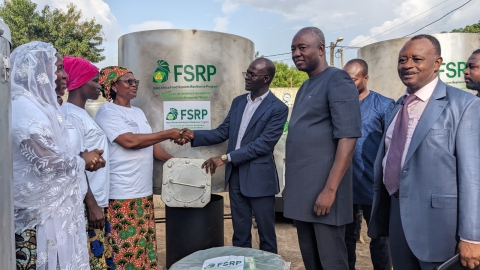
The West Africa Food System Resilience Programme in Niger (FSRP Niger) has provided 324 women in its area of intervention with goat kits consisting of three animals per woman: one male breeding goat and two female breeding goats. The aim of this initiative is to support women's efforts to strengthen food security and the resilience of vulnerable households by supporting their productive livestock capital to enable them to cope with climatic and economic crises.

This FSRP initiative is part of a broader effort to empower women economically and strengthen household resilience in the project's target areas.

According to Mr Mahamadou Ibro, FSRP branch manager in Zinder, households in these target areas are heavily dependent on subsistence activities such as livestock farming, agriculture and, to a certain extent, small-scale trade. This goat kit support operation, which began in 2025, has enabled 324 vulnerable women to benefit from 972 breeding animals at a total cost of 48,600,000 CFA francs. 

Ms Saoudé, a beneficiary of kits from the village of Dogo in the Zinder region, says, "I used to raise small ruminants, but unfortunately, for the past three years, I have had nothing. With the poor harvest, all my animals died. I was able to sell a few, but thank God, with this support from FSRP, I have been motivated, and I can guarantee that this kit will enable me to rebuild my herd."

The beneficiaries chose goats because this species is particularly prolific and therefore an effective response to the multiple needs of women in household life.

Sierra Leone: 10,000 bags of locally produced rice stored in Kambia to strengthen the country's strategic cereal reserves with the support of the FSRP

Published on 2 October 2025

Sierra Leone has taken an important step towards strengthening national food security by storing more than 10,000 bags of locally produced rice in the strategic cereal reserve in Kobia, Kambia District. This important step, funded by the World Bank-supported West Africa Food System Resilience Programme (FSRP), is a key component of Pillar 3 of the Feed Salone programme: aggregation, processing and market linkages. It represents a sustainable mechanism for responding to food crises while strengthening the rice value chain.

The Minister of Agriculture, Mr Henry Musa Kpaka, visited the facility, which currently holds 10,000 bags, with an initial stock of 1,200 tonnes of rice purchased and processed by the Sierra Leone Produce Marketing Company and the World Food Programme (WFP). The Minister highlighted that this initiative has not only created secure markets for farmers but has also helped to reduce illicit rice exports at Kambia border points, thereby stimulating private sector participation in the Feed Salone programme.

The strategic cereal reserve is designed to serve as a buffer stock, ensuring food availability in the event of emergencies, price fluctuations and supply shortages, while protecting vulnerable populations from food crises triggered by natural disasters, market failures or geopolitical instability.

Soon, as part of the Feed Salone initiative, the Ministry of Agriculture and Food Security (MAFS) through the FSRP will establish an integrated silo system with a capacity of 4,000 tonnes in Gbondapi, Pujehun District. This modern facility will serve as a rice processing and storage centre, laying the foundation for the creation of a food reserve authority. According to the minister, this authority is currently being established and will be responsible for managing the initiative, developing sustainable financing mechanisms and ensuring effective crisis management.

This important step enables Sierra Leone not only to meet international food security standards, but also to contribute significantly to the functioning of the ECOWAS Regional Food Security Reserve.

Chad/Locust control: the country on alert in the face of an imminent threat

Published on 2 October 2025

Faced with a growing threat from locusts, Chad is stepping up its vigilance. Since the beginning of September, the National Locust Control Agency (ANLA) has launched a vast prospecting campaign covering an area of more than 320,000 km². The main objective of this preventive operation is to monitor areas at risk, identify potential breeding grounds and prevent any invasion of locusts from neighbouring countries, particularly those in the Horn of Africa and the Sahel.

This mobilisation comes at a time of growing regional concern. Climate change, seasonal variability and the migratory cycles of insect pests such as the desert locust are making agricultural systems vulnerable. To address these challenges, Chad is receiving support from the Food System Resilience Programme in West Africa and the Sahel (FSRP-TD). This project, funded by the World Bank, brings together eight countries in the region and three regional organisations with a common goal: to strengthen food security and improve resilience to climatic and biological threats.

On the ground, the system put in place by ANLA is impressive. Several mobile teams, made up of specialists in prospecting, processing, logistics and data analysis, criss-cross areas identified as sensitive. Their mission is to detect the first signs of infestation in good time and intervene immediately. The resources deployed include surveillance drones, equipped vehicles and plant protection products to treat outbreaks in a targeted manner.

The data collected during this campaign plays a crucial role. Not only does it enable a rapid response to any detected threat, but it also enriches existing databases to better anticipate future risks. By improving its forecasting capabilities, Chad is equipping itself with a strategic tool to prevent famine, protect crops and safeguard the livelihoods of rural populations.

In short, this prospecting campaign marks a decisive step in the national strategy to combat locust invasions. It also illustrates the importance of regional cooperation in the face of cross-border threats that ignore national boundaries. Through this initiative, the FSRP-TD confirms its commitment to food security and the protection of its agricultural heritage.

Chad: a strategic workshop to finalise the FSRP financing manual

Published on 2 October 2025

From 10 to 16 September, the town of Bakara, some 20 kilometres from N'Djamena, hosted a strategic workshop dedicated to finalising the sub-project financing manual for the Project to Strengthen the Resilience of Agri-Food Systems in Chad (FSRP-TD).

The first session, from 10 to 14 September, was devoted to a critical review of the document by national stakeholders. The second session, held on 15 and 16 September, focused on the technical validation of the enriched version, in the presence of ministerial representatives.

The work, coordinated by the FSRP-TD team, focused on a participatory approach combining plenary sessions, thematic working groups and comparative analyses.

A first version of the manual had already been drafted on eligibility criteria, financial procedures and monitoring and evaluation procedures. However, to better adapt it to the realities on the ground, a thorough review was necessary.

The Bakara meeting provided an opportunity to review the various parts of the document with a view to producing a finalised and validated version of the manual, as well as a consolidated report of all the technical recommendations made during the discussions.

This meeting was certainly technical in nature, but it provided an opportunity for the Chadian authorities to strengthen financial governance in an inclusive and transparent manner. It also marked a key step in the implementation of the PRSA-TD, which aims to increase resilience to climatic, economic and social challenges to   achieve food sovereignty.

Togo: 75 producers from the Fresh Cassava Innovation Platform trained in good cassava production practices

Published on 2 October 2025

Seventy-five producers from farmers' organisations, including twenty-five women, members of the Fresh Cassava Innovation Platform (PIMF), received training on good cassava cultivation practices with the support of the West Africa Food System Resilience Programme (FSRP).

Held from 26 to 29 August, this session enabled participants to strengthen their skills across the entire technical process, from variety selection to pest management and the application of best farming practices. This support illustrates the FSRP's commitment to providing concrete and sustainable support to actors in agricultural value chains, as highlighted by Mr Ognankitan Koffi Dodji, President of the PIMF: "I commend the FSRP for this exceptional support. In the coming days, we will follow up with producers to ensure that they are effectively putting what they have learned into practice and following the technical guidelines."

This initiative goes beyond the simple transfer of technical knowledge. It also constitutes an act of solidarity and shared responsibility towards producers, according to the participants: "Today, we have learned a lot about cassava cultivation. Even as experienced producers, we have understood that certain practices were reducing our yields. Thanks to this training, we are leaving with solid knowledge that we will pass on to our peers."

The workshop, organised in two waves to encourage interaction and better assimilation of the content, was led by Dr Elikem SEGBEFIA, Head of the Cassava Programme at the Togolese Institute of Agricultural Research (ITRA), in collaboration with Mr Ognankitan Koffi Dodji, President of the PIMF.

Togo: 45 agricultural technical advisers trained to monitor the management of 60 motor cultivators

Published on 2 October 2025

As part of the implementation of the West Africa Food System Resilience Programme, 60 motor cultivators and accessories were purchased for agricultural cooperatives operating in the Planned Agricultural Development Zones (ZAAP) targeted in the Savanes, Kara and Centrale regions.

This action is part of the support for the implementation of the Emergency Programme for Strengthening Community Resilience and Security (PURS).

In order to optimise the use and management of this equipment, the FSRP has undertaken to strengthen
the capacities of 45 technical advisors in agricultural business management (CTGEA) in the cantons concerned to monitor the management of these motor cultivators by the beneficiaries.

The aim was to equip agricultural advisers in the cantons where the cooperatives benefiting from the motor cultivators are based with best practices for the use and monitoring of motor cultivators. These CTGEA will be responsible for supervising the use, maintenance and management of this equipment within the respective cooperatives of the beneficiaries.

The training was held at the National Agricultural Training Institute (INFA in Tové) from 22 August to 5 September 2025. Two sessions were organised, each bringing together 
22 and 23 participants, trained by INFA specialists in agricultural mechanisation.

Adopting an approach combining theory and practice, the training covered several modules, including: (i) preventive and corrective maintenance of motor cultivators, (ii) the basics 
of managing a mechanised agricultural services business, (iii) practical work including driving motor cultivators, hitching and unhitching, and carrying out mechanised agricultural work.

This training is a key step in ensuring the effective and sustainable use 
of the agricultural equipment provided. It contributes to strengthening the technical autonomy of cooperatives and ensuring the sustainability of investments made under the FSRP.

Organised as a prelude to the training of rotary tiller operators, this 
capacity-building session marks an essential preparatory phase. It aims to equip local equipment management bodies with the skills necessary to effectively supervise the use of motor cultivators, with a view to sustainable and concerted management in the service of rural development.

World Bank support mission to ECOWAS: progress in implementing the FSRP

Published on 7 September 2025

The World Bank regional team conducted a support mission to the Food System Resilience Programme in West Africa (FSRP) at ECOWAS from 25 to 26 August 2025. The meeting, held at the headquarters of the Regional Agency for Agriculture and Food (RAAF) in Lomé, Togo, assessed the progress of the Regional Trade Facilitation and Overall Coordination components and identified solutions to improve programme implementation.

The World Bank and ECOWAS teams were led by Dr Ashwini Sebastian, FSRP TTL, and Mr Alain Sy Traore, Director of Agriculture and Rural Development (DADR), respectively.

Over two days, discussions focused on the main achievements of the first half of 2025 and the level of implementation of the recommendations made at the mid-term review workshop in January 2025.

Overall, ECOWAS has made significant progress in implementing the FSRP. The coordination team was encouraged to intensify its efforts on technical activities that could help facilitate agricultural trade in West Africa to achieve the programme's results framework indicators.

Niger: 9,025 kits distributed in four regions to support women processors

Published on 7 September 2025

As part of the implementation of the Food System Resilience Programme (FSRP), funded by the World Bank through the IDA, the Government of Niger has launched an ambitious initiative to strengthen the economic autonomy of women processors and increase their active participation in agricultural value chains, thereby contributing to food security and inclusive development.

After a phase of identifying beneficiaries and their equipment needs, PRSA Niger distributed 9,025 processing kits to women's organisations in the intervention regions. The various kits were distributed as follows: 3,243 kits (Tahoua); 1,884 kits (Zinder); 3,071 kits (Diffa) and 827 kits (Tillabéry).

A total of 466 million CFA francs has been mobilised to purchase equipment for women processors. This equipment is essential for improving the quality and quantity of processed products and strengthening their marketing capacity in local and regional markets. In addition, this support will increase their income and economic autonomy, while contributing to the food resilience of their communities.

By providing these women with appropriate tools, the FSRP is pursuing its central objective of increasing preparedness for food insecurity and strengthening the resilience of food systems in Niger and West Africa.

According to Hadjia Housseina, "This important support from the PRSA comes at just the right time to address the financial difficulties faced by women in rural areas, enabling them to increase their turnover and provide for their families' basic needs." 

Senegal: Strong mobilisation of regional stakeholders following the FSRP's national tour on Matching Grant

Published on 7 September 2025

Senegal's Food System Resilience Programme (FSRP) continues to move towards the operationalisation of the matching grant mechanism. Following the national information and awareness-raising tour organised in Senegal's thirteen (13) regions, the momentum is now well underway. Private promoters, producers, livestock farmers, young people and women, as well as technical services and local authorities, have mobilised strongly to seize the opportunities offered by the programme. To date, more than ten thousand (10,000) sub-project submission files have already been registered.

Beyond the figures, the tour revealed an unprecedented mobilisation of communities, technical services and local authorities. The FSRP Matching Grant is now establishing itself as a concrete and inclusive tool, promoting the participation of women, young people and private entrepreneurs.

The FSRP Senegal's cost-sharing financing is an innovative mechanism that supports producers, livestock farmers, young entrepreneurs, SMEs and cooperatives through three (03) windows tailored to their needs.

The first window targets small sub-projects with a 70% grant (and up to 80% for women and young people) to facilitate access to inputs, water, infrastructure, energy and basic equipment.

The second supports SMEs and young people with innovative agricultural processing, production, storage or service projects, with a contribution of 50% of the investment.

Finally, the third window supports larger-scale projects with a 30% subsidy, promoting the modernisation and competitiveness of the agro-sylvo-pastoral sector.

A national dynamic set in motion after the FSRP information tour

The FSRP management unit, accompanied by its strategic partners, namely the Rural Sector Development Support Fund (FADSR) and the Livestock Fund (FONSTAB), met with key stakeholders in the 13 regions to provide information and widely publicise the mechanism, but also and above all to mobilise citizens around the windows, eligibility criteria and submission procedures. 

To reach as many people as possible, the communication strategy combined information sessions, targeted meetings, appearances in the national media – television, radio, print and online press, programmes in local languages on community radio stations – and an active presence on social media. This multi-channel approach helped to strengthen support and clarify the conditions for accessing funding. The stakeholders met committed to acting as relays in their respective territories so that no one would be left out of the process. In addition, the PMU held a series of consultations with value chain stakeholders, including onion producers' and processors' associations and the poultry industry association, to gather information on their issues with a view to better addressing their constraints.   

Tangible results: More than 10,000 applications already received

At the end of the tour, the conclusion is clear: local communities are mobilised, regional technical services are playing their role to the full, and a continuous flow of sub-project files testifies to the relevance of and support for the mechanism.

The initial results are encouraging. Decentralised technical services are regularly receiving sub-project files. Following the publication of calls for projects for windows 2 and 3, more than ten thousand (10,000) applications have already been received by the Departmental Services for Agriculture and Livestock. These structures provide an initial compliance filter before transmission to the National Committee, which will decide on the eligibility of the first beneficiaries.

This momentum demonstrates the stakeholders' ownership of the mechanism, but also the confidence placed in the FSRP as a lever for the revival and modernisation of the agro-sylvo-pastoral sector.

Beyond the figures, the tour revealed an unprecedented mobilisation of communities, technical services and local authorities. The FSRP Matching Grant is now establishing itself as a concrete and inclusive tool, promoting the participation of women, young people and private entrepreneurs.

Sierra Leone: Distribution of 45 motorcycles to strengthen agricultural extension services with the support of the FSRP

Published on 7 September 2025

The Ministry of Agriculture and Food Security (MAFS), through the World Bank-funded Food System Resilience Programme (FSRP) in West Africa, has handed over 45 new motorcycles to agricultural extension officers in Sierra Leone's agricultural districts.

This initiative aims to strengthen the delivery of extension services at the community level to ensure that farmers, including those in the most remote areas, have quick access to local support, improved practices and modern agricultural techniques.

Welcoming this FSRP initiative, the Minister of Agriculture and Food Security, Dr Henry Musa Kpaka, stressed that mobility has long been an obstacle for frontline agents. "Too often, our extension workers have struggled to reach farmers in hard-to-reach communities. These motorcycles will enable our agents to travel to train and support farmers with essential services that will transform their productivity," he said.

Dr Kepifri Lakoh, FSRP Project Manager, reaffirmed the programme's commitment to modernising agricultural extension. He highlighted ongoing investments, including the relaunch of the interactive voice response system and the launch of a dedicated call centre for farmers. "When farmers have the right knowledge and tools, they can improve their yields, ensure food security and, ultimately, transform their livelihoods," said Dr Lakoh.

Thanks to these motorcycles, extension agents now have greater means to bring innovation and practice closer together. They can thus bring agricultural knowledge directly to farming families and empower communities to contribute fully to Sierra Leone's Feed Salone vision.

Subscribe to